

Google Ads buys speed. SEO builds an asset that keeps paying you back long after you stop spending on it. For most small and mid-size businesses, the smartest move is not choosing one over the other but running ads to capture demand and test messaging now, while putting steady monthly investment into SEO so it can compound. A common starting split: heavier on ads in month one, shifting weight toward SEO as organic pages start ranking, with All City Graphix generally recommending both channels work in tandem rather than in isolation.
TL;DR:
- Running both Google Ads and SEO simultaneously offers immediate lead generation while building long-term organic rankings, especially in the first three months.
- Paid ads can deliver clicks within hours but are costly and stop once the budget ends, whereas SEO can generate steady traffic over years withlight ongoing effort.
- Test ad headlines and landing pages to gather data on high-converting keywords, then focus SEO efforts on those queries to maximize organic traffic.
- Ad campaigns are most effective for product launches, limited-time offers, and competitive keywords, while SEO excels in evergreen content and local visibility.
- Combining short-term ad spend with sustained SEO creates a balanced, cost-efficient strategy that adapts to market and budget constraints.
Table of Contents
- Google Ads vs SEO: What Actually Separates Them?
- What Do Google Ads and SEO Actually Cost?
- How Long Until Google Ads or SEO Actually Pay Off?
- How to Use Google Ads to Sharpen Your SEO Strategy
- Which Metrics Actually Tell You What’s Working?
- How Does All City Graphix Apply This Framework?
- Where This Is Heading as AI Reshapes Search
- Ready to Build a Budget That Actually Works?
- Sources
- FAQ
Google Ads vs SEO: What Actually Separates Them?
Google Ads is pay-per-click advertising, also called PPC or SEM. You bid in an auction for placement, and the moment you stop paying, your visibility disappears. SEO is the discipline of earning organic rankings through content, technical optimization, and authority signals, and it keeps working after the active investment slows down, as Google’s own comparison of SEO and PPC makes clear.
The practical differences show up fast once you run both side by side.
- Speed: Ads can generate clicks within hours. SEO usually takes months to show meaningful movement, according to SEMrush’s breakdown of SEO versus PPC.
- Control: With ads, you control the exact headline, offer, and landing page a searcher sees. With SEO, Google’s algorithm decides your position, and you can only influence it indirectly.
- Durability: Paid traffic stops the day the budget stops. Organic traffic from a well-optimized page can keep generating leads for years with light maintenance.
- Best fit for ads: Product launches, limited-time offers, competitive terms you have not ranked for yet, and rapid testing of new offers.
- Best fit for SEO: Evergreen questions your customers search repeatedly, local visibility, and brand-building content that never really goes “stale.”
One nuance worth flagging: industry click data on informational searches consistently shows organic results capturing a much bigger share of clicks than ads when the query is a question rather than a purchase intent, which is a strong argument for owning the organic result on top-of-funnel topics rather than paying for it repeatedly.
What Do Google Ads and SEO Actually Cost?
Ad costs are straightforward but relentless: you pay cost-per-click (CPC) every time someone clicks, plus whatever you spend on management, creative, and landing pages. Stop paying and the clicks stop. SEO costs are front-loaded and less predictable, going toward content production, technical fixes, tools, and often link-building work, but the traffic those pages generate does not carry a per-click price tag once they rank.
Statistic Callout: SEMrush’s research puts SEO’s meaningful results window at roughly three to twelve months, while PPC can start driving traffic within hours or days of launch. That gap is the entire reason a hybrid budget makes sense: ads fund the wait.
A few rules of thumb for tighter budgets:
- If your margins are thin, be careful chasing expensive commercial keywords with ads. A high CPC on a low-margin product can erase profit fast.
- If cash flow is tight, front-load a modest ad budget for validation and put the bulk of your ongoing spend into SEO content and technical fixes, since that spend keeps compounding.
- Track cost per lead, not just cost per click. A cheaper click that never converts is more expensive than an expensive click that closes.
How Long Until Google Ads or SEO Actually Pay Off?
Google Ads can put your business in front of buyers the same day a campaign goes live. SEO moves on a slower clock: initial indexing and small ranking movements might appear within a few weeks, but the real compounding effect (where a page starts pulling in steady traffic without additional spend) tends to show up between three and twelve months in, per SEMrush’s timeline data. That window varies by competition level and how much content and technical work you put in early.
Here is a ramp plan that reflects how most All City Graphix clients actually sequence the two channels:
- Weeks 1 to 4: Launch a focused ad campaign to generate immediate leads and start collecting query data.
- Months 1 to 3: Begin SEO work on the highest-converting queries the ads surfaced, while ad spend keeps the pipeline full.
- Months 3 to 6: Watch organic traffic start contributing measurably; consider trimming ad spend on terms where organic now ranks.
- Month 6 onward: Shift a growing share of the budget from ads to SEO production as rankings stabilize and compound.
How to Use Google Ads to Sharpen Your SEO Strategy
Paid search doubles as a research lab if you use it that way. Google’s own guidance confirms that ads don’t directly influence organic rankings, but the data they generate is genuinely useful for shaping SEO priorities.
- Run short ad campaigns to test headlines, calls-to-action, and landing page layouts before committing to a full content build.
- Pull search query reports from your ad account to find the exact phrases people use when they’re ready to buy, then prioritize those for organic content.
- Let ads defend your brand name and promote time-sensitive offers, while SEO handles the evergreen, informational pages that answer recurring questions.
Pro Tip: Bid on three to five target queries for two to four weeks, tracking landing page conversions and micro-conversions like signups or button clicks. Whichever queries convert best are the ones worth building a dedicated, optimized page around.
This loop turns paid spend into a shortcut for SEO planning instead of a sunk cost, and it’s one of the clearest ways Search Engine Journal’s hybrid framework recommends businesses use both budgets efficiently.
Which Metrics Actually Tell You What’s Working?
For ads, track cost-per-click (CPC), click-through rate (CTR), cost-per-acquisition (CPA), and return on ad spend (ROAS). For SEO, track organic sessions, assisted conversions, and customer lifetime value from organic leads, since that channel often nurtures buyers over multiple visits before they convert.
- Compare channels on cost per lead and cost per acquisition, not raw traffic volume.
- Run a simple geo-split or holdout test (pause ads in one region, keep them running in another) to see how much of your traffic is genuinely incremental versus traffic you’d have gotten organically anyway.
- Watch for attribution overlap: a customer who clicked an ad last month and converted organically this month often gets discredited without a clear multi-touch view.
How Does All City Graphix Apply This Framework?
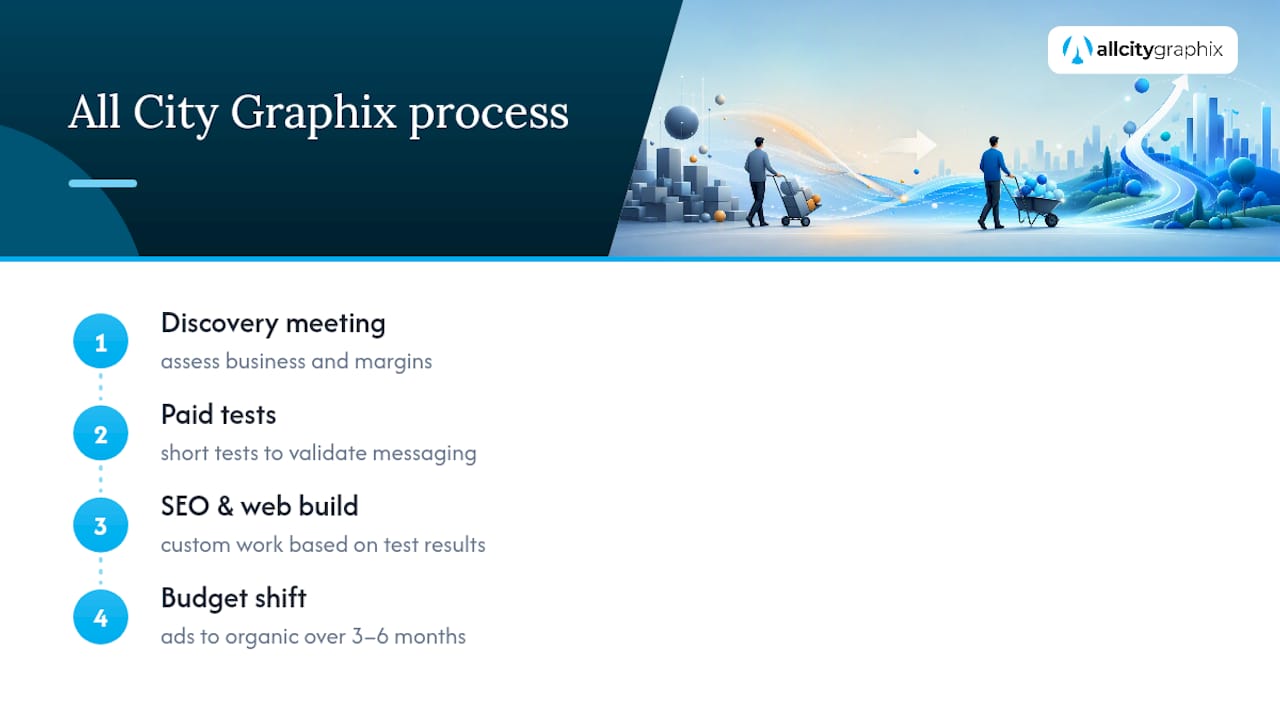
All City Graphix has spent over 15 years helping small businesses figure out exactly where to put marketing dollars first. The process starts with a discovery meeting to understand the business and its margins, moves into short paid tests to validate messaging, and then builds out custom SEO and web design work around whatever the testing phase proves converts.
Budget typically shifts from ads to organic over three to six months as pages start ranking, mirroring the ramp plan above. A retail client might launch with holiday-season ads while local SEO content builds in the background; a service business might run ads on a single high-value term while foundational SEO work takes root across its core pages. Neither path skips a channel. Both use one to protect the other.
Where This Is Heading as AI Reshapes Search
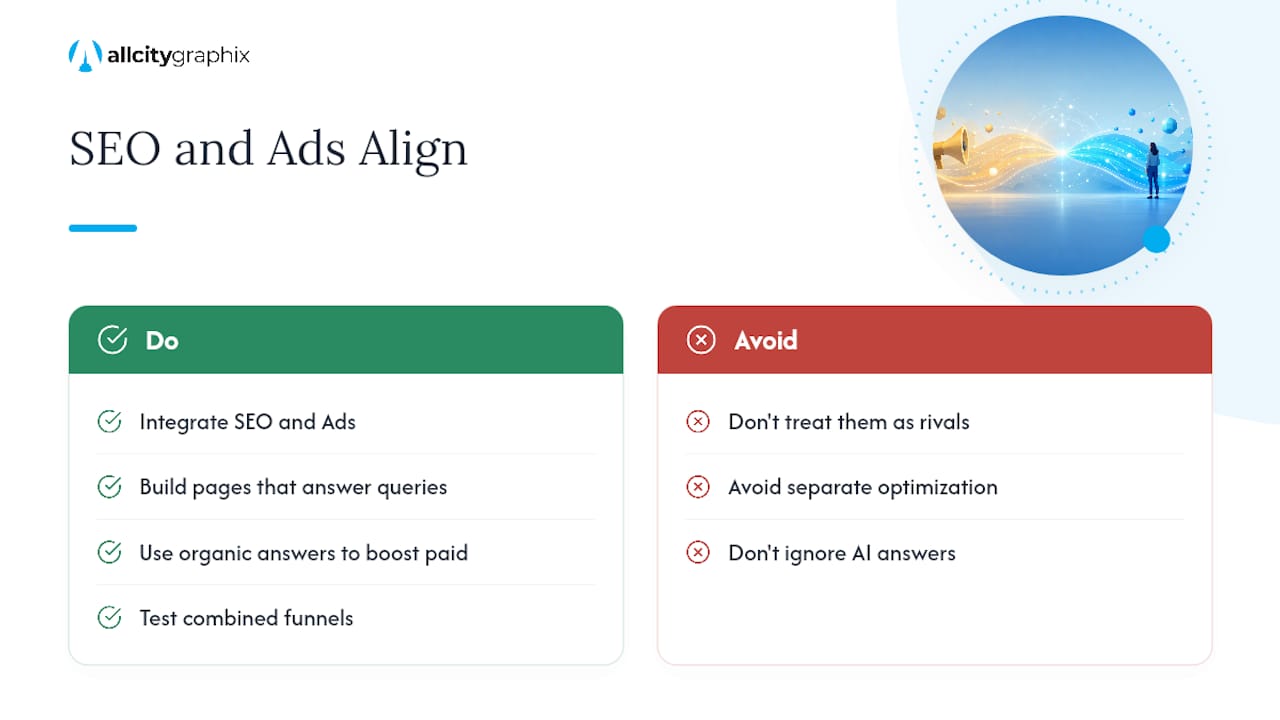
AI Overviews and other AI-generated answers are already changing click behavior, and Search Engine Land’s analysis argues the SEO-versus-PPC debate is effectively over because both channels now feed the same goal: being the answer a searcher sees first.
That shift raises the stakes for integration, not lowers them. A page that directly answers a question earns organic visibility and makes a paid landing page convert better too. Businesses treating SEO and Google Ads as rivals are optimizing for a search landscape that no longer exists.
— Alex
Ready to Build a Budget That Actually Works?
All City Graphix approaches Google Ads and SEO the way this article does: as one budget working two speeds, not two competing line items. Where a typical agency hands you a media plan or a keyword list and calls it done, All City Graphix runs the discovery, tests the messaging, and builds the web design and content around what the data actually shows converts, so your ad spend and your organic roadmap point the same direction instead of fighting each other.
If you’re not sure how to split your own budget between paid and organic, reach out through the Services page for a discovery conversation. It’s the same first step All City Graphix uses with every new client, and it costs you nothing but a few minutes to find out where your dollars will actually move the needle.
Sources
- SEO vs. PPC: Understanding the Difference – Google Ads
- SEO vs. PPC (Search Engine Journal)
- Why the SEO vs. PPC debate is finally over (Search Engine Land)
- SEO vs. PPC: Differences, Pros, Cons, & How to Choose (SEMrush)
FAQ
Is $10 a day enough for Google Ads?
It can work for very narrow, low-competition local keywords, but in most industries a small daily budget gets you very few clicks once CPCs are factored in, so treat it as a test budget rather than a growth budget.
How much does Google Ads pay per 1,000 views?
Google Ads doesn’t pay you for views. You pay Google per click (CPC) or per thousand impressions if you choose a CPM bidding strategy, with costs varying widely by industry and competition.
Is $20 a day good for Google Ads?
Twenty dollars a day is a reasonable starting test budget for a local business in a moderately competitive market, enough to gather early click and conversion data without major financial risk.
Does Google Ads come under SEO?
No. Google Ads is paid search (PPC/SEM) and SEO is organic search; they’re separate channels that show up in different parts of the results page, though data from one can inform strategy for the other.
Should a small business start with Google Ads or SEO first?
Most small businesses get the fastest return by starting with a modest ads budget to generate leads and test messaging, while investing steadily in SEO from day one so it’s compounding by the time ad costs start feeling heavy.