

A brand messaging framework is the internal document that defines what your brand says, to whom, and why, so every team member repeats the same story instead of inventing a new one each time. Get it right and you cut brand drift, speed up content production, and lift conversion, since governed messaging frameworks typically run 4 to 7 layers deep. All City Graphix builds these for clients precisely because a scattered message costs more than a bad logo ever will.
TL;DR:
- A brand messaging framework should include clear layers such as positioning, pillars, proof points, and audience variants, typically limited to five to ten pages for practicality.
- Developing the framework requires thorough discovery through stakeholder and customer interviews, with proof points created before crafting pillar headlines.
- Activation tools like a messaging matrix and hierarchy are essential for ensuring consistent messaging across channels and stages, and must be mapped to real sales and marketing channels.
- The framework’s effectiveness depends on ongoing governance, with a designated owner, regular reviews, and integration into team workflows and content templates.
- External agencies can build these frameworks through a structured process involving discovery, drafting, validation, and training, ensuring long-term usability and alignment.
Table of Contents
- What Is a Brand Messaging Framework, and How Is It Different From Positioning or Voice?
- Core Components: Positioning, Pillars, Proof, and Persona Variants
- How Do You Turn Messaging Pillars Into a Usable Matrix?
- Building the Framework: A Five-Step Process You Can Run This Quarter
- Where Should the Framework Live, and Who Owns It?
- How Do You Know the Framework Is Actually Working?
- How an Agency Actually Builds This: A Practitioner Walkthrough
- Why Governance Beats One-Off Polish
- Get Your Messaging Framework Built and Actually Used
- Sources
- FAQ
What Is a Brand Messaging Framework, and How Is It Different From Positioning or Voice?
A brand messaging framework is a working document, not a mood board. It answers a narrow question: what does this brand say, in what order, and with what proof? Positioning, voice, and brand guidelines each solve a different problem, and confusing them is why so many marketing teams end up with three documents that contradict each other.
- Positioning defines where you sit against alternatives in the customer’s mind. It’s a single statement, usually one paragraph, that never gets quoted verbatim in copy.
- Voice governs how you sound: word choice, sentence rhythm, humor, formality. A brand voice guide covers this territory.
- Brand guidelines cover visual identity: logo use, color, typography.
- The messaging framework sits between positioning and execution. It takes the strategic positioning and turns it into sentences real people can paste into a landing page, a sales email, or an ad.
Marketing uses it to brief agencies and freelancers. Sales uses it to answer “why you” on a call. Product uses it to name features consistently. Leadership uses it to check that a new campaign hasn’t quietly drifted off-strategy. Because so many functions touch it, the document has to stay short. Practical guidance from agency work suggests keeping it to roughly 5 to 10 pages for a small or midsize business. Anything longer gets skimmed once and ignored forever.
Core Components: Positioning, Pillars, Proof, and Persona Variants
Most working frameworks stack five or six layers, and each layer answers a different question a copywriter or salesperson would actually ask mid-project.
- Positioning statement. Internal only. Answers: who is this for, what category are we in, and why do we win. Never appears verbatim in customer-facing copy.
- Core message (top-line). The one sentence that has to survive if everything else gets cut. This is what shows up in a hero headline or the first line of an elevator pitch.
- Value proposition. A two- or three-line expansion of the core message that names the specific outcome the buyer gets. This is where “value proposition messaging” earns its keep, translating positioning into a benefit a buyer actually feels.
- Messaging pillars. Three to four themes that support the core message, each with its own short headline. Pillars are the connective tissue between the top-line claim and the proof underneath it.
- Proof points. Two to three concrete facts, numbers, or examples backing each pillar. Proof is what keeps a pillar from sounding like a slogan.
- Audience and persona variants. The same pillar, reworded for a different buyer’s vocabulary and priorities.
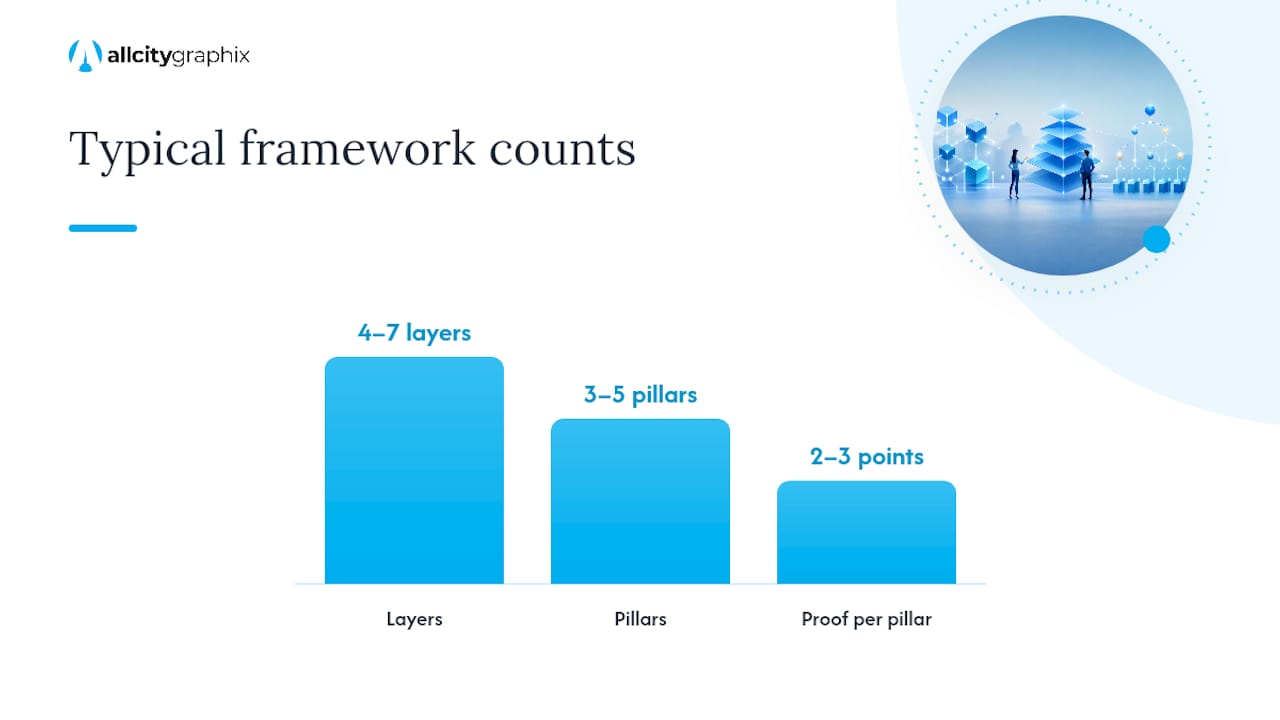
A complete messaging framework typically runs 4 to 7 of these layers, with 3 to 5 pillars as the load-bearing middle. Here’s what that looks like assembled, using a generic B2B software example:
Top-line: “The only inventory tool built for teams that ship same-day.”
Value prop: “Cut stockouts by catching supply gaps three days before they hit the warehouse floor, not after.”
Pillar headline: “Built for speed, not spreadsheets.”
Pro Tip: Write your proof points before you write your pillar headlines. Teams that draft the punchy line first tend to reverse-engineer weak proof to justify it. Start with what you can actually demonstrate, then write the headline that fits.
Skip persona variants and you get one message trying to serve a CFO and a warehouse manager equally badly. Skip proof points and pillars read as marketing filler nobody on the sales team will actually say out loud on a call.
How Do You Turn Messaging Pillars Into a Usable Matrix?
A framework without an activation layer is a strategy document nobody opens twice. The two tools that make pillars usable day to day are the messaging matrix and the messaging hierarchy, and most guides skip straight past both. A genuinely operational framework needs this activation layer to flex the same pillars across different personas and funnel stages without anyone freelancing new language.
The messaging matrix is a grid. Rows are your pillars; columns are your audience segments or funnel stages. Each cell holds a short, pre-written variant of that pillar for that audience.
| Segment A (enterprise buyer) | Segment B (small business owner) | |
|---|---|---|
| Pillar 1: Speed | “Deploy across 50 locations in under a week.” | “Set up in an afternoon, no IT team required.” |
| Pillar 2: Reliability | “99.9% uptime backed by a dedicated SLA.” | “It just works, every day, without a call to support.” |
| Pillar 3: Cost control | “Consolidate three vendor contracts into one.” | “One flat price, no surprise overage fees.” |
The messaging hierarchy governs order, not content. It ranks what appears first, second, and third, and it changes by channel, not by audience.
- Primary message first, always, in the largest visual weight the channel allows. A hero headline, an ad’s first line, the subject line of a sales email.
- Pillars second, condensed to a phrase or subhead, used to support the primary claim within the first scroll or paragraph.
- Proof last, the specific number, case, or credential that a skeptical reader needs before converting.
Cognitive research on message recall backs a simple rule: the first sentence carries most of the retention weight, so it should never carry more than one idea. Before publishing any channel-first variant, run this checklist:
- Does the primary message survive if every other sentence gets cut?
- Is there exactly one pillar leading, not three competing for attention?
- Does the proof point match a claim actually made two sentences earlier?
- Would a stranger reading only the first line understand what you sell?
Building the Framework: A Five-Step Process You Can Run This Quarter
Building a messaging framework is a project, not a workshop afternoon. Here’s the sequence that avoids the two most common failure modes: drafting from opinion instead of research, and shipping a document nobody tests before it goes live.
- Discovery. Interview 5 to 8 internal stakeholders across sales, product, and leadership, then talk to 5 to 10 actual customers. Run a content audit across your website, sales decks, and recent ads to catalog what language is already out there, contradictory or not. Map competitor language too. You’re looking for gaps between what customers say they want and what your current copy claims.
- Draft in sequence. Positioning first, since everything downstream depends on it. Then the core top-line message. Then 3 to 4 pillars. Then proof points for each pillar, pulled directly from the discovery interviews rather than invented after the fact. Only then build the matrix and hierarchy, because they’re activation layers for content that has to exist first.
- Validate before you finalize. Run synthetic headline A/B tests on your two or three strongest top-line candidates. Call 5 to 10 real buyers and read them two versions of your value proposition, unprompted, and see which one they can repeat back accurately a minute later. Emotional framing tends to outperform purely rational claims in these tests, so test at least one emotionally weighted variant against your most logical, feature-driven one. Don’t assume the rational version wins by default.
- Document. Keep the finished framework to that 5 to 10 page range. Include the matrix, the hierarchy rules, and at least three ready-to-use templates so teams don’t have to interpret abstractions into their own words.
- Roll out with training, not just an email. Walk sales and marketing through the document live. Hand content briefs to writers that reference specific pillars by name, not “our brand voice.” Set a governance owner before launch, not after the first inconsistency shows up in a campaign.
Pro Tip: Skip the fully polished creative brief during validation. Test rough, unpolished copy variants first. Buyers react to the substance of a claim, not the design around it, and polished mockups tend to bias interview subjects toward complimenting the visuals instead of critiquing the message.
Teams that shortcut discovery almost always end up rewriting the framework within six months, because pillars built on internal opinion rather than customer language rarely survive contact with a real sales call.
Where Should the Framework Live, and Who Owns It?
A framework that lives in a forgotten Google Doc is functionally dead. Messaging fragmentation is usually not a creativity problem, it’s an infrastructure problem: without one governed source of truth, homepage copy, sales decks, and ad campaigns quietly diverge within a few months of launch.
Assign a single owner, typically a brand or marketing lead, who approves any change to the core message or pillars. Set a lightweight review gate: anyone proposing new customer-facing copy checks it against the framework before it ships, not after a campaign is already live. Update cadence matters more than perfection at launch.
- Host the framework somewhere every team already works, like a shared workspace or your CMS, not a folder only marketing can find.
- Embed the matrix and hierarchy directly into content brief templates so writers pull from it by default instead of guessing.
- Publish it alongside your website content strategy documentation, since the homepage hero is usually the first place the framework gets tested in public.
Three templates belong inside every framework document, ready to copy:
- Homepage hero: primary message plus one supporting pillar line, under 20 words combined.
- Sales email opening: primary message reworded as a question or a specific claim relevant to that prospect’s role.
- Social variant: the core message compressed to fit a 280-character post, with one pillar reference and no proof point, since social rarely has room for it.
How Do You Know the Framework Is Actually Working?
Validation doesn’t stop at launch. Run 5 to 10 customer interviews within the first quarter after rollout and ask people to repeat your core message back in their own words. If they can’t, the hierarchy isn’t landing.
Headline A/B tests on your hero variant give you a faster, cheaper read: click-through rate on the winning version tells you which top-line message actually earns attention. Watch three metrics on an ongoing basis: click-through rate on messaging-led creative, demo or contact-form conversion rate, and qualitative message recall from sales call notes or support tickets.
As AI-generated content scales across more channels, the risk of quiet message drift rises alongside it, making AI recommendations for brokerages essential for maintaining content governance. Gartner’s research on trust in the AI era highlights governance as the factor separating brands that stay coherent from brands that don’t.
Set two cadences: a quick signal check every quarter (are CTR and recall holding steady?) and a full audit once a year, where you re-interview customers and re-check whether your positioning still matches how the market actually talks about the problem you solve.
How an Agency Actually Builds This: A Practitioner Walkthrough
An agency engagement for a brand messaging framework typically runs through four phases, and it’s worth knowing what deliverables to expect before you sign anything. Discovery comes first: stakeholder interviews, a handful of customer calls, and a full audit of existing copy across the website and sales materials. From there, drafting moves in sequence, positioning, then the top-line message, then pillars and proof, mirroring the same order any team should follow internally.
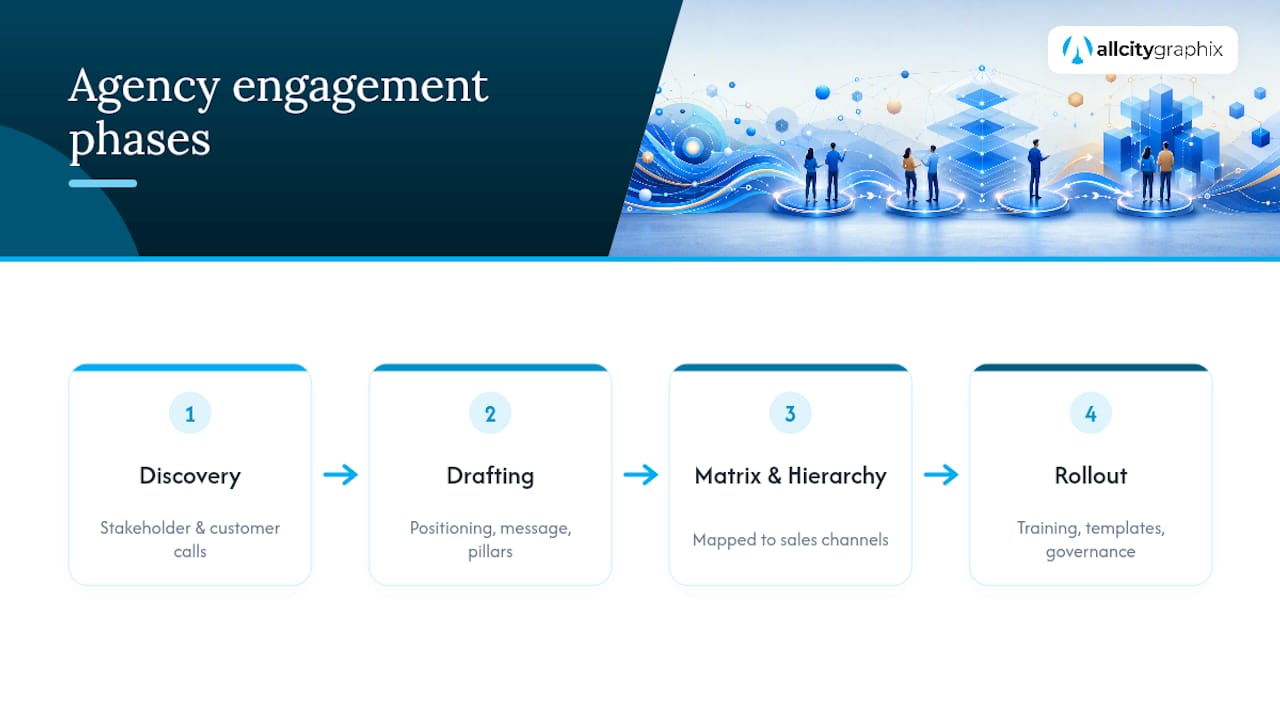
The matrix and hierarchy get built next, mapped specifically to the client’s actual sales channels rather than a generic template. Rollout closes the engagement: training sessions with the internal team, content brief templates handed off, and a documented governance plan so the framework survives past the agency’s involvement. All City Graphix structures its brand strategy work this way, treating the finished framework as a working tool the client’s team owns going forward, not a static PDF.
A typical engagement produces a positioning statement, a full pillar set with proof points, a filled-in messaging matrix, and a rollout checklist the internal team can run without outside help six months later.
Why Governance Beats One-Off Polish
Most teams obsess over getting the top-line message perfectly clever. That’s the wrong fight. A mediocre message with a governance owner and a quarterly review beats a brilliant one that nobody’s tracking after launch, because drift happens quietly and compounds fast once three different teams start improvising. Start smaller than you think you need to: one tight matrix, one owner accountable for changes, and a real review date on the calendar. Polish is a one-time win. Governance is what keeps that win from expiring in a year.
— Alex
Get Your Messaging Framework Built and Actually Used
Most in-house teams can draft a decent top-line message. Where they get stuck is the activation layer, the matrix and hierarchy that keep a sales deck, a homepage, and an ad campaign saying the same thing without someone manually policing every asset. All City Graphix’s discovery-led process, built over more than 15 years of client work, exists specifically to close that gap between a strategy document and copy your team will actually use.

A typical engagement moves through the same sequence outlined above: stakeholder and customer discovery, drafted positioning and pillars, a working matrix mapped to your real sales channels, and a rollout plan your team can run without outside help. That’s different from hiring a freelancer for a one-off brand voice document. You get direct collaboration with experienced strategists from day one, and support that continues after the framework ships, not a deliverable that goes stale the moment the invoice clears. Explore the full range of brand strategy and identity services All City Graphix offers, or start with a conversation about what your current messaging is actually missing.
Sources
For deeper detail on framework layers, Writer’s guide to brand messaging frameworks breaks down the standard structure. For matrix templates specifically, this structural breakdown is worth a close read. On keeping messaging governed once it’s live, Confluent’s take on messaging as infrastructure reframes the whole governance problem well.
- The ultimate brand messaging framework for the AI era — Writer
- Brand Messaging Framework: The Full Structure and Matrix (2026)
- Emotional vs scientific claims: which is better for increasing brand loyalty? — PM360
FAQ
What Are the Three C’s of Brand Messaging?
Definitions vary across practitioners, but a common version refers to Clear, Consistent, and Compelling: your message has to be understood instantly, repeated the same way across every channel, and give the buyer a real reason to care. Some versions swap in Credible for Compelling, emphasizing proof points over persuasion.
How Long Should a Brand Messaging Framework Document Be?
Most practical guides recommend keeping it to roughly 5 to 10 pages for a small or midsize business, short enough that teams actually read and reference it. Longer documents tend to get skimmed once during launch and then ignored.
What’s the Difference Between a Messaging Matrix and a Messaging Hierarchy?
The matrix maps your pillars against audience segments or funnel stages, giving you a pre-written variant for each combination. The hierarchy governs order within any single piece of content, primary message first, pillars second, proof last, and it stays consistent even as the matrix content changes by audience.
How Often Should You Update a Brand Messaging Framework?
Run a quick signal check quarterly, watching click-through rate and message recall for early drift, and schedule a full audit once a year that includes fresh customer interviews. A framework that never gets revisited tends to fall out of sync with how customers actually talk about the problem within a year or two.
Can an Agency Build a Brand Messaging Framework for My Business?
Yes. All City Graphix builds messaging frameworks as part of its brand strategy services, running discovery interviews, drafting positioning and pillars, and delivering a working matrix and rollout plan your internal team can maintain afterward. Current pricing for engagements is available on the client’s website.