

A brand launch plan is the coordinated set of decisions, assets, and timelines that turn a new or repositioned brand into market awareness and measurable demand. The first move is not a logo reveal, it is naming a single launch owner, setting measurable goals tied to brand KPIs, and locking a realistic timeline before any creative work begins.
TL;DR:
- A brand launch must include clear objectives, target audiences, and governance structures before creative work begins to avoid underperformance.
- A phased approach, with dedicated ownership for creative, technical, and PR assets, ensures timely delivery and message consistency across channels.
- Launch day sequencing is critical, involving simultaneous asset activation, coordinated PR and paid media, and rapid support escalation plans.
- Setting measurable KPIs for awareness, engagement, and conversion before launch allows effective tracking and timely adjustments based on realistic benchmarks.
- Building in contingency plans for technical failures or messaging issues, along with a structured post-launch review, helps sustain brand equity and manage risks.
Table of Contents
- What counts as a brand launch versus a relaunch?
- Pre-launch checklist: research, positioning, and governance
- Execution playbook: what happens on launch day and after
- Assets, ownership, and a sample 12-week calendar
- Common pitfalls and how to avoid them
- Measurement and KPIs: what to track and when to act
- Post-launch: turning early attention into lasting equity
- Research-backed guidance: timing scenarios and the 5Bs framework
- Budgeting and resource allocation for a brand launch
- Contingency planning for unexpected issues during launch
- Agency-tested priorities for a brand launch
- How All City Graphix can execute your brand launch plan
- Primary sources and further reading
- Sources
- FAQ
What counts as a brand launch versus a relaunch?
A brand launch introduces a new identity, company, or product line to the market with the goal of building awareness, establishing positioning, generating early demand, and starting to accumulate long-term brand equity. A relaunch or brand refresh works differently: it repositions an existing brand, usually to fix a perception problem or catch up with a changed market. It also has to account for existing customer memory and possible confusion.
The distinction matters because it changes the scale of work. A brand-new company launch can move faster since there is no legacy positioning to unwind. A relaunch needs a longer stakeholder-readiness runway, more internal communication, and often a phased rollout so existing customers are not blind sided.
This is also where you decide between a soft rollout and a coordinated full launch. A soft rollout, quietly shipping the new identity on a website or single channel before a public push, works well when you need to test messaging or when internal readiness is uneven. A full launch, with synchronized PR, paid media, and sales enablement, fits when the market opportunity is time-sensitive or competitors are already moving.
Pre-launch checklist: research, positioning, and governance
Everything downstream depends on decisions made before launch day. Skipping this stage is the single most common reason launches underperform.
- Set goals that ladder to KPIs, such as a target share-of-search lift or a specific new-customer conversion rate, not vague brand awareness ambitions.
- Define two or three priority audiences with short personas describing their buying context, not just demographics.
- Write the positioning statement and core narrative first, then build every asset from it so messaging stays consistent.
- Assign launch governance: one accountable owner, a short RACI covering marketing, product, sales, and legal, and a clear approval chain.
- Run readiness checks across legal (trademark clearance), operations (support and fulfillment capacity), product (feature completeness), and channel capability (ad accounts, CRM triggers, page infrastructure).
The AMA’s launch timing research frames this stage as a coordination problem more than a creative one: launches underperform when internal stakeholders are not equally ready, and the fix is building readiness deliberately through demos, preannouncements, and staged education rather than rushing to a fixed date.
Pro Tip: Write the one-page launch brief before any design work starts. It should fit on a single screen: goal, audience, positioning line, owner, and date.
Execution playbook: what happens on launch day and after
Launch day runs on sequencing, not improvisation. Treat it as a series of coordinated switches, not a single event.
- Flip the live assets: publish new pages, activate redirects from old URLs, and confirm tracking fires correctly before any traffic push.
- Distribute PR and press materials on a fixed schedule so coverage lands close to your paid and organic pushes rather than trickling out.
- Send launch emails and switch paid media live within the same window to avoid a gap between announcement and discoverability.
- Post scheduled social content across owned channels, staggered slightly so the feed doesn’t look automated.
- Staff support and sales with a rapid-escalation path for questions the new positioning will inevitably generate.
Once the day-of checklist is clear, the launch window itself should move through a deliberate sequence: awareness first, then engagement, then conversion, then a sustain phase that keeps the story alive without new spend spikes. Channel orchestration matters here. The Edelman research on brand relevance points to personal, peer-to-peer, and local creator activation as a way to build trust faster than broadcast messaging alone, which is useful in the engagement phase when awareness has landed but trust has not yet formed.
Build in operational safeguards before you need them: a written incident plan for site outages or messaging backlash, a monitoring dashboard checked at fixed intervals rather than constantly, and a rapid A/B testing cadence for ad creative so underperforming variants get cut within days, not weeks.
Pro Tip: Assign one person to own the monitoring dashboard for the first 72 hours. Split ownership during the highest-risk window creates the exact gaps incidents exploit.
Assets, ownership, and a sample 12-week calendar
A launch needs three categories of deliverables built well before launch week: creative and content assets (logo files, brand guidelines, key visuals, launch video or photography), technical and operations deliverables (live website, redirects, analytics events, CRM triggers), and PR materials (press release, media kit, spokesperson talking points). Each needs a clear owner for creation, a separate approver, and a named publisher, since conflating those roles is a common source of last-minute bottlenecks.
- Creative and identity assets: designed by the creative team, approved by brand leadership, published by marketing operations.
- Website and technical infrastructure: built by web/dev, approved by product and legal, published by the web team.
- PR and media kit: drafted by communications, approved by leadership, distributed by the PR lead.
A compact planning window helps keep everyone honest about deadlines.
| Phase | Weeks | Key activities |
|---|---|---|
| Foundation | Weeks 1 to 4 | Positioning, goals, personas, legal clearance |
| Build | Weeks 5 to 7 | Creative production, website build, PR drafting |
| Launch week | Week 8 | Day-0 checklist execution, PR distribution, paid media activation |
| Sustain | Week 8 | Engagement content, early KPI review, optimization |
Keep a single source-of-truth document for messaging so every channel, from the website to social captions, pulls from the same story rather than improvising variations.
Common pitfalls and how to avoid them
Most launch failures trace back to a handful of repeatable mistakes.
- Rushing planning without stakeholder alignment: enforce a gate where the launch cannot proceed until the owner signs off on the readiness checklist.
- Skipping the measurement plan: agree on a minimal KPI set before a single asset is built, not after launch day.
- Letting messaging drift across channels: maintain one narrative document and a shared asset library everyone pulls from.
- Underestimating support and operations load: simulate a traffic or inquiry spike beforehand and test the support workflow under pressure.
- Betting everything on one channel: stage investment across owned, earned, and paid channels so a single underperforming channel doesn’t sink the launch.
Measurement and KPIs: what to track and when to act
A launch without a measurement plan is a guess dressed up as a strategy. Keep the KPI set small enough to actually monitor.
- Awareness: brand lift or a share-of-search delta shows whether the market noticed.
- Consideration: site engagement quality and demo or inquiry requests show whether interest is converting to intended.
- Conversion: new-customer conversion rate and acquisition cost show whether intent is converting to revenue.
- Operations: support ticket volume and response time show whether the business can handle the demand it generated.
A measurement approach worth adopting: Think with Google’s brand measurement guidance recommends combining brand lift studies with marketing mix modeling, since lift gives a short-term causal read while mix modeling contextualizes the longer-term investment effect.
Set targets before launch, not after, so you have a fixed line to measure against. Review results on a fixed cadence, weekly in the first month, then monthly, and set explicit triggers: if awareness metrics move but conversion lags for two consecutive reporting periods, that is the signal to revisit messaging or the offer rather than simply spending more.
Post-launch: turning early attention into lasting equity
The weeks right after launch decide whether initial attention becomes durable brand equity or fades. Attention without follow-up is wasted spend.
- Build nurture sequences that keep educating the audience you just won, rather than assuming one touch converts.
- Feed launch learnings back into the product and messaging, since real customer reactions almost always surface gaps the planning phase missed.
- Run a 90-day review to decide what to maintain at current investment, what to scale because it is working, and what to stop because it isn’t.
- Set ongoing governance for brand stewardship, so messaging consistency and measurement don’t quietly stop once the launch team disbands.
This is also the phase where a content marketing strategy earns its budget: the launch created attention, but sustained content is what keeps the brand relevant between major moments.
Research-backed guidance: timing scenarios and the 5Bs framework
The AMA’s timing research identifies four timing scenarios, synergistic, antagonistic, flexible, and inflexible, based on how aligned your internal stakeholders and external market conditions are. When alignment is low, the recommendation is to build readiness deliberately through preannouncements, demos, and soft releases rather than forcing a date.
Complementing that, the 5Bs branding framework treats brand equity as the central asset, supported by relevance, image, loyalty, and portfolio decisions. Every launch activity should ultimately answer: does this build brand equity, or is it just a short-term campaign push?
- Choose a soft release when stakeholder readiness is uneven or the offer needs testing.
- Choose a demo-driven rollout when the audience needs education before they can evaluate the offer.
- Choose a full launch when timing is synergistic and the market opportunity is time-sensitive.
Pro Tip: Score your own readiness against the four AMA scenarios before setting a launch date. A date chosen before that scoring is a guess, not a plan.
Budgeting and resource allocation for a brand launch
Launch budgets tend to fail in one of two directions: overspending on paid media in week one with nothing left for sustain, or underfunding the creative and technical foundation and then scrambling to fix gaps mid-launch. A more durable split allocates roughly even weight across three buckets: foundational assets (identity, website, core content), launch-week activation (PR, paid media, events), and the sustain phase (nurture content, ongoing optimization).
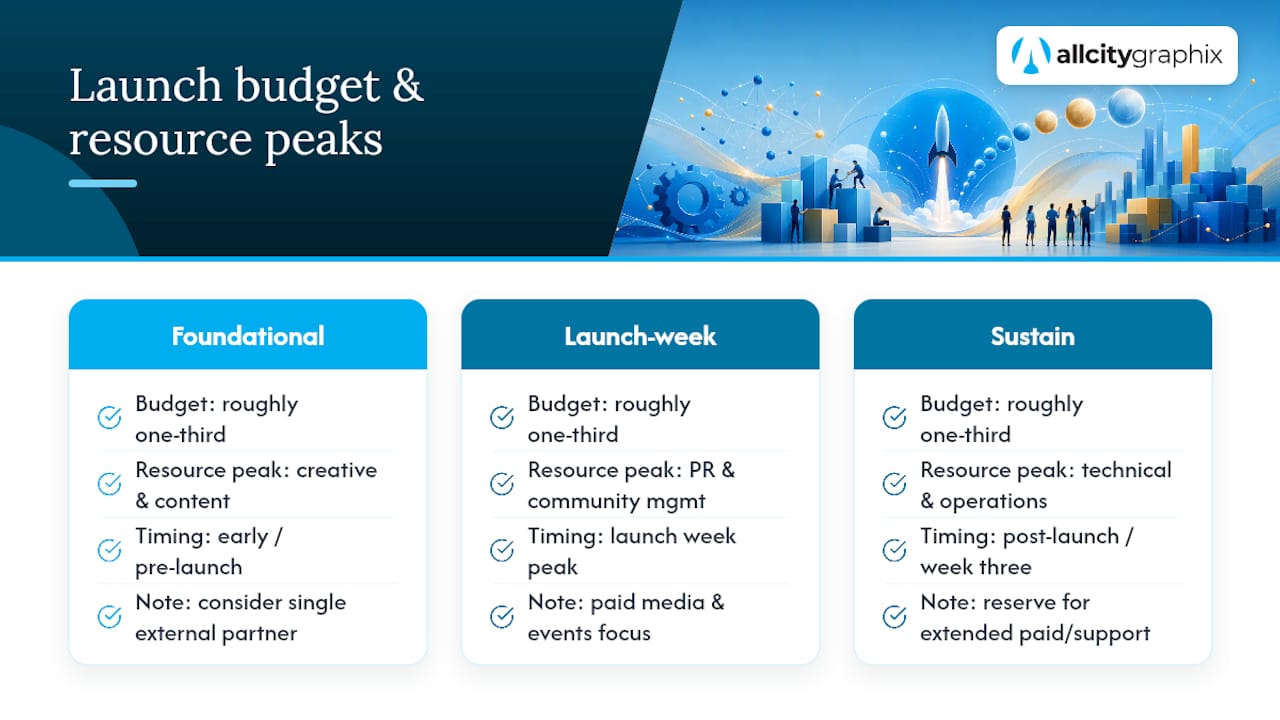
Resource allocation follows the same logic as the RACI you set during pre-launch planning. Creative and content production usually needs the largest team hours early, technical and operations work peaks in the weeks immediately before launch, and PR and community management peak during launch week itself. Mapping hours to phases, rather than assuming one team carries the whole launch, prevents the common failure of a design team still finishing assets during launch week while marketing is already live.
Budget for contingency explicitly rather than hoping the plan holds. A reserve set aside for extended paid media if organic traction is slow, or for additional support staffing if inquiry volume outpaces forecasts, keeps a strong launch from stalling for lack of funds in week three. Smaller teams and businesses without in-house capacity for every function, legal trademark review, PR distribution, paid media management, often find it more efficient to budget for a single external partner across brand strategy, creative, and web rather than piecing together multiple vendors with no shared context.
Contingency planning for unexpected issues during launch
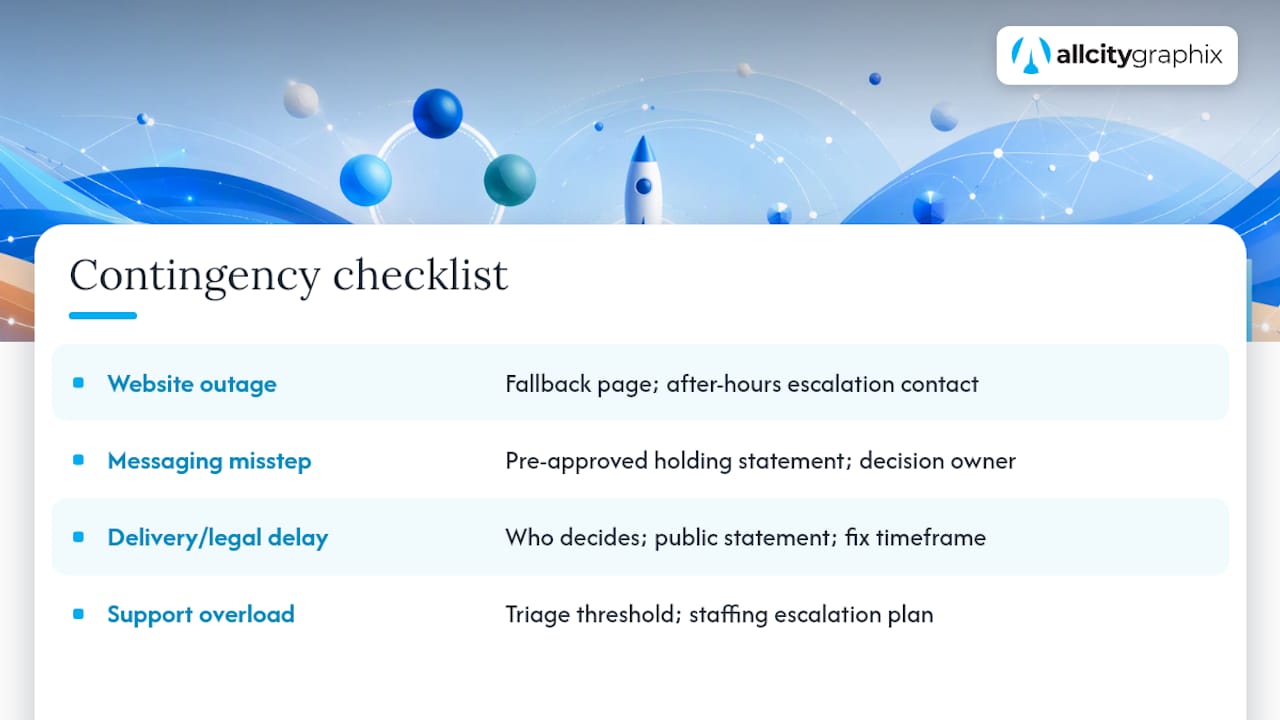
Every launch plan needs a written answer to “what if this goes wrong,” decided before it happens rather than improvised in the moment. The most common failure points are predictable: a website outage during a traffic spike, a messaging misstep that draws public criticism, a delayed product or legal clearance, or a support team overwhelmed by inquiry volume.
For each of these, write a short response plan in advance: who decides, what the first public statement says, and how fast the fix needs to happen. A site outage plan should include a fallback page and a technical escalation contact who can be reached outside business hours. A messaging misstep plan should include a pre-approved holding statement so the brand isn’t improvising a public response under pressure.
Build a decision threshold into the plan too: define in advance what level of negative reaction or technical failure triggers a pause versus a public correction versus simply monitoring. Without that threshold, teams tend to either overreact to minor noise or underreact to a genuine problem because no one wants to be the one who calls it.
Keep the contingency plan as a living one-page document, reviewed at each phase gate rather than written once and filed away. The goal is not to predict every possible issue but to make sure the team isn’t deciding governance and escalation paths for the first time in the middle of a crisis.
Agency-tested priorities for a brand launch
Running launches for small businesses and growing companies surfaces the same patterns repeatedly. Three habits consistently separate launches that build lasting equity from ones that generate a short spike and fade: a fixed discovery rhythm before any creative starts, a single named launch owner with real decision authority, and a fast post-launch learning loop that feeds results back into messaging within weeks, not quarters.
— Alex
How All City Graphix can execute your brand launch plan
Running a launch well means coordinating brand strategy, identity design, web development, content, and measurement at the same time, which is exactly where most internal teams run short on hands. Some agencies build launch plans around that full stack rather than handing off pieces to separate vendors with no shared context.
- Brand strategy and identity: positioning, messaging, and visual identity built through a discovery-led process before any launch asset gets designed.
- Web design and development: launch-ready sites built on WordPress or Shopify, including the content strategy that keeps messaging consistent post-launch.
- Launch creative and events: graphic design and event design for launch-week activation, plus ongoing digital marketing to sustain momentum.
Engagements may run as project work for a defined launch or as ongoing support once the launch phase ends. If you are mapping out a launch and want a second set of eyes on the plan, visit our services page to see the full range and get in touch for a discovery conversation.
Primary sources and further reading
For deeper detail beyond this guide: the AMA’s timing research covers the four readiness scenarios in full, the 5Bs framework article explains the brand equity model, the AMA go-to-market playbook walks through cross-functional GTM design, and the Think with Google measurement playbook details brand lift and MMM methodology. For reporting frameworks specifically, this campaign reporting guide is a useful companion.
Sources
- How to Time Your Product Launch for Maximum Success
- The new role for brands: From change the world to change my world
- Modern Brand Measurement Playbook
FAQ
How long should a brand launch plan take to build?
Most brand launches need eight to twelve weeks of preparation, covering positioning, asset production, and readiness checks, before a launch-week push. A relaunch involving existing customers often needs a longer runway to manage internal alignment and customer communication.
What is the single most important KPI to track at launch?
There is no single universal metric, but a minimal set covering one awareness signal, one engagement signal, and one conversion signal keeps early tracking focused rather than scattered. The Think with Google measurement playbook recommends pairing brand lift with marketing mix modeling for a fuller read.
Do I need a trademark check before launching a brand name?
Yes, clearing a proposed brand name and logo for trademark conflicts should happen during pre-launch planning, not after assets are built. This is a legal readiness step best handled by a trademark attorney or your relevant national trademark office rather than left until launch week.
What is the difference between a soft launch and a full launch?
A soft launch introduces the brand quietly on limited channels to test messaging before a public push, while a full launch coordinates PR, paid media, and sales enablement simultaneously. The AMA’s timing research suggests choosing based on how aligned your stakeholders and market conditions actually are, not on a fixed calendar date.
Can an agency handle a full brand launch from strategy through execution?
Yes, an agency covering brand strategy, identity, web, and content can manage a launch end to end rather than requiring separate vendors for each piece. All City Graphix structures engagements this way, running discovery through launch and into ongoing support as either a project or a retainer.