

The brand awareness metrics worth tracking fall into three groups: what people say when you ask them (unaided recall, aided recognition, top-of-mind awareness), what they do when they look for you (branded search, direct traffic), and how loud you are next to competitors (share of voice). No single number tells you whether your brand is known. Surveys tell you whether people know you, behavior tells you whether they act on it, and you need both measured the same way every quarter.
Below is how we would set up measurement for a small or mid-sized business: which numbers to pick, how to collect them, and how to avoid the reporting mistakes that make a flat quarter look like growth.
TL;DR
- Brand awareness has levels: aided recall, unaided recall and top-of-mind. Measure the level you actually need to move.
- Unaided recall is the most honest survey metric, because prompted lists invite overclaiming.
- Pair survey data with behavioral signals: branded search, direct traffic, social reach and share of voice.
- A small change in a survey result (say 21% to 24%) can sit inside the margin of error. Do not report it as growth.
- Pick 4 to 6 metrics, set a baseline, and track them on a fixed schedule.
Table of Contents
- What brand awareness actually means
- The core metrics, grouped by what they tell you
- A simple metric map
- How to set up measurement in five steps
- Writing a survey that gives clean data
- Reading the results without fooling yourself
- What to do with the numbers
- Our perspective: measure less, but measure it the same way
- Need help turning awareness into a system?
- FAQ
- Sources
What brand awareness actually means
Brand awareness is how well people recognize, recall and remember a brand and what it offers. Kantar describes three levels: aided recall (you recognize the brand when prompted), unaided recall (you can name it with no prompt) and top-of-mind awareness (it is the first brand you name). Marketers often lay these out as a ladder: no awareness, recognition, recall, top-of-mind.
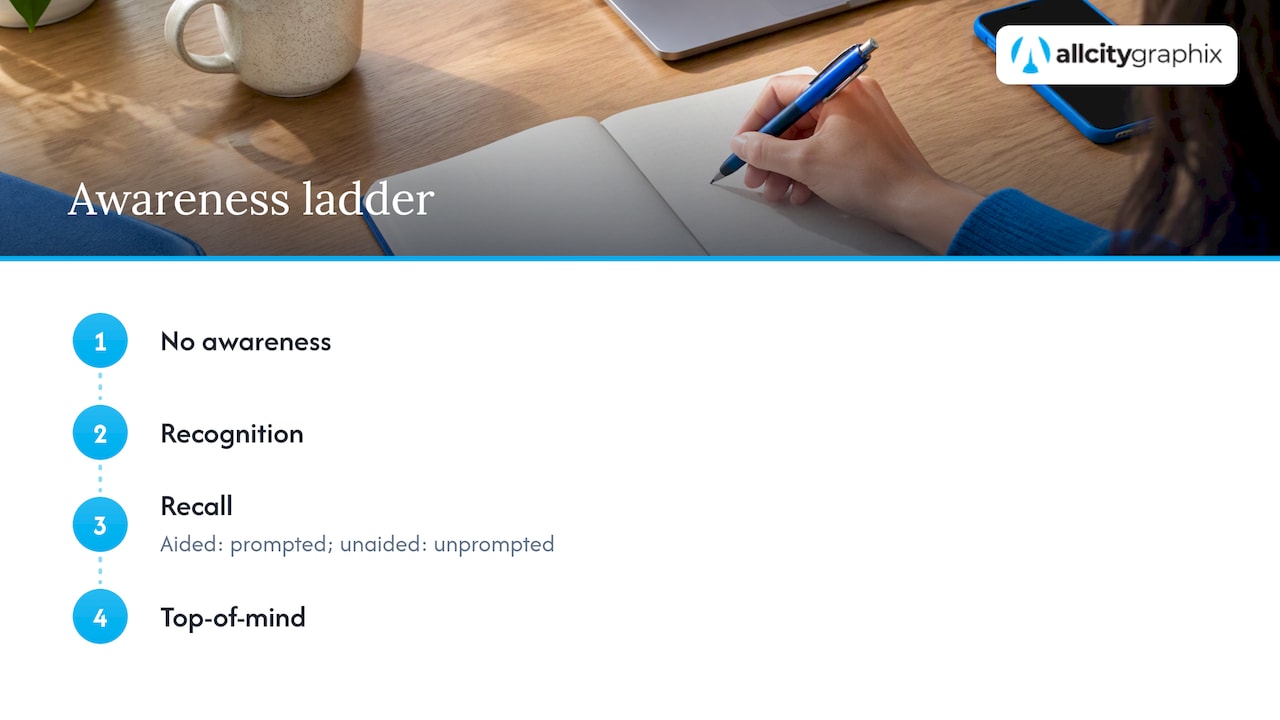
This matters because each rung needs a different metric. A new bakery in Queens is trying to get from zero to recognition. A regional accounting firm that is already known locally may care about being the first name that comes up when someone needs a tax preparer. The brand identity itself, including the name, logo and visual assets, is what people use to recognize you, a point Amazon Ads makes in its brand awareness guide. If you want a visual refresher on how recognition builds through physical presence, this piece on signage and brand exposure covers how awareness, exposure and impact differ.
Awareness is also not the same as preference or sales. It is the entry condition: people cannot choose a brand they never think of.
The core metrics, grouped by what they tell you
Survey metrics: what people say
Surveys are the most direct way to measure awareness. SurveyMonkey’s guide recommends leading with unaided recall, and for good reason: when you show respondents a list of brands, some will claim to know ones they have never heard of. Open-ended questions such as “Which brands come to mind when you think of [your category]?” give a more reliable read on whether you are mentally available to buyers.
The three survey metrics to use:
- Unaided recall. The share of respondents who name your brand with no prompt. This is your headline number.
- Aided recognition. The share who say they know you when shown a list. Useful for newer brands, but inflated by overclaiming.
- Top-of-mind awareness. The share who name you first. It is the hardest number to move and the one most tied to being chosen.
One practical trick: add at least one plausible fictional brand to the aided list. Anyone who claims to know it is overclaiming, and you can filter those answers out, a control SurveyMonkey describes.
Behavioral metrics: what people do
Surveys are a snapshot. Behavior runs all the time and costs less to watch.
- Branded search volume. How often people search your company name, product names or founder name. Google Search Console and Google Trends both show it. It is a demand signal, but bear in mind that growth can come from a PR hit or an offline campaign, so read it next to what you were doing that month.
- Direct traffic. Visitors who type your URL or use a bookmark. A rising share suggests people know where to find you without a search.
- Social reach and impressions. How many unique people saw your content, and how many times. These measure exposure, not awareness, so treat them as inputs.
- Engagement and follower growth. Likes, comments, shares, saves and new followers. Useful trend lines, but easy to inflate with giveaways.
- Mentions and backlinks. Unprompted references to your brand in articles, reviews and forums.
Competitive metrics: how loud you are in your market
Share of voice (SoV) is the proportion of market conversation or search traffic your brand owns compared with competitors. Qualtrics notes that it is commonly calculated with social listening tools that scan news, blogs and social platforms, or with SEO tools that measure your share of organic search traffic. Search-based and social-based SoV are the two versions most teams use.
SoV is especially useful for small businesses, because it answers the question surveys struggle to answer on a small budget: are we gaining ground on the three or four rivals our customers actually compare us with?
A simple metric map
| Metric | What it shows | Source | Best for |
|---|---|---|---|
| Unaided recall | Whether people think of you unprompted | Survey | Established or growing brands |
| Aided recognition | Whether people know you when prompted | Survey | New brands, launches |
| Top-of-mind | Whether you are the first name | Survey | Competitive categories |
| Branded search | Active interest in you by name | Search Console, Trends | Any brand with a site |
| Direct traffic | People who come to you without searching | Web analytics | Any brand with a site |
| Social reach | Exposure to your content | Platform analytics | Social-led brands |
| Share of voice | Your slice of category conversation | SEO and listening tools | Crowded markets |
How to set up measurement in five steps
1. Tie each metric to a business goal
Awareness numbers are not isolated scores. NIQ makes the point that brand measurement has moved from an intangible to a systematic process, and that it works best when tied to defined objectives such as the long-term impact of campaigns or shifts in consumer sentiment. Write the goal first. “Become the first-named web design shop among Brooklyn restaurant owners” points to top-of-mind awareness in a defined segment. “Get found by people who have heard of us” points to branded search.
2. Define the audience you are measuring
A national panel is wasteful if you sell to dental practices in New Jersey. Choose the group that could realistically buy from you: a location, a job title, a category. Then survey within it.
3. Capture a baseline before you spend
Run your first survey and pull 12 months of branded search data before a campaign, a rebrand or a launch. Without a baseline, every later number is just a number. If you are planning a launch, our brand launch plan shows where measurement fits in the timeline.
4. Pick a cadence and stick to it
A survey run once measures awareness. The same survey run every quarter with comparable questions and audience turns into brand tracking. Most small businesses do well with a quarterly or twice-yearly survey and monthly checks of search and traffic data.
5. Combine numbers with the reason behind them
The strongest approach, according to Kantar, is to pair quick quantitative checks with qualitative follow-ups. Add one or two open questions: “What is the first thing you think of when you hear our name?” and “Why would you pick one provider over another?” That tells you not just whether you are seen but how your value is perceived.
Writing a survey that gives clean data
Keep it to a handful of questions and put them in this order, so earlier prompts do not contaminate later answers:
- Unaided: “When you think of [category], which brands come to mind?”
- Top-of-mind: capture the first brand named.
- Aided: “Which of these have you heard of?” with your brand, competitors and one fictional brand.
- Familiarity or consideration: “How likely are you to consider each for your next purchase?”
- Open-ended why: “What makes you say that?”
Ask the unaided questions before the list appears. Once people have seen your name on a list, you can no longer measure what they would recall without help.
Reading the results without fooling yourself
There is no universal “good” percentage
People often ask what a good brand awareness percentage is. There is no single answer. SurveyMonkey’s guidance is that benchmarks should be set relative to your industry, audience and your own history. A niche B2B firm with 12% unaided recall among its exact buyers may be doing better than a consumer brand with 40% among everyone.
Respect the margin of error
If awareness moves from 21% to 24%, that 3-point change can fall inside a 5-point margin of error, which means you cannot honestly call it growth. The same source advises measuring within segments such as region or age band, and making sure each subgroup is large enough to support the claim. Otherwise you are reporting noise. As a rule, wait for a change that clears the margin or persists across two or three survey waves.
Do not read one metric alone
Branded search up, but unaided recall flat? Maybe a promotion drove a spike. Social reach up, branded search flat? You may be reaching people who are not remembering you. Look for the same direction across a survey metric and a behavioral metric before you declare a win.
What to do with the numbers
Awareness data is only useful if it changes a decision. Some examples of how to translate it:
- High aided, low unaided recall: people recognize you but do not think of you. Work on category association: clearer positioning, consistent messaging and repeated visibility in the places buyers look.
- Low branded search despite decent recall: make sure your site, Google Business Profile and listings are easy to find under your own name.
- High reach, low recall: the creative is not sticking. Review your visual identity and messaging for distinctiveness. A brand audit is a fast way to find inconsistencies.
- Strong recall but weak share of voice: competitors are louder in search or social. Look at content and SEO.
When you need to link awareness to revenue, remember that awareness effects build slowly and attribution tools miss much of it. Our pieces on proving brand ROI over 18 to 36 months and why attribution alone falls short go deeper. For a view on how teams judge creative work against outcomes, this campaign development guide is a useful companion.
Our perspective: measure less, but measure it the same way
Most small businesses we meet either measure nothing or drown in dashboards. Both fail for the same reason: the numbers are not connected to a decision.
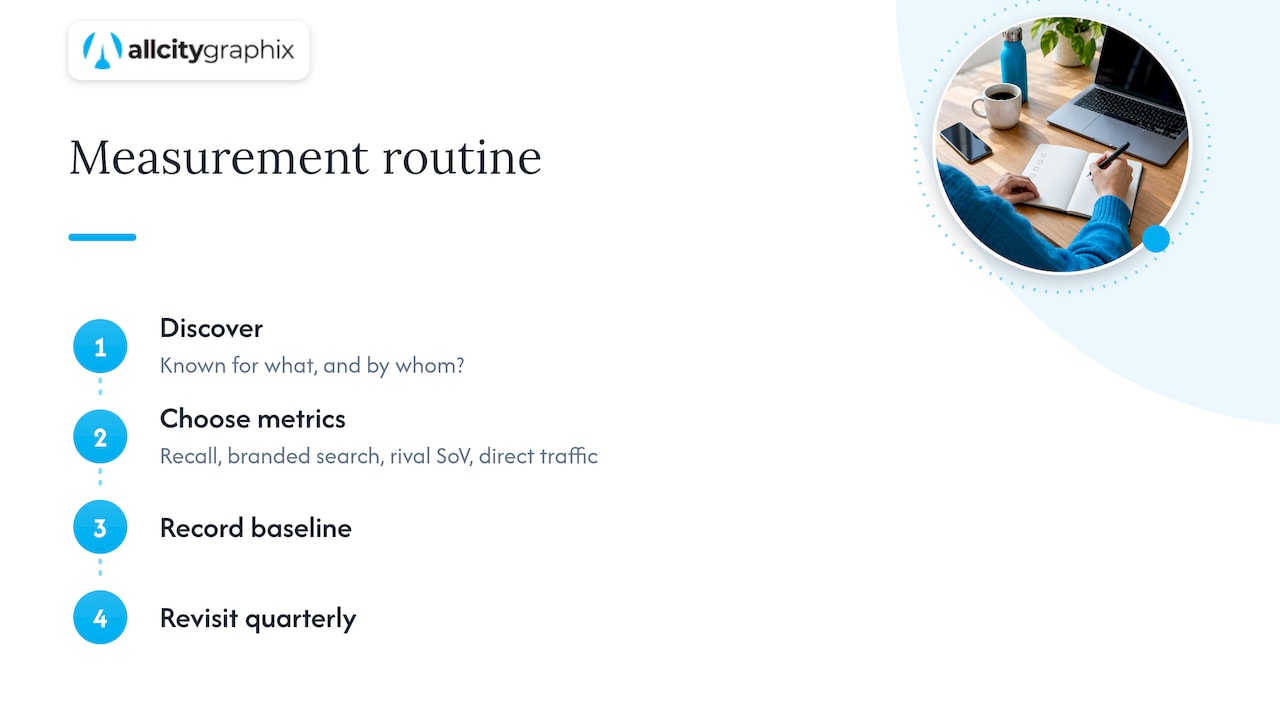
We start with discovery. What does the business want to be known for, and by whom? Only then do we choose metrics. Often that means four numbers: one survey measure (unaided recall in the target audience), branded search from Search Console, share of voice against three named rivals, and direct traffic. Then we write down the baseline and revisit it quarterly.
We also think awareness measurement has a design problem that gets ignored. If your logo, colors, voice and website look different across touchpoints, you spread your exposure across several partial identities, and recall suffers. Consistency is not decoration. It is what lets repeated exposure add up. That is why branding and measurement belong in the same conversation, and why we stay involved after launch rather than handing over files and walking away.
The discipline we ask clients for is boring and effective: same questions, same audience, same schedule, and honesty about the margin of error.
— Alex
Need help turning awareness into a system?
If your brand looks or sounds different from one channel to the next, measurement will only confirm the problem. We build the identity, the website and the marketing around it, with a discovery-led process and support after launch. See our branding services or the full list of services, or get in touch to talk through where your brand stands today.
FAQ
What are the most important brand awareness KPIs?
Start with unaided recall, branded search volume, direct traffic and share of voice. Add aided recognition if you are a newer brand and social reach if social is a main channel. Four to six KPIs, tracked consistently, beat a long dashboard nobody reads.
How do you measure brand awareness on a small budget?
Use free behavioral data first: Google Search Console for branded queries, Google Trends for interest over time and your web analytics for direct traffic. Add a short survey sent to your own customer list and a targeted audience once or twice a year. Keep the questions identical so you can compare results.
What is a good brand awareness percentage?
There is no universal figure. A good result depends on your industry, your audience and your own starting point, so compare against your baseline and direct competitors. Also check that any change is larger than your survey’s margin of error before calling it progress.
How often should I measure brand awareness?
Check behavioral metrics monthly and run surveys quarterly or twice a year. A single survey is a snapshot, while repeating it on a schedule turns it into tracking. Avoid changing question wording between waves.
Sources
- Kantar: brand awareness levels
- Kantar: choosing the right metrics for brand growth
- SurveyMonkey: how to measure brand awareness
- Qualtrics: how to measure brand awareness
- NIQ: brand awareness
- Amazon Ads: what is brand awareness