
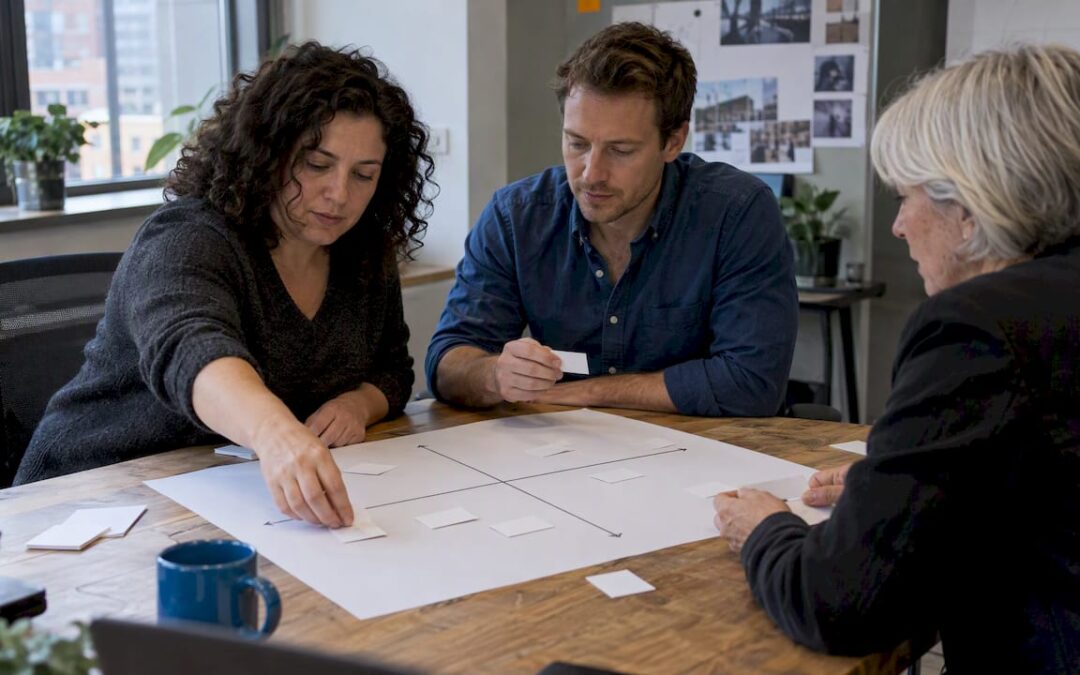
A brand discovery workshop is a structured working session where the people who run a business and the team shaping its brand agree on who the brand is for, how it differs from the alternatives and what it should stand for, before anyone draws a logo or builds a page. Done well, it replaces opinions with decisions. This guide covers what happens in the room, who should be there, the questions worth asking, what you should have in hand afterward and how to prepare.
TL;DR
- A brand discovery workshop is a decision-making session, not a presentation. Its output is a written foundation: audience, positioning, personality and messaging.
- Keep the group small and make sure the person who signs off on the brand is in the room.
- Expect a pre-work questionnaire, a few hours of exercises that force choices, and a written readout afterward.
- The workshop is only worth the time if the results feed straight into design, web and marketing work.
- Prepare by gathering customer feedback, sales data and a list of competitors you actually lose deals to.
Table of Contents
- What a brand discovery workshop is, and what it is not
- Who should be in the room
- The brand discovery process, step by step
- Brand discovery questions worth asking
- What you should have when the workshop ends
- Using the 5 Cs to check where you start
- Why it pays to build for people who are not buying yet
- How to prepare for a brand discovery workshop
- Our perspective: strategy first, then design
- Where a workshop fits with an agency
- When to run one
- Common mistakes to avoid
- FAQ
- Sources
What a brand discovery workshop is, and what it is not
The terms get used loosely. Brand discovery, a brand discovery session, a brand strategy workshop: in practice they describe the same early-stage activity, with different emphasis. “Discovery” stresses learning about the business. “Strategy workshop” stresses the decisions that come out of it. A good one does both.
One workshop guide for branding studios describes it as a two to four hour session in which a studio and the client’s founders settle who the brand is for, who it competes with, how it should feel and what it stands for, before anything is designed. That matches how most working teams use it.
What it is not:
- A design review. No one should be reacting to logos in a discovery workshop. Visuals come later and are judged against what the room decided.
- A brainstorm with no end. Every exercise should end in a choice: this audience, not that one; this tone, not that one.
- A questionnaire alone. Written answers are a starting point. The value comes from watching leaders disagree, then resolve it.
Who should be in the room
The most common reason a workshop fails is that the real decision-maker was not there. If the person who approves the final identity skips the exercises, the concept presentation becomes the workshop they missed, and the debate starts over.
The same workshop guide recommends three to six participants. That is a sensible range for a small or mid-sized company:
- The founder or owner, or the executive who owns the brand.
- Whoever leads sales or customer relationships, because they hear the objections.
- Whoever leads marketing or operations, depending on the business.
- Optionally, one person who talks to customers every day, such as a service manager or account lead.
More than six and the session turns into a negotiation among departments. Fewer than three and you lose the range of views that makes the exercise useful.
The brand discovery process, step by step
The sequence below is the shape most agencies and in-house teams follow. Timings vary with the size of the business.
1. Pre-work: the questionnaire and the evidence
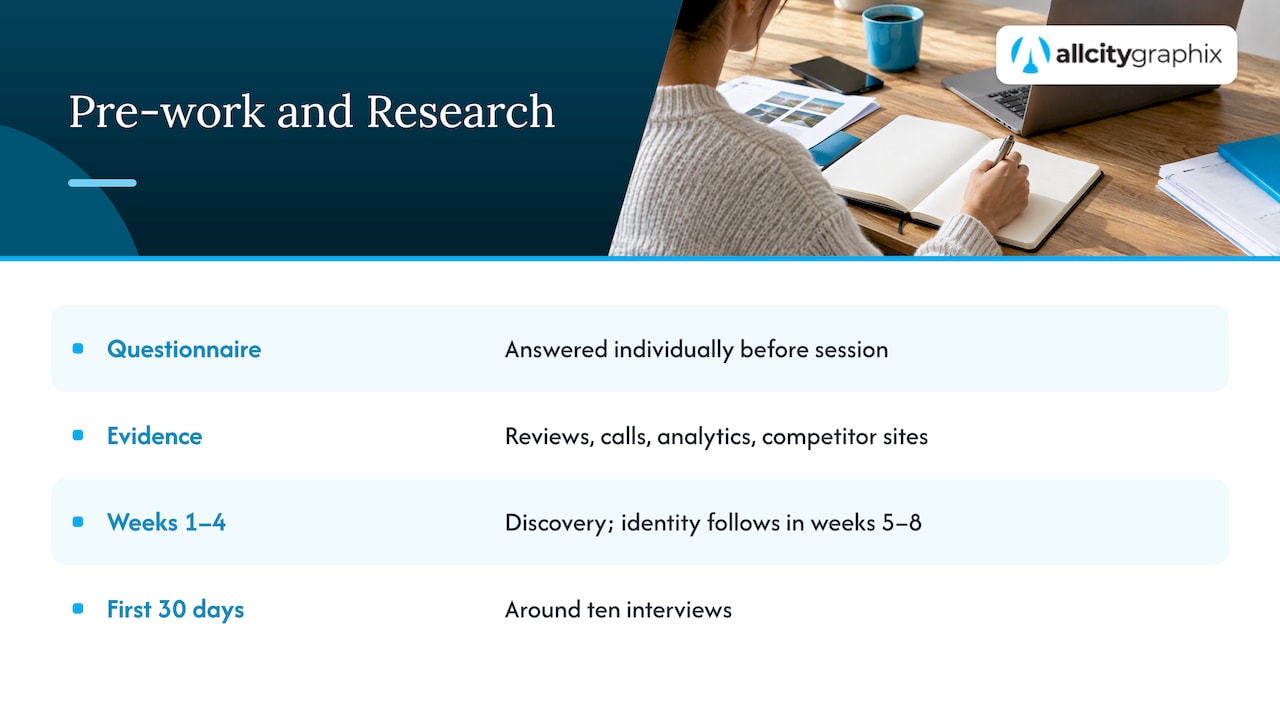
Before the session, participants answer a short written questionnaire on their own. This gets honest answers before groupthink sets in, and it shows early where leaders already disagree. Alongside it, the team collects evidence: customer reviews, sales calls, website analytics, competitor sites, existing brand materials.
Some published frameworks put discovery work at the start of a longer program. One brand-building plan lays out weeks one to four as discovery, with customer interviews and a competitor audit, followed by identity work in weeks five to eight. A consulting guide suggests that the first 30 days can include around ten interviews, a simple survey and a draft of positioning and message pillars. Treat those as examples of sequencing, not fixed timelines: the point is that research comes before identity.
2. Purpose, values and the business goal
The session usually opens with why the business exists and what it needs the brand to do in the next one to three years. Win larger clients? Raise prices? Enter a new neighborhood or state? A brand built for “more awareness” is vague. A brand built to move from small residential jobs to commercial contracts has a clear test.
3. Audience and customer reality
Participants name the customers they most want and the ones they serve today, and compare them. This is where assumptions break. The founder believes customers buy on quality; the sales lead says they buy on speed and responsiveness. Both may be right for different segments, and the workshop forces the group to decide which one the brand leads with.
4. Competitors and the space you can own
List the alternatives a buyer considers, including doing nothing and handling it in-house. Then map them on two axes that matter in your category, for example price against specialization, or traditional against modern. The goal is a gap that is both open and believable for you.
5. Personality and voice
Exercises here ask the group to pick among pairs: formal or casual, bold or reassuring, expert or approachable. Forcing pairs prevents the usual answer of “all of the above.” The result is a short set of personality traits that later guide tone, photography and layout.
6. Positioning and messaging
The group drafts a positioning statement: for whom, what you offer, what category you belong to, and why you are the better choice, backed by proof. From that come three or so message pillars. If you want to see how those turn into something marketers can use day to day, our guide to a brand messaging framework with a matrix and hierarchy shows the next step.
7. Readout and next steps
The session ends with agreed decisions, open questions and an owner for each. Within days, a written summary should follow. That document is the brief for everything downstream.
Brand discovery questions worth asking
Any list of questions is a starting point. Tailor them to the business, and keep the total short enough that people answer thoughtfully. These cover the ground that matters most.
Business and goals
- What does the business need to achieve in the next 12 to 36 months, and how will you know?
- What would change if customers understood you better?
- What have you tried before that did not work?
Customers
- Who are your best customers, and what do they have in common?
- What problem are they trying to solve when they find you?
- What nearly stopped them from buying?
- Which customers would you happily never serve again?
Competition and position
- Who do you lose deals to, and why?
- What do competitors say that you would never say?
- If a customer could only remember one thing about you, what should it be?
Personality and voice
- If the brand were a person walking into a meeting, how would they behave?
- Which three brands, in any industry, do you admire, and what exactly do you admire?
- Which words must never appear in your marketing?
Proof
- What results, numbers or stories can you show?
- What do customers say about you when you are not in the room?
Be skeptical of answers that sound like marketing copy. Follow with “Can you give me an example?” until the answer is a real customer, a real project or a real number.
What you should have when the workshop ends
A workshop is valuable only if it leaves behind something your team can use. Ask for these deliverables, in writing:
| Output | What it answers |
|---|---|
| Audience definition | Who we are building the brand for, and who we are not |
| Competitive map | Where we sit among alternatives and what space we can own |
| Positioning statement | Why a specific buyer should choose us |
| Personality traits and voice notes | How the brand should feel and sound |
| Message pillars | The three or so ideas every page, ad and pitch supports |
| Priorities and open questions | What happens next, and who owns it |
If the summary reads like generic filler that could describe any company in your industry, the session did not go far enough. Specific beats polished.
Using the 5 Cs to check where you start
Many teams open a workshop with a quick health check. The “5 Cs of branding” are clarity, consistency, credibility, connection and commitment, a diagnostic for whether messaging, values and customer relationships line up. Score yourself honestly on each: is the message clear to a stranger, consistent across channels, believable, emotionally connected to the audience and backed by sustained effort?
The visual side of credibility is easy to underestimate. Photography that looks generic undermines even a sharp message, which is one reason brands invest in professional fashion and commercial photography once the direction is set. If you want a structured way to find gaps in an existing brand, our 25-point brand audit checklist pairs well with a workshop.
Why it pays to build for people who are not buying yet
Brand work can feel less urgent than a campaign that produces leads this month. But strategy consultants argue that out-of-market buyers make up roughly 95% of the market at any given time, so relying only on people ready to buy limits growth. A clear brand makes you the name that comes to mind when those buyers do enter the market.
That is also why the workshop belongs before the campaign calendar. Promotions and seasonal pushes work harder when they sit on a clear brand. If you plan promotions for a small business, a practical walkthrough on how to build a seasonal promotion calendar in a day can help, once your messaging is settled.
How to prepare for a brand discovery workshop
- Pick the decision-maker and block the time. Protect the full session. A half-attended workshop produces half-agreed decisions.
- Gather customer evidence. Reviews, testimonials, emails, win and loss notes. Real words from customers are better raw material than internal opinions.
- List competitors honestly. Include the ones you lose to and the ones you consider beneath you. Buyers do not make that distinction.
- Collect your current brand assets. Logos, decks, brochures, social profiles, website pages. Note what you like and dislike about each.
- Write down your goals with numbers. Revenue targets, client types, markets. Vague goals produce vague brands.
- Check the name early. If a new name or product name is on the table, screen it before you fall in love with it. Practitioners recommend preliminary searches in official USPTO databases, but an exact-match search is not enough: sound, meaning and commercial impression all count, and a clean result in a free tool is not legal clearance. Budget for an attorney before committing.
Our perspective: strategy first, then design
We have spent more than 15 years building brands, websites and marketing for businesses in New York and beyond, and the pattern is consistent. Companies rarely struggle because they lack a logo. They struggle because they cannot say, in a sentence, what makes them the right choice, and every design decision after that becomes a matter of taste.
That is why we start with discovery meetings rather than mockups. We want to hear how the business makes money, who its best customers are and where it loses them. Then the creative work, whether it is identity, web or marketing, is built to carry those decisions. Each design element should earn its place by supporting a result.
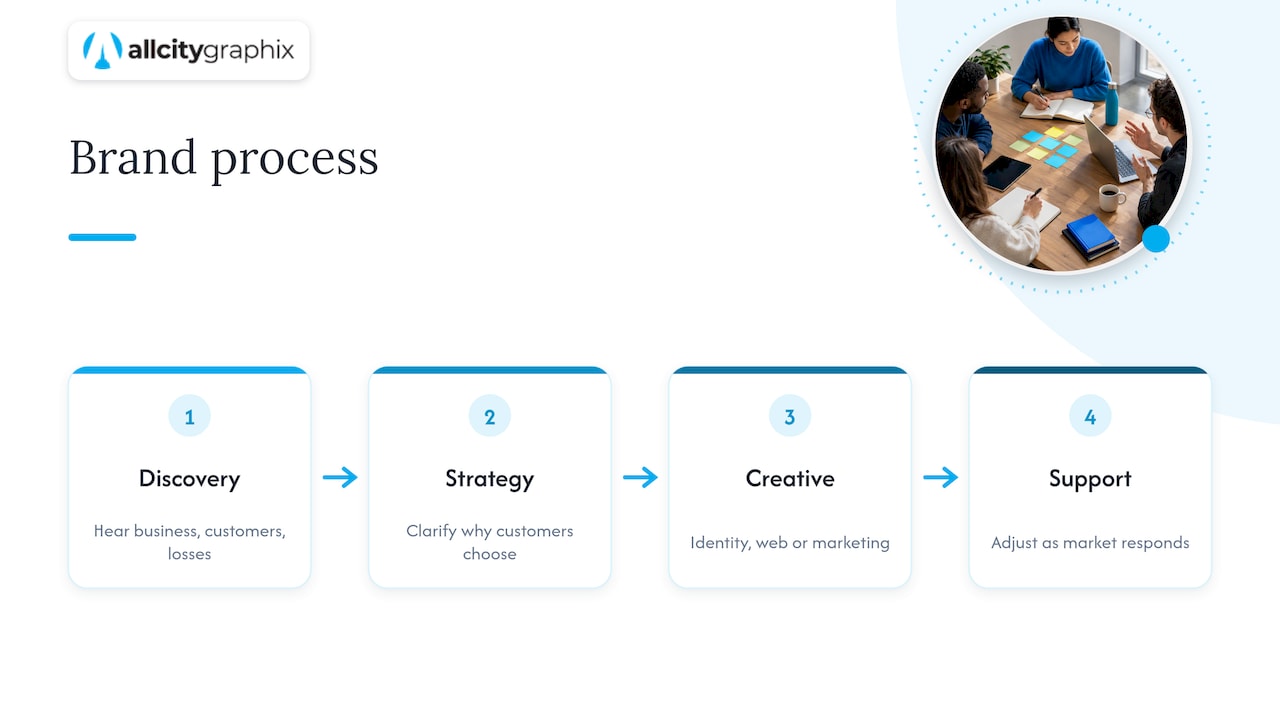
Two habits matter most to us. First, you work directly with experienced leadership, not a hand-off chain where the context gets lost. Second, we do not treat launch as the finish line. Brands need adjustment as the market answers back, so we offer ongoing support after the work ships.
If a workshop ends with a document that sits in a folder, it was wasted. The test is whether the next website, packaging or campaign is easier and sharper because of it.
— Alex
Where a workshop fits with an agency
If you are a small business, startup or established company that needs the foundation and the execution from one team, our brand development services take you from strategy to visual identity, starting with a discovery meeting and followed by custom solutions built around your answers. You can also see how we approach brand identity design as a NYC branding agency, or browse everything we do on our services page. We do not publish fixed prices because scope varies by project, so the first step is a conversation.
When to run one
The timing matters as much as the format. A workshop is most useful at these moments:
- Before a rebrand or new logo. Otherwise the redesign becomes a refresh of surface, not substance.
- Before a new website. Page structure and copy depend on audience and message. Our brand launch plan guide covers what follows.
- After a merger, expansion or new service line. Several voices need to become one.
- When growth stalls. If leads are coming in but the wrong ones, positioning is often the cause.
- When the team describes the company differently. This is the cheapest signal that alignment is missing.
If none of these apply and the brand is working, a lighter audit may be all you need.
Common mistakes to avoid
- Inviting too many people. Consensus among ten people yields a bland result.
- Skipping the evidence. A workshop built on opinion alone tends to confirm what the loudest person already believed.
- Letting exercises stay abstract. If an exercise does not end with a choice, rerun it with a forced trade-off.
- Confusing taste with strategy. Colors and fonts are not discovery outputs. Tone, audience and promise are.
- Not following through. Without a written readout and owners, decisions fade within weeks.
FAQ
What is a brand discovery workshop?
It is a facilitated session where business leaders and a brand team define the audience, competitive position, personality and messaging of a brand before design begins. The result is a written foundation that guides identity, web and marketing work.
How long does a brand discovery workshop take?
Published agendas often run two to four hours, with questionnaires beforehand and a written summary afterward. Larger organizations or multi-stakeholder projects may split it across several sessions.
Who needs to attend?
The person who approves the final brand has to be there, plus a few people who know customers and operations. Three to six participants is a workable range for most small and mid-sized businesses.
What is the difference between a brand discovery session and a brand strategy workshop?
The names are used interchangeably. Discovery emphasizes learning about the business, customers and market, while strategy emphasizes the decisions that follow. A well-run workshop covers both in one sequence.
Sources
- Brand Discovery Workshop: Agenda and Questions (Storyflow)
- Brand Your Business: Essential Strategies for Effective Branding (Future Ventures)
- Brand Strategy Consulting: Positioning, Messaging & Naming (NMS Consulting)
- 12 Best Brand Name Research Tools for 2026 Launches (MixBright)