

Brand positioning is the specific place you want your brand to hold in your customers’ minds: who it is for, what it offers, and why it is the better choice. The fastest way to learn it is to study brands that got it right, then run your own business through the same questions. Below are real examples, what each one shows, a statement template you can fill in today, and a process built for small businesses and startups.
TL;DR
- Positioning means choosing one audience, one frame of reference and one believable point of difference, then repeating it everywhere.
- Strong examples (Lyft, Bumble, Trader Joe’s, Driscoll’s) each define themselves against a convention or competitor, not in a vacuum.
- A positioning statement has five parts: target market, brand, point of difference, frame of reference and reason to believe.
- Check your position against the 3 C’s: Customer, Competition, Company. It has to be relevant, distinctive and deliverable.
- Treat the first version as a hypothesis and test it before you build a logo, website or campaign on top of it.
Table of Contents
- What brand positioning actually is
- Brand positioning examples worth studying
- Positioning statement examples and a template
- A framework: the 3 C’s of brand positioning
- How to position a brand: a step-by-step process
- Testing whether your position is working
- Common positioning mistakes
- Turn your position into a brand that shows it
- FAQ
- Sources
What brand positioning actually is
The classic academic definition comes from Kotler and Keller, who describe it as designing the company’s offering and image to occupy a distinctive place in the minds of the target market. In plainer words: positioning is a decision about what you want to be known for, and what you are willing to be left out of.
Shopify’s guide frames it as expressing how a brand best solves a need for a specific audience, which can help it stand out, improve recall and loyalty, and attract customers. Forbes goes further and calls it the anchor of most marketing plans, a blueprint for much of go-to-market execution. That matches what we see in practice: when positioning is vague, the logo, the website copy and the ad creative all drift in different directions.
Two distinctions save a lot of confusion:
- Positioning vs. slogan. A tagline is public. A positioning statement is not public facing; it is the internal North Star that guides messages and marketing decisions.
- Positioning vs. brand identity. Positioning is the strategic choice. Identity (name, logo, color, typography, voice) is how you express it visually and verbally.
Brand positioning examples worth studying
Each example below is chosen for a lesson you can borrow, not for the size of the company. A neighborhood bakery can use the same logic.
Lyft: the friendly alternative to the elite option
Harvard Business School Online describes how Lyft positioned itself as the friendly “your friend with a car” alternative to Uber’s “everyone’s private driver” positioning, which was more elite and pricey. Lyft did not try to be better at everything. It picked a different emotional territory and made the leader’s stance the contrast.
Lesson: you can define your position by what the dominant player in your category is not.
Bumble: challenging a convention
According to HubSpot’s roundup, Bumble differentiated by challenging the antiquated rules of dating, empowering women to make the first move, while Tinder leaned on its established leadership and popularity. The point of difference was a product behavior and a belief at once.
Lesson: a strong position pairs a clear belief with a product feature that proves it.
Trader Joe’s: a store with a point of view
Trader Joe’s described itself on its own site as selling unconventional and interesting products under its own label alongside everyday basics, with low everyday prices and no coupons, membership cards or discounts. The same page notes that prices can vary between states because of differing laws, taxes and distribution costs. The position is not “cheapest”; it is a curated, no-gimmick neighborhood grocery.
Lesson: what you refuse to do (coupons, memberships) can sharpen a position as much as what you offer.
Voss, Perrier and Ethos: same category, three audiences
HBS Online uses bottled water to show how one category supports very different positions. Voss targets upscale consumers with a luxurious, stylish drinking experience. Perrier targets middle-class consumers with elegant, refreshing sparkling water at an affordable price. Ethos targets socially conscious millennials with high-quality water that helps combat the clean water crisis.
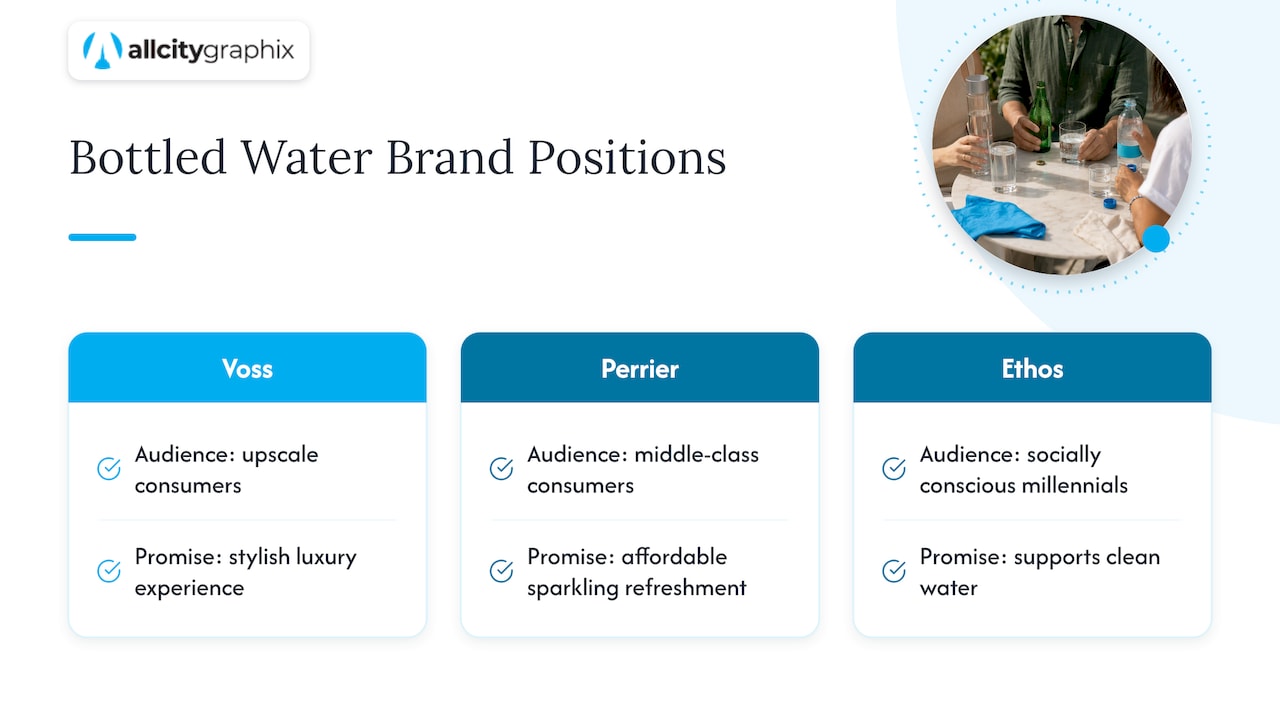
Lesson: it is the audience and the promise, not the product, that separates brands in a commodity category. If you sell something people think is interchangeable, this is your template.
Driscoll’s: positioning built on research
A Forbes account of Driscoll’s says the berry brand combined qualitative and quantitative research into why people eat berries, then connected the insight of shared everyday joy with proprietary varieties, growing expertise, transparency and a consistent premium product experience.
Lesson: the best positions start from a human need you have evidence for, then connect it to proof you can actually deliver.
Tesla and Apple: positions kept visible in the product
Both companies make their positioning obvious on the front door of their sites. Tesla’s homepage sells cars alongside solar panels, Powerwall and Megapack, which reinforces a clean-energy identity beyond vehicles. Apple’s homepage puts a tight, curated product lineup front and center. Neither says “we are premium”; the presentation does the work.
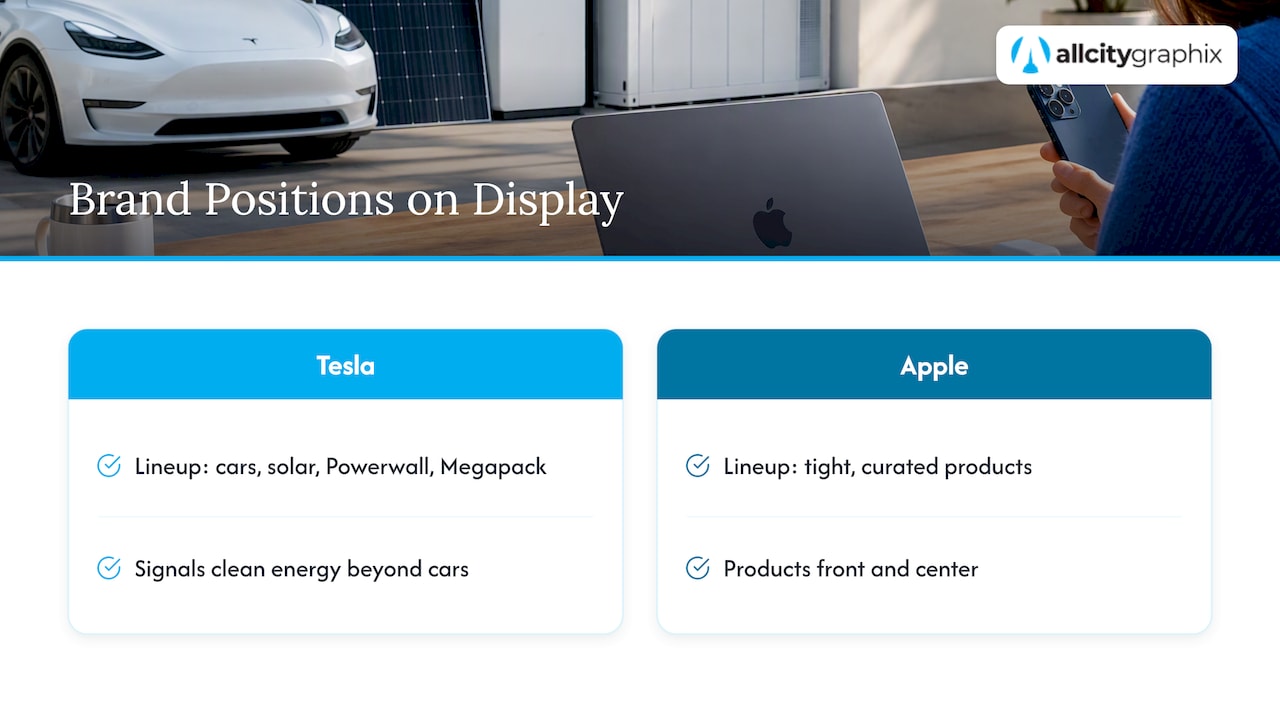
Lesson: your website is where positioning either shows up or does not. Every page should reinforce the same promise.
Quick comparison
| Brand | Audience | Point of difference | Position type |
|---|---|---|---|
| Lyft | Riders who want approachable rides | Friendly, “friend with a car” | Personality-led, anti-elite |
| Bumble | Women dating online | Women make the first move | Belief-led |
| Trader Joe’s | Neighborhood grocery shoppers | Own-label, unusual products, low everyday prices | Curation-led |
| Voss | Upscale consumers | Luxurious, stylish experience | Premium |
| Perrier | Middle-class consumers | Elegant sparkling water at an affordable price | Accessible luxury |
| Ethos | Socially conscious millennials | Water that supports a clean-water cause | Values-led |
| Driscoll’s | Berry eaters | Everyday joy backed by proprietary varieties | Insight-led |
Positioning statement examples and a template
A statement turns the strategy into one or two sentences your team can use to judge ideas. eCornell lists the elements of a positioning statement: a target market, the brand, a point of differentiation, a frame of reference and a reason to believe.
A short template from Marketful is:
For [target audience], [brand name] is the [market category] that [unique benefit] because [proof or reason to believe].
A historical example: Amazon in 2001
eCornell shares Amazon’s 2001 statement as a model. It targeted book-loving web users and promised instant access to over 1.1 million books, extraordinary convenience, low prices and comprehensive selection, compared with traditional book retailers. Notice the structure: a named audience, a named alternative, concrete benefits and numbers as proof.
A fictional example for a local business
Here is the template applied to an invented neighborhood bakery, for illustration only:
For busy Brooklyn parents, Corner Crumb is the neighborhood bakery that makes allergy-safe birthday cakes you can order in two minutes, because every recipe is made in a dedicated nut-free kitchen.
The audience is narrow, the category is familiar, the benefit is specific and the reason to believe is checkable. Swap in your own details and read it aloud. If a competitor could say the same sentence, keep sharpening.
What a good one avoids
- Adjectives anyone can claim (“quality,” “innovative,” “customer-focused”).
- Several audiences at once.
- Benefits with no reason to believe.
- A frame of reference so broad (“a marketing company”) that it tells nobody anything.
A framework: the 3 C’s of brand positioning
The 3 C’s are Customer, Competition and Company. Jill Avery’s academic reading describes them as consumer, competition and company analysis: understand customer jobs and needs, identify distinctive and defensible claims versus competitors, and choose a position the company can feasibly deliver.
Use them as three filters:
| Filter | Question | Failure if you skip it |
|---|---|---|
| Customer | Is this relevant to what your buyer is actually trying to get done? | A clever position nobody cares about |
| Competition | Is it distinct from what others already claim? | You sound like everyone else |
| Company | Can you deliver it consistently, in product, price, service and every touchpoint? | A promise you cannot keep |
A position has to pass all three. Differentiation alone is not enough if customers do not want it or you cannot sustain it.
How to position a brand: a step-by-step process
Kotler and Keller’s approach to deciding a position involves determining a frame of reference, identifying points of parity and difference, and creating a brand mantra. Here is a practical version for a small business or startup.
1. Pick one primary customer
Ipsos advises that distinct positioning be crafted around the primary target and driven by human needs. Write down who they are, what they are trying to accomplish and what frustrates them today. Talk to at least five real customers if you can. Their words are better than yours.
2. Map the real competitive set
Good competitor analysis covers direct, indirect and tertiary competitors, plus market trends. For a service business, the indirect competitor is often “do it ourselves” or “do nothing,” and that deserves a line in your map.
3. Find the gap
List what each competitor claims on their homepage. Look for a need that nobody owns. Ipsos argues the strongest positioning sits where a deep human need overlaps with a product-supported point of difference, and that ownability can come from an unmet need, not only a unique feature.
4. Decide what you will not be
Al Ries, in an AMA interview, stresses focus and contrast: brands clarify their position by identifying what they will not offer and the convention they stand against. This is the Trader Joe’s and Bumble move. Write a “we are not” list; it will feel uncomfortable, which is a good sign.
5. Gather your reasons to believe
HBS Online recommends documenting the reasons to believe that make the difference credible. Examples: a process, a guarantee, a certification, years of experience, customer results, a proprietary method. If you cannot prove it, soften the claim or build the proof first.
6. Write the statement, then pressure-test it
Fill in the template. Ipsos suggests pressure-testing a position for being motivating, credible and ownable. Stripe’s startup guidance adds practical checks: match positioning to the value proposition and customer preferences, check your resources and capabilities, consider long-term viability, and test before full commitment.
7. Express it consistently
Once the position is set, it needs a home: a messaging hierarchy, a visual identity, a website and content that all say the same thing. Our guide to an operational brand messaging framework shows how to turn a positioning statement into messages your whole team can reuse, and brand content pillars keep your ongoing content on-position.
Testing whether your position is working
Positioning lives in customers’ heads, so measure it there. An AMA summary of Journal of Marketing research reports that visual elicitation can measure brand associations and uniqueness relative to the category. You do not need a research lab to apply the idea:
- Ask ten customers to describe you in three words. Compare with your statement.
- Show your homepage to a stranger for five seconds and ask what you sell and who it is for.
- Cover the logo on your competitors’ sites and yours. Can you tell them apart?
A Qualtrics case study on Airtasker reports that brand research exposed a proposed visual identity’s limited appeal and polarization, letting the company test, iterate and improve memorability. The takeaway for smaller brands is simple: showing drafts to real people early is cheaper than relaunching later. When you are ready to see whether the investment pays off, our piece on proving brand ROI covers measurement over an 18 to 36 month horizon.
Common positioning mistakes
- Trying to appeal to everyone. A position that fits all customers fits none.
- Copying a leader’s claims. If the category leader owns “premium,” claiming it too just makes you the smaller version.
- Describing features instead of a need. Customers buy outcomes. Driscoll’s started from why people eat berries, not from a list of varieties.
- Claiming what you cannot deliver. The Company filter in the 3 C’s exists for this reason.
- Changing it every quarter. Positioning compounds only through repetition.
- Keeping it in a slide deck. If your website, packaging and sales pitch disagree, customers believe the weakest of them.
Perspective
After more than 15 years of working with New York businesses, we have noticed that the brands that struggle are rarely short on creativity. They are short on a decision. They want a new logo or website before they have answered who they are for and why they are the better choice.
That is why our process is discovery-led. We start with meetings about your customers, your competitors and what you can truly deliver, and only then move to visual identity, web design and marketing. Design that is not tied to a position is decoration. Design that is tied to one does a job.
We also think positioning should not end at launch. Markets shift, new competitors appear, and a position needs checking against real customer behavior. That is why we stay involved with ongoing support, working directly with experienced leadership rather than handing you off.
Alex
Turn your position into a brand that shows it
If you have a draft statement and need it expressed in a name, logo, website and marketing, that is what we do. All City Graphix is a New York City creative agency covering brand strategy and brand identity, logo design, web design, digital marketing and ongoing support. We start with a discovery meeting, then build custom solutions around your audience and goals.
Looking for a place to start? Explore our branding agency services or see everything we offer on the services page. If your position is settled and you are ready for the visual side, our logo design in NYC page explains how we approach it.
FAQ
What is a brand positioning statement?
It is a short internal statement of how you want your brand to be perceived: who it serves, what category it competes in, what makes it different and why that is believable. It is not a slogan. As HBS Online puts it, it acts as a North Star for marketing strategies and messages, even though customers never see it.
What are the 3 C’s of brand positioning?
They are Customer, Competition and Company. Your position should matter to the customer, stand apart from competitors and be something your company can deliver consistently. If a draft fails any one, revise it before building anything on top.
How is a positioning strategy different from a positioning statement?
The strategy is the set of decisions: audience, frame of reference, points of difference and proof. The statement is the one-sentence summary of those decisions. The strategy drives pricing, channels, messaging and design, while the statement keeps everyone aligned on it.
How long should a positioning statement be?
One to three sentences is usually enough. The template “For [audience], [brand] is the [category] that [benefit] because [proof]” fits in a single line. If you need a paragraph to explain it, the position probably is not focused enough yet.
Can a small business or startup have a strong position without a big budget?
Yes. Positioning is mostly a thinking and decision exercise, and a narrow audience is an advantage. Talk to customers, study what competitors claim, choose a gap you can credibly fill and test it before spending on design and ads.
Sources
- Brand Positioning: Complete Guide With Examples (Shopify)
- Kotler and Keller, Crafting the Brand Positioning
- Demystifying The Science Underlying Brand Positioning (Forbes)
- How to Craft the Perfect Brand Positioning Statement (Harvard Business School Online)
- 15 brand positioning examples (HubSpot)
- Trader Joe’s general FAQs (archived)
- How Driscoll’s Has Navigated The Reinvention Of Its 100-Year-Old Brand (Forbes)
- Tesla
- Apple
- How to Write Market Positioning Statements (eCornell)
- Developing Your Market Positioning
- Core Reading: Brand Positioning
- Owning It: Three Requirements for Distinct Positioning (Ipsos)
- How To Write a Product Positioning Statement (airfocus)
- The need for a strategic enemy (American Marketing Association)
- How to determine market positioning for your startup (Stripe)
- Revolutionizing How We Measure Brand Perceptions (American Marketing Association)
- Small tasks, big ambitions: How Airtasker designed a brand (Qualtrics)