

A logo is one part of a brand identity. The identity is the full system of visual and verbal elements that makes your business recognizable: the logo, colors, typography, imagery, voice and the rules for using them together. The logo is the mark at the center of that system. It cannot do the job of the whole system on its own.
If you are a small business owner deciding where to spend money first, this guide explains the difference in plain terms. It covers what each piece does, where “brand” and “branding” fit, and how to tell when a logo alone is no longer enough.
TL;DR
- A logo is a single visual mark. Brand identity is the whole set of tangible elements, including the logo, that you create and control.
- Your brand is different again: it is the perception people hold of your business, shaped by every interaction.
- Branding is the ongoing work of shaping that perception. Identity is what you design. Branding is what you do with it.
- A logo without color, type, voice and usage rules tends to look different on every surface. An identity keeps it consistent.
- Start with strategy, then build the identity around a logo that fits it, not the other way around.
Table of Contents
- The short answer: logo, identity, branding and brand
- What a logo does
- What a brand identity includes
- Brand identity vs. branding vs. brand
- How a logo fits inside the identity
- Why a logo alone stops being enough
- What to build first
- Logo vs. brand identity: which do you need?
- Perspective: why we start with strategy, not the mark
- How we can help
- Common mistakes to avoid
- FAQ
- Sources
The short answer: logo, identity, branding and brand
These four words get used as if they were the same thing. They are not. Here is the simplest way to separate them.
| Term | What it is | Who controls it | Example |
|---|---|---|---|
| Logo | A visual mark that represents your business | You | A wordmark, symbol or combination of both |
| Brand identity | The tangible visual and verbal system around the logo | You | Colors, typography, imagery, voice, guidelines |
| Branding | The ongoing practice of shaping how people see you | You, through action | A campaign, a new website page, a social post |
| Brand | The perception people hold of your business | Your audience, influenced by you | The feeling a customer has when your name comes up |
The useful way to hold this: you design a logo, you design an identity, you practice branding, and your customers decide what the brand is.
What a logo does
Penn State Extension describes a logo as a visual symbol that represents a company, product or service, usually a graphic element or icon paired with text. Its job is recognition. A good logo helps someone spot you on a storefront, an invoice, a social profile or a delivery box in a second or two.
Shopify calls the logo one part of branding and describes it as an anchor that guides other visual decisions such as typography, color and packaging. That is a practical way to think about it. The logo is often the first design decision, and it sets the tone for the rest.
What a logo cannot do:
- Explain what you stand for or who you serve.
- Set the tone of your emails, website copy or sales conversations.
- Tell a designer which colors and fonts are “yours” for a flyer, a menu or an ad.
- Make customers trust you. That comes from how you deliver.
The US Chamber of Commerce makes the same point: a logo is just one piece of your brand and does not replace building a distinct identity that connects with customers.
What a brand identity includes
The American Marketing Association describes brand identity as the visual and symbolic elements that represent a brand, including name, logo, color scheme, typography and design elements. In practice, a working identity for a small business usually covers these components:
- Logo and logo variations. A primary version, a stacked or horizontal version, a small icon for profile pictures and favicons, and one-color versions for stamps, embroidery or signage.
- Color palette. A small set of colors with defined roles: a main color, supporting colors and neutrals. Our guide to choosing 2 to 4 brand colors explains how saturation and lightness help you build a palette that holds up across screens and print.
- Typography. One or two typefaces and a clear hierarchy for headlines, body text and captions.
- Imagery and graphic style. The look of your photography, icons, patterns and illustration.
- Voice and tone. How you write and speak: formal or relaxed, technical or plain, playful or serious.
- Messaging. Your name, tagline, positioning statement and the few things you want every customer to remember.
- Usage guidelines. The rules that keep everything consistent, so a freelancer, a printer or your own staff can apply the identity correctly.
HubSpot describes brand identity as your brand’s personality, expressed through elements like name, logo and color choices, and kept consistent so audiences recognize it. The word that matters there is consistency. Each element alone is replaceable. Together, repeated over time, they become recognizable.
A real-world example
Harvard Business School Online points to Burt’s Bees as an example. Its identity reflects sustainability through eco-friendly packaging, natural-ingredient messaging, its logo and its tagline. Notice that the logo is only one of four signals. Take away the packaging and the messaging, and the logo would say much less.
Brand identity vs. branding vs. brand
This is where most of the confusion lives, and it is worth a few minutes because it changes how you budget.
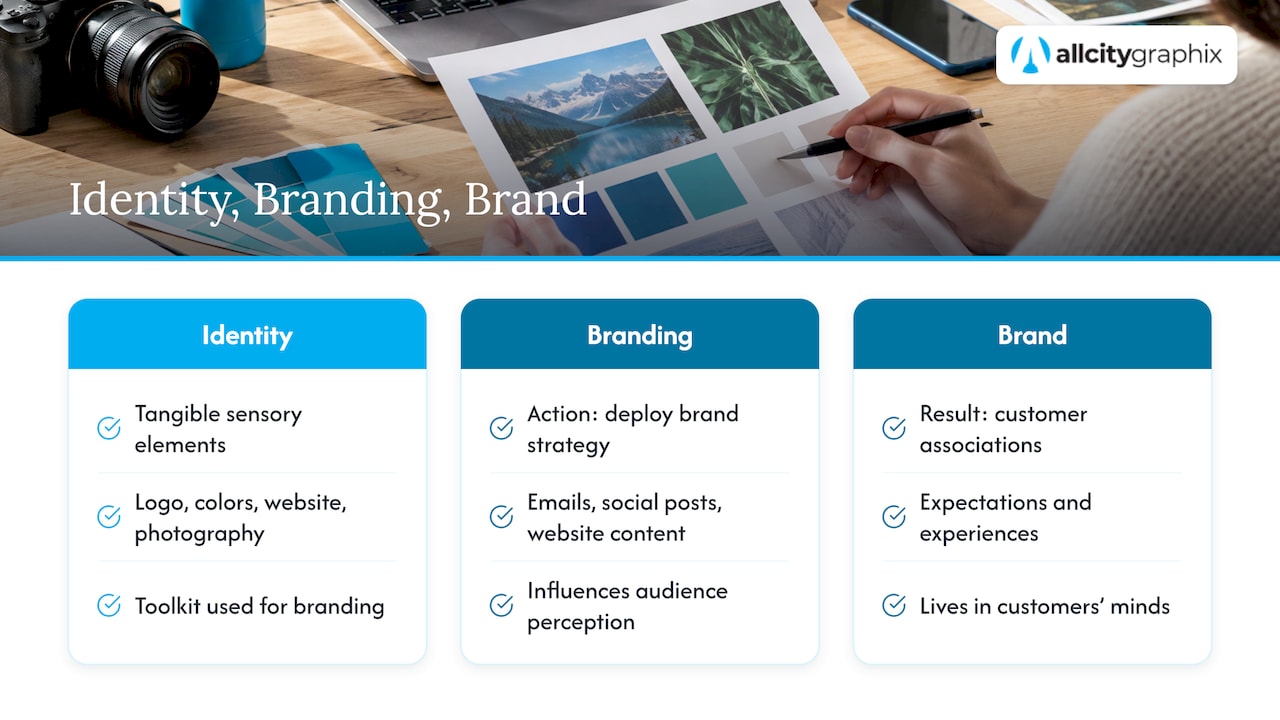
Brand identity is tangible. MarketingProfs describes it as the sensory elements used to identify a brand, such as your logo, colors, website and photography, plus material goods like stationery, brochures, signage and apparel.
Branding is an action. The same article defines branding as deploying the strategic plan for your brand so your audience perceives your business as you intend. Sending an email campaign, posting on social media and writing new website content are all branding.
The brand is the result. HubSpot describes a brand as the full set of associations, expectations and experiences people connect with your business. It sits in your customers’ minds, not in your files.
HubSpot also separates brand identity from brand image: identity is what you create and control, while image is what your audience forms through every touchpoint. The goal is alignment, where your identity and your image tell the same story.
So when someone asks “brand vs. branding,” the shortest accurate answer is that the brand is what people think, and branding is the work you do to influence it. Identity is the toolkit you do that work with.
How a logo fits inside the identity
Think of the identity as a house and the logo as the front door. People notice the door first, and it needs to look right. But a door with no house behind it leads nowhere.
In practice, the relationship runs in both directions:
- The logo anchors the identity. Shopify notes that once other identity elements like voice, tone and visual style are chosen, the logo should align with them so the whole experience feels cohesive.
- The identity governs the logo. Guidelines decide how much clear space the logo needs, what color it can appear in, how small it can go and what it may sit on.
- The logo should reflect the strategy. It works best when it helps customers understand what makes your business different, not just when it looks attractive.
A few signs your logo is working inside an identity, not in isolation:
- Your website, business cards, packaging and social profiles look like they come from the same business.
- A new team member or vendor can use your materials correctly without asking you.
- Your logo looks right in a one-inch social avatar and on a large banner.
- Your colors and fonts show up in the same way everywhere, not just the logo.
Why a logo alone stops being enough
Most businesses start with a logo, and that is reasonable. A logo is the fastest way to look like a real business. The trouble begins when the business grows and the logo is asked to do more than it can.
Common symptoms:
- Every piece looks different. The website uses one blue, the printed menu another, and the Instagram posts a third font.
- Outside vendors guess. Without guidelines, each printer, sign maker or freelancer makes their own choices.
- Your message is vague. Customers can recognize the logo but cannot say what you do better than the next business.
- You are about to expand. A second location, an online store, packaging or a new service line all need a system that stretches.
Constant Contact makes the case for consistency directly: when colors, voice and logo stay steady, the business becomes more recognizable, builds trust, and makes marketing easier. That is the business value of an identity. It is not decoration. It reduces the effort of every future marketing decision.
What to build first
If you are starting from nothing, the order matters. A logo designed before you know your positioning often has to be redone.
1. Clarify the strategy
Decide who you serve, what you promise, how you are different and how you want to sound. Even a one-page summary helps. This is the part that makes the later design choices easy to defend.
2. Design the logo to fit the strategy
A logo should suit your audience and industry and work at many sizes. Ask for versions you will actually use: horizontal, stacked, icon-only and single color. If you are in New York, our logo design in NYC page shows how we approach this.
3. Build the supporting system
Add the palette, typography, imagery style and voice. This is the step that turns a logo into an identity. It is also where you decide what you will never do, which is as useful as what you will do.
4. Write it down
A short guideline document, even a few pages, protects the work. It should cover logo usage, colors with their exact values, fonts, photography style and sample wording.
5. Apply it where customers meet you
Your website, signage, packaging, social profiles, invoices, email signatures and ads should all carry the same system. Then keep branding: publish, post and communicate in a way that matches the identity.
Logo vs. brand identity: which do you need?
| Your situation | What you likely need first |
|---|---|
| Brand-new business, nothing designed yet | Strategy, then logo and a starter identity together |
| Have a logo, but materials look inconsistent | An identity system built around the existing logo, if it still fits |
| Logo no longer matches who you are | A refresh or redesign guided by updated positioning |
| Launching a store, packaging or new locations | A full identity with guidelines |
| Mostly selling through one-to-one relationships | A clean logo, a strong website and consistent templates may be enough for now |
The honest answer for most growing businesses is that the logo and the identity are not competing choices. The logo is the first deliverable inside the identity.
Perspective: why we start with strategy, not the mark
We hear “I just need a logo” often, and we understand why. A logo is visible, it feels finite, and it gets you moving.
Our experience of more than 15 years in New York is that the businesses that get the most from a logo are the ones where we first understand the business behind it. That is why our process starts with a discovery meeting. We want to know who your customers are, what you promise, and where you are headed before we draw anything.
From there, we design custom work, and you work directly with experienced leadership, not a hand-off chain. The logo, the colors, the type and the voice are designed to work as one system, so your website, packaging and ads look like they belong together.
We also believe the work should not stop at launch. A brand identity earns its value when it is applied consistently, and that takes ongoing support: web design, marketing, content and maintenance that keep the system intact as your business grows.
If you are choosing between “just a logo” and a full identity, our advice is to decide based on where the business is going, not just where it is today.
Alex
How we can help
All City Graphix is a New York City creative agency covering brand strategy, logo design, brand identity, web design and digital marketing. If you need one mark, we design custom logos. If you need a complete system, our branding agency team builds the identity around your strategy.
If you want the identity carried from strategy through to visuals, see our brand development services. Prefer to start with the mark? Our logo design page explains the process, and we also work with businesses in Brooklyn, Queens, the Bronx and Staten Island. Tell us about your business and we will recommend where to begin.
Common mistakes to avoid
- Treating the logo as the brand. The logo is a symbol. The brand is what customers believe and expect from you.
- Designing the logo first, strategy later. This often leads to a mark that looks fine but says nothing specific about you.
- Choosing too many colors and fonts. A tight palette and one or two typefaces are easier to apply consistently.
- Skipping logo variations. Without an icon version or a one-color version, the logo breaks down on small or unusual surfaces.
- Never writing the rules down. Guidelines save money because they prevent redesigns and reprints.
- Changing everything too often. HubSpot advises designing a logo that can carry through changing market aesthetics, since the best logos are ones companies commit to for the long haul.
FAQ
What is the difference between a brand and a logo?
A logo is a visual symbol that represents your business. A brand is the perception people hold of your business, shaped by your actions, messaging, customer interactions and reputation. You design the logo, but your customers form the brand over time.
What is brand identity in simple terms?
Brand identity is the collection of visual and verbal elements you use to present your business: logo, colors, typography, imagery, voice and messaging. It is the part of your brand you create and control. It is what makes your business recognizable before anyone reads a word.
What are the main components of a brand identity?
The core components are a name, logo, color palette, typography, imagery style, voice and tone, messaging and usage guidelines. Some businesses add packaging, signage or sound. The exact mix depends on where customers meet you.
Is branding the same as brand identity?
No. Brand identity is what you design: the tangible elements. Branding is the ongoing work of using those elements, along with strategy and communication, to shape how people perceive you. A strong identity makes branding easier because every campaign starts from the same foundation.
Can I start with just a logo and add the rest later?
Yes, many businesses do. It helps to choose a logo that fits your positioning and to ask for useful variations at the start. That way, adding colors, typography and guidelines later extends the logo instead of forcing a redesign.
Sources
- Unveiling the Divide: Brand vs. Logo, Penn State Extension
- 7 Elements of a Great Business Logo, US Chamber of Commerce
- Branding, American Marketing Association
- Branding vs Brand Identity, MarketingProfs
- What Is Brand Identity? Tips & Examples, HBS Online
- Logo and Branding: How To Make Them Work Together, Shopify
- What is branding?, HubSpot
- What are brand identity elements?, HubSpot
- Brand Management for Small Businesses, Constant Contact