

Marketing ROI is incremental revenue minus marketing cost, divided by cost, shown as a percentage or a ratio. To get a first number today, subtract a campaign’s cost from the revenue attributed to it and divide by that cost. For a figure your finance team will trust, you usually need attribution, experiments, or marketing mix modeling behind it.
TL;DR:
- Use incremental revenue when possible, include every campaign cost, and calculate ROI with gross margin; wait at least one full sales cycle.
- Use attribution for daily adjustments, experiments to verify causal lift, and marketing mix modeling for quarterly or annual planning; calibrate attribution with experiment results.
- Compare ROAS with ROI when product margins differ, and shift added budget toward channels with stronger marginal ROI rather than the highest average return.
- Connect ad spend to closed revenue in your CRM and accounting system through campaign tags, customer identifiers, and order records; broken links undermine ROI.
- Before a large budget shift, run a holdout test if platform reported attribution is the only evidence supporting the decision.
Table of Contents
- 1. How do you calculate marketing ROI step by step?
- 2. Which measurement methods should you use, and when?
- 3. Which metrics belong next to ROI?
- 4. What data do you need to connect?
- 5. How do you improve marketing ROI once you can measure it?
- 6. What realistic timelines and pitfalls should you expect?
- 7. How can All City Graphix help you measure and improve ROI?
- FAQ
- Sources
1. How do you calculate marketing ROI step by step?
Start with the basic formula: marketing ROI = (growth in sales − marketing costs) ÷ marketing costs × 100. The campaign version swaps in the revenue attributed to that campaign, as Shopify’s ROI guide lays out. Follow these steps:
- Add up every cost: media spend, creative, production, agency fees, and any tooling used only for the campaign.
- Choose the revenue base. Attributed revenue works for a quick read, but incremental revenue (sales the marketing actually caused) is the more honest input.
- Decide gross or net. Revenue-based ROI flatters low-margin products, so multiply revenue by gross margin when finance asks for profit-adjusted ROI.
- Subtract cost from revenue, divide by cost, and multiply by 100.
- Express the result as a ratio too, so a 300% ROI reads as 4:1 revenue to cost.
Here is a worked example with illustrative numbers. Say a campaign costs a certain amount and drives more in attributed incremental revenue. Calculate ROI by subtracting the campaign cost from that revenue and dividing by the cost. The revenue-to-cost ratio is also the campaign’s ROAS. If you account for gross margin, profit-adjusted ROI may tell a very different story.
Treat ROMI as a derived metric built from top-line performance, profit margins, and marketing costs, and measure it over at least one full sales cycle, according to the American Marketing Association. A campaign judged before a full buying cycle has elapsed may look worse than it is.
2. Which measurement methods should you use, and when?
No single method answers every question. Google’s modern-measurement guidance recommends attribution for tactical optimization and marketing mix modeling for strategic, long-term planning, combined into one toolkit. Here is how the pieces compare:
- Data-driven attribution (MTA): Credits conversions across touchpoints and gives fast signals for day-to-day optimization. Its weakness is privacy: lost cookies and consent limits leave gaps in the journey. For a technical walkthrough of setup, see this practitioner’s guide to multi-touch attribution.
- Marketing mix modeling (MMM): Works from aggregated spend and outcome data, so it does not depend on cookies. Given sufficiently granular media inputs, it can produce ROI, marginal ROI, and response curves, according to Google’s MMM guidebook. It suits annual and quarterly budget planning, and it needs a long enough history to separate seasonality from marketing effect.
- Incrementality experiments: Holdout groups or geo tests show what happened with and without the marketing. This is the closest you get to causal evidence. The trade-offs are time, cost, and the sales you forgo in the holdout.
- Unified measurement: Blends MTA, MMM, and experiments into one view. Google’s unified measurement whitepaper says this can produce more accurate budget decisions and more granular, unbiased estimates than isolated methods. Usercentrics makes the same case: don’t lean on a single tool.
In practice, use attribution to steer daily spend, run experiments to check that attribution isn’t fooling you, and use MMM for cross-channel budget allocation. Privacy-era guidance follows the same split: attribution for fast signals, experiments and MMM for validation and planning.
The methods should also feed each other. If an experiment shows a channel’s true lift is half what attribution claims, apply a calibration multiplier to that channel’s attributed numbers. MMM tools let teams set ROI or marginal ROI priors from experiment results, and those priors shape how the model recommends budget shifts. Calibration also works the other way: an MMM result that contradicts attribution is a prompt to schedule a test.
Pro Tip: Before every big budget shift, ask which method backs the decision. If the answer is only platform-reported attribution, run a small holdout test first.
3. Which metrics belong next to ROI?
ROI alone hides too much. These metrics give it context:
| Metric | Formula | What it tells you |
|---|---|---|
| ROAS | Revenue ÷ ad spend | Revenue per ad dollar, ignores margin |
| CAC | Total acquisition cost ÷ new customers | What one customer costs you |
| LTV | Average revenue per customer × margin × expected lifetime | What one customer is worth |
| LTV:CAC | LTV ÷ CAC | Whether acquisition spend is sustainable |
| mROI | Incremental return on the next dollar | Where extra budget should go |
ROAS is the right metric for fast channel-level checks, such as comparing two ad sets. It misleads when margins differ by product, which is why ROI and ROAS should sit side by side. A healthy LTV:CAC ratio tells you whether growth is paid for or borrowed against future cash.
The most useful metric for budgeting is marginal ROI. Meridian defines ROI as incremental outcome divided by cost, and mROI as the return on the next dollar, with response curves visualizing incremental outcome by spend to reveal saturation. An example makes the point. Search may have a strong average return while its next increment of spend returns less because the best keywords are already covered, while paid social may have a lower average return but a stronger return on its next increment. The extra dollar belongs in the channel with the stronger marginal return. Consumer response is often non-linear (concave or S-shaped), so the AMA advises using marginal ROI rather than simple total-revenue correlations.
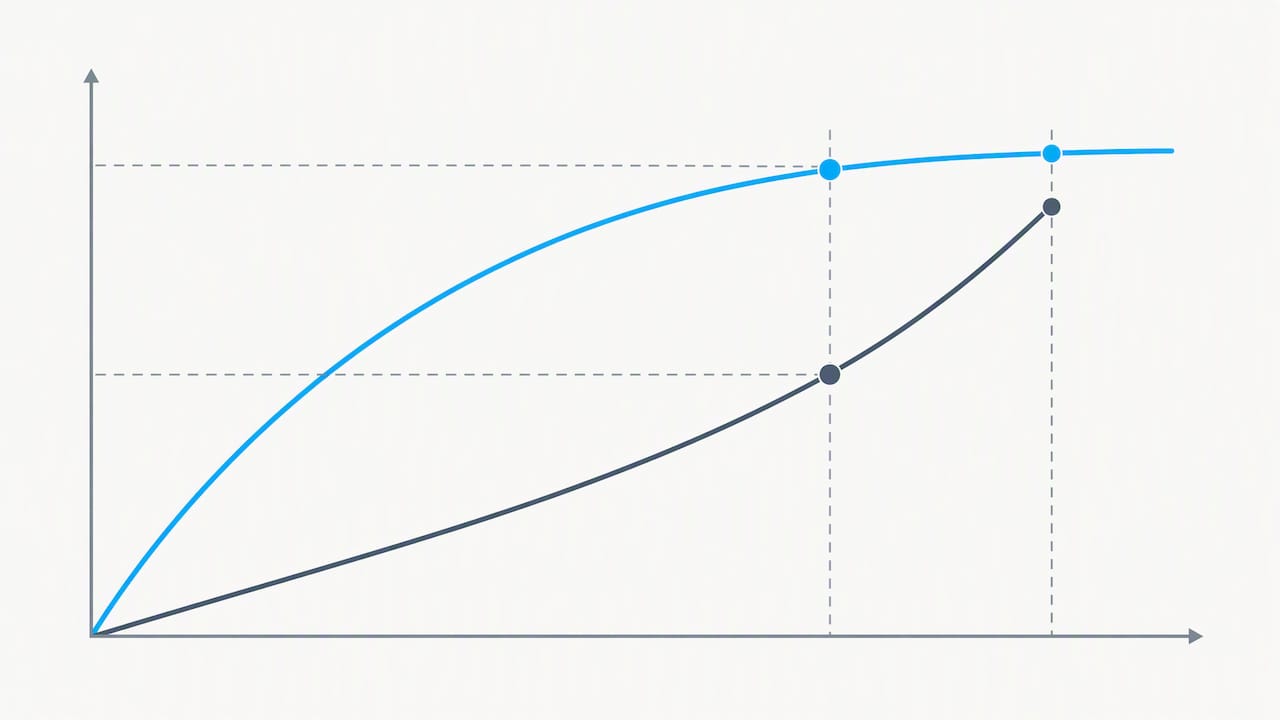
For finance, report incremental outcome, then revenue and profit versions of ROI side by side, with margin assumptions stated.
4. What data do you need to connect?
Reliable ROI starts with connected systems, since accuracy depends on reliable attribution, integrated systems, and clean financial data. Connect these:
- Web analytics (GA4): sessions, conversion events, and campaign parameters.
- Ad platforms: spend, impressions, and platform-reported conversions by campaign.
- CRM: leads, opportunities, deal stages, and closed revenue tied to a customer ID.
- Accounting or ERP: actual invoiced revenue, refunds, and cost of goods.
- Minimum fields to capture: spend by campaign and date, timestamps, conversion events with monetary values, order IDs, customer IDs, and offline sales linked to marketing activity.
Cookie loss and privacy rules leave holes in click-level tracking, which is why aggregated and modeled approaches matter. Trace one conversion end to end to test your setup: tag the ad with UTM parameters, capture those parameters on the form submission, store them on the CRM record, and match the closed deal to an invoice in accounting. If any link breaks, your ROI figure rests on a guess.
5. How do you improve marketing ROI once you can measure it?
Measurement only pays off when it changes spending. Work through this sequence:
- Rank channels by marginal ROI, not average ROI. Move budget from saturated channels to ones with steeper response curves.
- Take the quick wins. Refresh tired creative, tighten landing pages, refine targeting, and test offers. These often lift conversion without extra spend.
- Test before moving big money. Run an incrementality test on any strategic channel before shifting a large share of budget.
- Agree on targets with finance. Set incremental ROI targets and settle margin assumptions up front so nobody argues about the math later.
- Keep a cadence. Review tactical performance monthly and strategy quarterly.
Pro Tip: Write down your hypothesis before each test, such as “shifting some budget to social lifts total revenue.” Tests with no stated prediction rarely change decisions.
For long-horizon brand spend, our piece on proving brand ROI with MMM and brand lift shows how to keep awareness investments in the ROI conversation.
6. What realistic timelines and pitfalls should you expect?
Measurement is slower than most dashboards imply. You need at least a full sales cycle before judging a channel, and a model is only trustworthy once an experiment has checked it. The biggest trap I see is over-reading short-term swings: a brief spike in clicks is a vanity metric, not proof of return, and a weak week is not proof of failure. The staged path that works is analytics and attribution first, experiments second, then MMM or unified measurement once you have enough history. Skipping straight to modeling on messy data just produces confident-looking noise.
— Alex
7. How can All City Graphix help you measure and improve ROI?

If you want a measurement setup that survives a CFO review, our team can build it with you. We offer marketing strategy, digital marketing, web design, and campaign creative, and we can connect those efforts to the analytics that show what is paying back. Review everything we do on our services page, then reach out to discuss your measurement needs and start with your highest-spend channel.
FAQ
What is ROI in digital marketing?
Digital marketing ROI is the profit or revenue your online campaigns generate compared with what they cost. The standard version is (revenue attributed to the campaign − campaign costs) ÷ campaign costs × 100, as in Shopify’s formula. Use incremental revenue where you can, since it counts only sales the marketing caused.
What is the 3-3-3 rule for marketing?
There is no single standard definition of the 3-3-3 rule, and different marketers use the label for different things. Check how a source defines it before applying it. For measurement decisions, rely on tested methods such as attribution, experiments, and MMM instead.
What is the 40-40-20 rule in marketing?
The 40-40-20 rule is a direct-marketing heuristic that credits audience, offer, and creative with different shares of a campaign’s results; definitions vary, so treat it as a planning rule of thumb, not a measurement method. It cannot replace testing your own channels against your own data.
What does 10% ROI mean?
A 10% ROI means that after covering the cost, you earned an extra ten cents per dollar spent. In revenue terms, $1.10 came back for every $1.00 invested.
Sources
- Using Return on Marketing Investment Effectively
- Thinkwithgoogle
- TwG Whitepaper_v5
- copy of Marketing Mix Modeling Guidebook
- Incremental Outcome, ROI, mROI & Response Curves | Meridian | Google for Developers