

A brand voice guide is a short, operational document that shows writers, designers, and AI tools exactly how your brand sounds, so a support reply, a product page, and a social caption all feel like the same company wrote them. It works for marketing teams, freelancers, and any AI tool given the right context.
You can start building one in under an hour:
- Pick 3 to 5 personality traits and write a one-sentence definition for each.
- Draft one do/don’t example pair per trait.
- Attach a single channel note (how the voice bends for social versus support).
This guide includes a copy-ready voice chart, a tone map, and a library of do/don’t snippets you can adapt today.
Key Takeaways
A usable brand voice guide is a one-page chart of 3 to 5 traits with do/don’t examples and channel notes, built through research and audit rather than guesswork.
| Point | Details |
|---|---|
| Definition drives usage | A voice guide only gets used when it’s short enough to fit inside a brief or AI prompt. |
| Voice stays fixed, tone flexes | Personality never changes; only sentence length, humor, and formality adjust by channel. |
| Documented voice pays off | Consistent brand presentation is linked to measurable revenue uplift and faster review cycles. |
| Build it in stages | Research, audit, define traits, document, train, and measure in a repeatable cycle. |
| Governance keeps it alive | Quarterly audits and brief attachment prevent the guide from becoming shelfware. |
| Agency support speeds rollout | Allcitygraphixny’s workshop process builds the chart, trains the team, and follows up after rollout. |
Table of Contents
- What Is a Brand Voice Guide, Exactly?
- Brand Voice vs. Tone: What’s the Real Difference?
- Why a Documented Voice Actually Pays Off
- The One-Day Quick-Start Checklist
- How to Build a Brand Voice Guide, Step by Step
- The Brand Voice Chart Template You Can Copy Today
- Mapping Your Voice Across Channels Without Losing It
- What Mailchimp, Slack, and Other Brands Do Well
- How to Govern, Audit, and Update the Guide
- Case Study: What Happened When All City Graphix Rebuilt a Client’s Voice
- Copy-Ready Snippets and Word Lists
- Why Short Guides Beat Long Manuals
- Get Your Brand Voice Documented by People Who Do This Daily
- Frequently Asked Questions
- Sources
What Is a Brand Voice Guide, Exactly?
Brand voice is the consistent personality behind every word your company puts out. It’s not a tagline or a mission statement. It’s the pattern that makes a reader recognize your writing even with the logo removed.
You can see it in three places immediately:
- A website header with different phrasing that conveys different personality.
- A product description that either leads with technical specs or solves a problem for the user.
- A support reply that is either formal or casual and empathetic.
None of these are inherently right or wrong. They are correct only relative to a clearly defined voice. Documenting a voice ensures all writers, freelancers, and AI prompts work from the same personality, preventing inconsistent content that sounds like multiple different brands. This consistency builds recognition, trust, and provides clear guidance to new contributors.
Brand Voice vs. Tone: What’s the Real Difference?
Voice is the personality that never changes. Tone is how that personality adjusts to the moment. A brand with a witty, irreverent voice doesn’t drop the wit during a product recall, but it does dial down the jokes and turn up the directness. Mailchimp’s style guide frames this well: the rules (active voice, plain English, no jargon) stay fixed, while the delivery flexes by situation.
| Controls | Voice (stable) | Tone (situational) |
|---|---|---|
| Vocabulary | Fixed word choices, consistent terminology | Adjusts formality within those choices |
| Sentence length | A general rhythm (short and punchy, or long and detailed) | Shortens under urgency, lengthens for explanation |
| Empathy level | Baseline warmth or directness | Rises sharply during complaints or crises |
Picture the same voice across three moments: a product launch (confident, a little playful), a service outage (direct, apologetic, zero jokes), and a routine social post (still confident, more casual). The personality doesn’t move. The volume knob does.
Why a Documented Voice Actually Pays Off
Companies that treat voice as a governance tool, not a decorative brand asset, scale communication faster and see it reflected in the numbers. Sprinklr notes that consistent voice can drive measurable revenue uplift, largely because customers trust brands that sound the same everywhere they encounter them.
Documented voice pays off, and undocumented voice costs you.
The operational upside shows up fast:
- Briefs get shorter because writers already know the guardrails.
- Review cycles shrink since fewer drafts come back “off-brand.”
- New hires and freelancers ramp up in days instead of weeks.
Skip the documentation and you get the opposite: inconsistent copy across campaigns, a support team that sounds nothing like marketing, and a brand that reads as five different companies stitched together.
The One-Day Quick-Start Checklist
You don’t need a two-week workshop to get a usable first draft. A single focused day works if you come prepared.
Before you start, gather:
- A one-paragraph audience sketch (who you’re writing to, what they care about).
- Ten samples of existing content (website copy, emails, social posts).
- Your current mission statement or positioning line.
Hour 1: Read the ten samples aloud. Flag anything that sounds off, generic, or inconsistent with how you want to be perceived.
Morning block (half-day): Draft 3 to 5 voice traits based on patterns you want to keep, plus one or two you want to kill. Write a one-line definition for each.
Afternoon block: Build do/don’t example sentences for each trait, then add three channel notes (how the voice shifts on social, email, and support).
By end of day, you should have a one-page voice chart, five do/don’t pairs, and three channel notes. That’s a working guide, not a placeholder.
How to Build a Brand Voice Guide, Step by Step
The canonical process runs in six stages: research, audit, define traits, document, train, and measure. Skipping straight to “define traits” without the research and audit steps is the most common reason guides end up generic.
-
Research your audience and positioning. Talk to five to ten customers or review support tickets and reviews for language patterns they already use to describe you. This tells you what vocabulary already resonates versus what you’re forcing.
-
Audit your existing content. Pull samples from your website, emails, and social accounts. Agencies typically check observable patterns: sentence length, word choice, rhythm, and emotional posture. An audit finding might read: “Website copy uses formal, passive language. Support replies use casual, active language. These two don’t match.”
-
Choose 3 to 5 traits with limits. A trait without a limit is just a compliment. “Friendly” isn’t a trait. “Friendly, but never casual to the point of sloppy grammar” is. Turning an audit insight into a trait looks like this: if your audit found customers repeatedly describing you as “no-nonsense,” the trait becomes “Direct: we lead with the answer, not the setup,” with a limit like “direct doesn’t mean blunt or dismissive.”
-
Document each trait with a definition, a do example, and a don’t example. Hootsuite’s framework recommends pairing every trait with two or three concrete example sentences, because a definition alone doesn’t change how someone writes. An example sentence does.
-
Train the team. Run a short workshop where writers rewrite three pieces of existing copy using the new chart. This surfaces gaps in your do/don’t examples faster than any amount of discussion.
-
Measure and iterate. Set a quarterly or biannual review to re-audit a sample of recent content against the chart and adjust traits that aren’t holding up in practice.
Pro Tip: Paste your voice chart directly into your content brief template and into any AI prompt’s system context, rather than expecting writers to remember it. Guidance that lives outside the workflow gets ignored within a month.
The Brand Voice Chart Template You Can Copy Today
A one-page chart with 3 to 5 traits, a definition, a do example, a don’t example, and a channel note is the single most useful artifact you can produce, because it’s short enough to live in a brief and specific enough to actually change writing. Sivon HQ’s framework makes this point directly: most brand guidelines go unused because they’re not operational.
| Trait | Definition | Do example | Don’t example |
|---|---|---|---|
| Approachable Expert | Explains complex things simply, never talks down | “Here’s what that number actually means for you.” | “Per industry standards, the metric indicates…” |
| Bold Minimalist | Says less, means more, cuts filler words | “Ships in two days. No exceptions.” | “We’re pleased to announce our commitment to fast, reliable shipping.” |
| Personality-First | Leads with humor or attitude before information | “We built this because the old way was annoying.” | “Introducing our newest product enhancement.” |
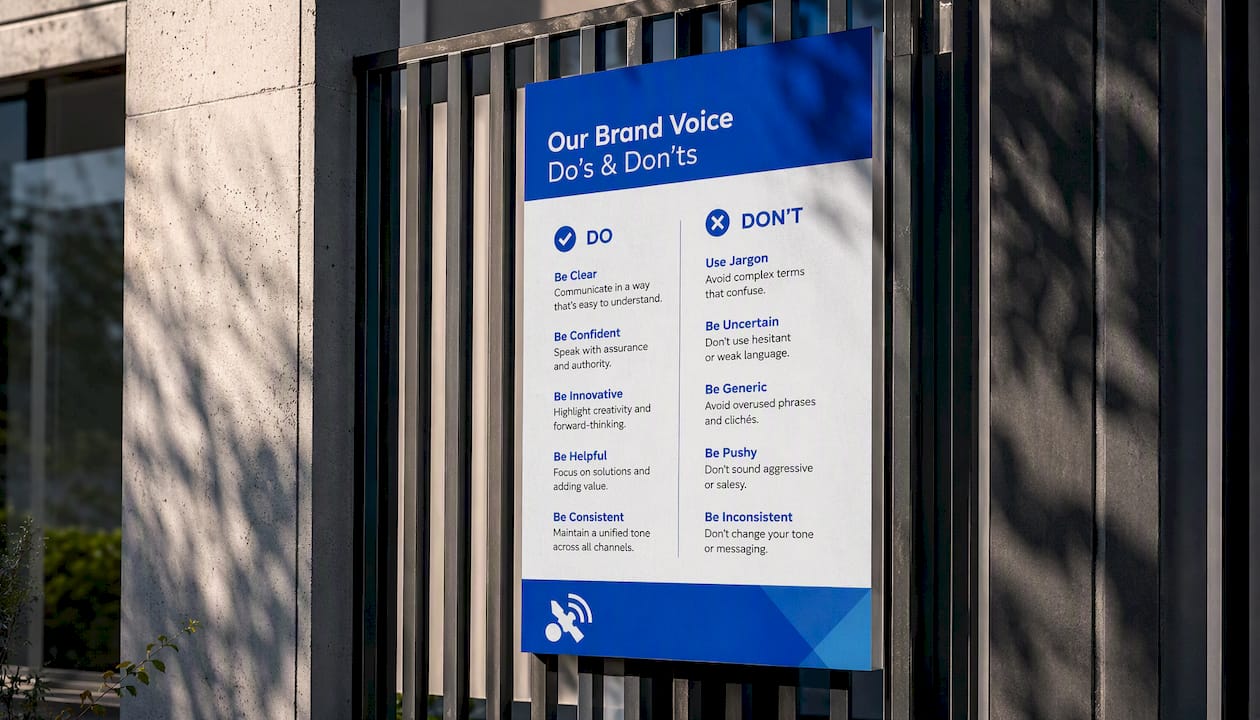
Add a fifth column for channel notes when you adapt the chart for briefs or AI prompts. A prompt fragment might read: “Voice: Approachable Expert. Never use jargon. Always explain the ‘so what’ in the first sentence.”
Mapping Your Voice Across Channels Without Losing It
Voice stays fixed. Tone adjusts by channel and by emotional stakes. The mistake most teams make is treating a channel switch as a personality switch, when it should only be a volume adjustment.
| Channel | Sentence length | Humor | Formality |
|---|---|---|---|
| Social | Short, punchy | High | Low |
| Medium | Moderate | Medium | |
| Product copy | Short to medium | Low to moderate | Medium |
| Support replies | Short, direct | Low during issues | Low, but respectful |
Compare a launch snippet and a support snippet from the same brand: “We just made your mornings 10 minutes shorter. New auto-brew is live.” versus “Totally get the frustration. Here’s exactly how we’re fixing it, no fluff.” Same directness, same short sentences, same personality. One just carries more weight.
What Mailchimp, Slack, and Other Brands Do Well
Studying real brand voices gives you patterns to borrow instead of building from a blank page.
- Mailchimp pairs plain-English rules with channel-specific notes in its public style guide. Borrow: publish your rules externally-ready, and separate voice rules from tone-by-situation guidance.
- Slack writes like a helpful coworker, not software. Borrow: use second person constantly, and favor short sentences over feature-speak.
- Walmart translates broad brand principles into specific voice principles with do/don’t rules built for scale across thousands of contributors. Borrow: write guardrails specific enough that a first-time contractor gets it right on the first try.
- Calm stays quiet and unhurried even in marketing copy. Borrow: match sentence rhythm to the emotional experience you’re selling.
- Liquid Death commits fully to a Bold Minimalist, irreverent voice that never softens for polite company. Borrow: pick a lane and defend it, even when it alienates some buyers.
- La Croix leans Personality-First with playful, almost chaotic social copy. Borrow: let one channel carry more personality risk than your core brand copy.
Mailchimp and Walmart lean Approachable Expert, Liquid Death is Bold Minimalist, and Calm and La Croix each represent different flavors of Personality-First.
How to Govern, Audit, and Update the Guide
Governance is what separates a guide people reference from one that gathers dust after the launch meeting. It comes down to three habits: regular audits, ongoing training, and a review board that owns updates.
Run a quarterly audit against a simple checklist: pull 20 to 50 recent pieces of content, score them against your traits, and track an off-brand incident rate. Sprinklr ties this discipline directly to customer experience outcomes, since inconsistent voice erodes the same trust a documented guide is meant to build.
Training doesn’t need to be elaborate:
- A 30-minute onboarding walkthrough for every new hire or freelancer.
- The voice chart attached directly to every content brief.
- A biannual refresh workshop where the team rewrites recent off-brand examples.
Update the guide itself once or twice a year, not every time someone has a strong opinion about a word choice.
Case Study: What Happened When All City Graphix Rebuilt a Client’s Voice
A client came to All City Graphix with three years of inconsistent copy: formal on the website, casual on social, and inconsistent everywhere else. After a structured rollout, the client reported faster campaign approvals and copy that finally read as one brand across every channel.
The process ran in four stages:
- Discovery: audit existing content and interview stakeholders about brand personality.
- Voice chart: define 4 traits with do/don’t examples and channel notes.
- Rollout: train the internal team and attach the chart to every brief template.
- Follow-up: review a content sample 60 days later and adjust one trait that wasn’t holding up in support copy.
The biggest shift wasn’t a new tagline. It was that briefs got shorter because writers stopped guessing, and review cycles dropped because there was finally a shared reference for what “on-brand” meant.
The actionable takeaway: a voice chart only works if it’s attached to the workflow, not filed away after the kickoff meeting.
Copy-Ready Snippets and Word Lists
Keep a short, prioritized do/don’t list for daily use, not an exhaustive dictionary nobody opens.
Do/don’t basics:
- Do use contractions if your voice is casual; don’t if it’s formal.
- Do lead with the outcome; don’t bury it in the third sentence.
- Do use “you”; don’t default to passive corporate phrasing.
Ready phrases to adapt:
- Welcome email: “Glad you’re here. Here’s exactly where to start.”
- Outage apology: “This shouldn’t have happened. Here’s what we’re doing about it.”
- Launch headline: “The thing you asked for, finally built.”
Keep these snippets and your voice chart together in one shared template so every writer pulls from the same source.
Why Short Guides Beat Long Manuals
The best brand voice work I’ve seen in agency settings never came from a 40-page manual. It came from a single chart someone actually pinned to their desktop. Long documents get read once, during onboarding, then forgotten. Short, specific artifacts get reused every week because they fit inside the actual writing process instead of sitting beside it.
Two things prevent drift over time. First, attach the chart to every brief template rather than trusting people to remember it from a meeting three months ago. Second, run a small quarterly audit, even just 20 pieces of content, because voice erosion happens gradually and nobody notices until the brand sounds like three different companies again.
If your current guide is longer than two pages, that’s worth a hard look before you write another word of it.
Get Your Brand Voice Documented by People Who Do This Daily
Building a voice chart from scratch takes focus most in-house teams don’t have room for between campaigns. Allcitygraphixny runs a workshop-led process, a discovery session, a custom voice chart, and hands-on rollout support, so your team walks away with a working guide instead of a half-finished spreadsheet.

The package includes the audit, the trait definitions, do/don’t examples, and channel notes, all built around how your team actually writes and briefs work. That means faster alignment across departments, fewer review cycles chasing inconsistent copy, and messaging that holds together whether it’s a website page, a social caption, or a support reply. Explore the full service offerings or get in touch through the main site to schedule a discovery call and start building your chart this month.
Frequently Asked Questions
What is a brand voice guide used for?
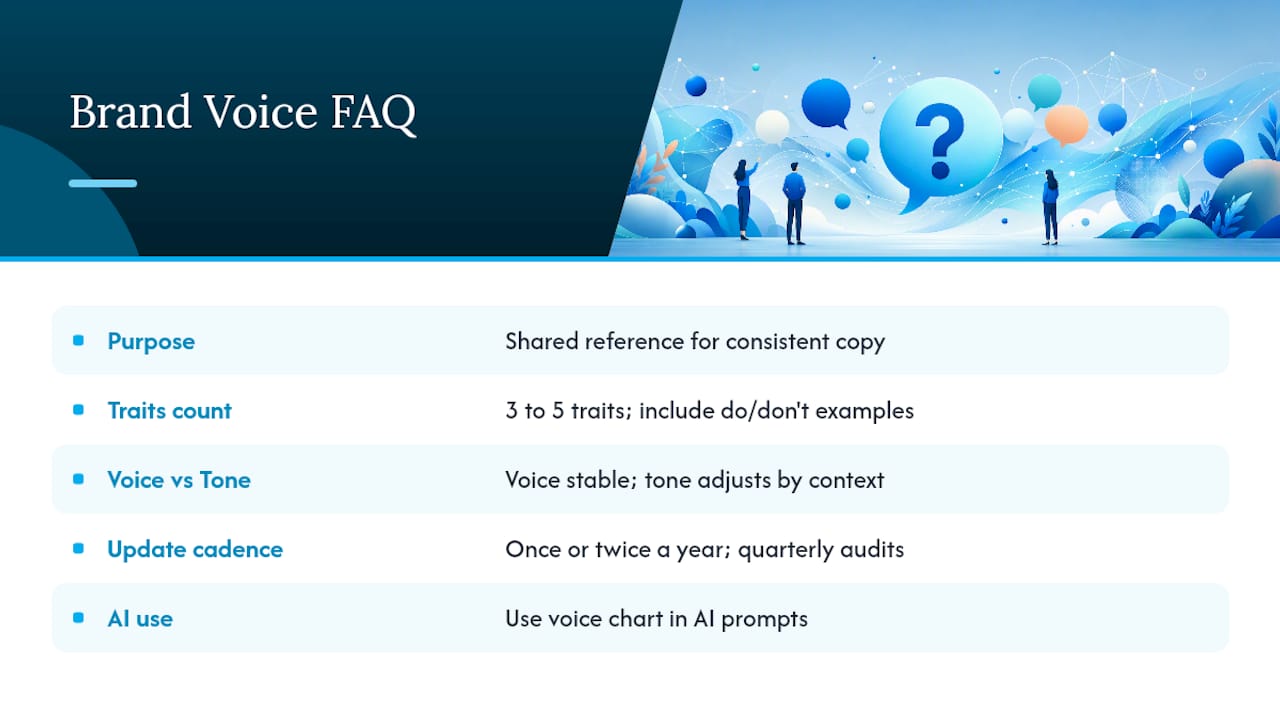
It gives writers, designers, and AI tools a shared reference for how your brand sounds, so copy stays consistent across your website, email, social, and support channels.
How many voice traits should a brand voice guide have?
Most effective guides define 3 to 5 traits, each with a clear limit and a do/don’t example. More than that tends to dilute the guidance and slow adoption.
What’s the difference between brand voice and brand tone?
Voice is the stable personality that never changes. Tone is how that personality adjusts for context, like dialing down humor during a service outage while keeping the same directness.
How often should you update a brand voice guide?
Once or twice a year is usually enough, paired with quarterly content audits to catch drift before it becomes a pattern.
Can a brand voice guide help with AI-generated content?
Yes. Pasting your voice chart into an AI tool’s system prompt or context block keeps generated copy aligned with your traits far better than re-explaining tone each time.
Sources
- Brand Voice Strategy: How to Build Brand Guidelines | Sprinklr
- Brand voice | Hootsuite
- Voice and Tone | Mailchimp Content Style Guide
- Walmart brand voice (Voice principles) | Walmart Brand Center