

A graphic design retainer is a monthly prepaid agreement that gives you predictable design capacity and faster turnaround, ideal when you have recurring design needs but not enough work to justify a full-time hire. Retainers usually come as an hour-bank, a set number of dedicated hours, or an unlimited-queue subscription. Whether one fits your business depends on your monthly volume, and the rest of this guide walks through pricing, contract terms, and a checklist for picking a provider.
TL;DR:
- Retainers typically offer predictable speed and consistency, especially for recurring campaigns, content updates, or branding refreshes, compared to ad-hoc freelancers.
- Pricing models include hourly packages, fixed monthly scopes, and unlimited throughput caps, with no inherent cost advantage but different billing and usage structures.
- Clear contract terms should specify scope, turnaround times, revision limits, ownership rights, rollover policies, and cancellation procedures to prevent disputes.
- Unused hours often expire or rollover, so assessing your monthly workload and ensuring you utilize your hours is crucial to avoid overpaying.
- Transitioning from freelancers to a retainer makes sense if you regularly rehire the same designer, need faster turnaround, and want consistent brand management within a predictable budget.
Table of Contents
- What Is a Graphic Design Retainer, and What Are the Common Models?
- What Are the Benefits of a Retainer, and When Should You Choose One?
- How Does Pricing and Billing Typically Work?
- What Should a Retainer Contract Actually Specify?
- Retainer vs. Full-Time Hire vs. Freelancer: Which Fits Your Workload?
- How Do You Choose and Contract the Right Retainer Provider?
- Moving From Ad-Hoc Freelancers to a Retainer
- Common Pitfalls in Managing a Retainer
- How Do You Measure ROI on a Design Retainer?
- Agency Perspective: How All City Graphix Approaches Retainers
- Get Started With a Design Retainer Built Around Your Brand
- Sources
- FAQ
What Is a Graphic Design Retainer, and What Are the Common Models?
A graphic design retainer is a flat monthly fee that buys you a fixed amount of design time or output, month after month, instead of paying per project or per hour as work comes up. You’re essentially reserving a designer’s or a design team’s capacity ahead of time.
Three formats dominate the market:
- Hour-bank retainers: you prepay for a set number of hours (say, 15 or 20 a month) that get drawn down as you submit requests.
- Dedicated-hours retainers: a designer is blocked off for a fixed daily or weekly chunk of time, whether or not you use every minute.
- Unlimited-queue subscriptions: you submit unlimited requests, but only one or two move through the pipeline at a time, capped by throughput rather than hours.
Most agencies also offer hybrid packages that blend a base hour allotment with overflow billed hourly. The workflow is fairly consistent across models: you submit a request, it enters a queue, the designer delivers a draft, you request revisions within a set limit, and unused hours either roll over for a month or expire, depending on the contract. That rollover-versus-queue distinction is one of the first things to clarify before signing.
What Are the Benefits of a Retainer, and When Should You Choose One?
The biggest advantage isn’t the discount, it’s the speed. A designer who already knows your brand guidelines, tone, and past campaigns doesn’t need a 45 minute briefing call every time you need a social graphic. That familiarity cuts revision cycles and shortens turnaround, a pattern backed by broader research on how reduced context switching speeds up delivery and improves output quality, according to Harvard Business Review.
A retainer arrangement tends to pay off fastest under these conditions:
- You run recurring campaigns (weekly email graphics, monthly newsletters, seasonal promotions) rather than one-off projects.
- Your paid ad creative needs constant refreshing to fight ad fatigue.
- You update collateral often, think sales decks, one-pagers, trade show banners, or packaging refreshes.
- Your workload is steady but unpredictable week to week, too irregular for a full-time hire, too frequent for one-off freelancers.
Budgeting gets simpler too. A fixed monthly line item beats chasing invoices from three different freelancers, and brand consistency improves because one team, not a rotating cast, is producing everything.
How Does Pricing and Billing Typically Work?
Retainer pricing generally falls into three shapes: hourly-banked packages (you buy a block of hours at a set rate), tiered monthly subscriptions (fixed price, fixed scope, fixed cap), and flat unlimited models that cap throughput rather than hours. None of these are inherently cheaper. They just distribute cost differently.
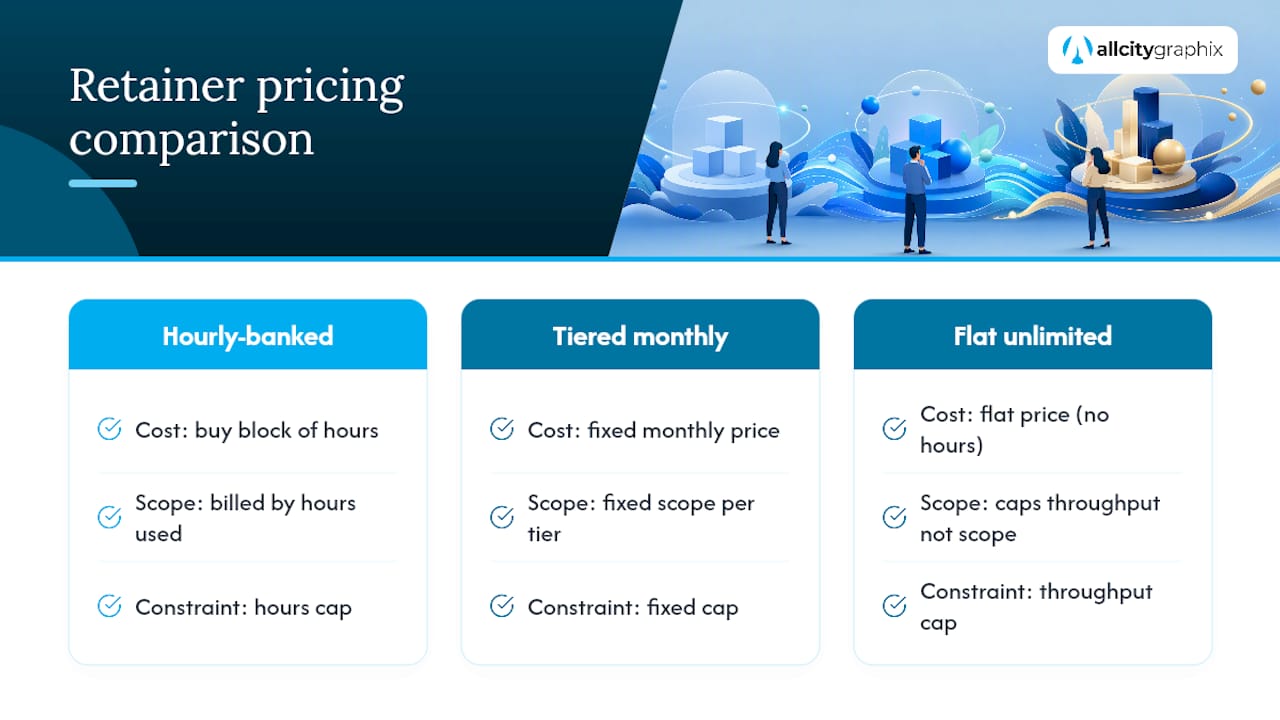
Here’s a simple way to compare options. Take a monthly retainer that includes a set number of hours. Compare that against typical freelancer hourly rates for similar work, and the retainer looks competitive, especially once you factor in that a freelancer’s hourly rate doesn’t include the ramp-up time spent explaining your brand from scratch.
Against a full-time hire, run the math using loaded cost, not salary alone. The Bureau of Labor Statistics tracks employer costs for wages plus benefits, and adding payroll taxes, benefits, and overhead typically pushes total employer cost well above base salary. A retainer breaks even against an in-house hire only when your actual design workload is well below full-time capacity.
Pro Tip: Ask exactly what counts as a “task” or “hour” before signing. A logo revision and a 40-page catalog layout should never draw from the same flat-rate bucket.
Watch for common add-ons that inflate the effective price: rush fees for same-day turnaround, surcharges for complex projects like full identity systems or website builds, and limits on the number of revision rounds per request.
What Should a Retainer Contract Actually Specify?
A vague retainer agreement is where most disputes start. Before signing anything, confirm the contract spells out:
- Included work types (social graphics, print, web assets) and what’s explicitly excluded.
- Turnaround SLAs for standard and rush requests.
- The revision policy: how many rounds per deliverable, and what happens beyond that.
- Ownership and IP: when files and rights transfer to you.
- Billing cadence and what happens to unused hours.
- Cancellation terms and required notice period.
A well-structured sample retainer agreement typically lists an explicit exclusions section, calling out complex brand systems or large web projects that fall outside the base scope. That single clause prevents more scope creep than almost anything else in the document.
Onboarding matters just as much as the contract language. Expect to hand over a brand brief, existing templates, logo files, and font and color specs during week one. Agencies that skip this step tend to burn your first month on guesswork rather than output.
On rollover: some agreements let unused hours carry into the next month (usually capped at 25 to 50 percent), while others expire them outright. Expiring hours push the provider to use your budget efficiently each cycle, but they also punish slow months. Decide which trade-off fits your volume before you sign.
Pro Tip: If a contract doesn’t mention rollover at all, assume it expires. Ask directly, and get the answer in writing.
Retainer vs. Full-Time Hire vs. Freelancer: Which Fits Your Workload?
The right resourcing model comes down to volume, predictability, and how much brand context matters for the work.
- Under 10 hours a month, irregular timing: an ad-hoc freelancer usually wins on cost and flexibility, since you’re not paying for idle capacity.
- 10 to 30 hours a month, recurring needs: this is the retainer sweet spot. You get consistent quality and faster turnaround without carrying a full salary.
- 30+ hours a month, sustained: a full-time hire starts to make financial sense, assuming you can keep that person busy year round.
Cost favors freelancers at low volume and in-house at high volume, but retainers win the middle ground on speed and brand consistency because the same team handles every request. Flexibility runs the opposite direction: freelancers are easiest to scale up or down, full-time hires are the hardest to adjust once hired.
A startup launching one campaign a quarter doesn’t need a retainer. A subscription box brand refreshing packaging and ad creative every month almost always does.
How Do You Choose and Contract the Right Retainer Provider?
Run through this checklist on your first vendor call:
- What exactly is included in scope, and what triggers an extra charge?
- What’s the SLA for standard requests versus rush jobs?
- How many revision rounds come with each deliverable?
- Do unused hours roll over, and for how long?
- Will I have a dedicated designer, or does work rotate through different people?
- What happens to my files and brand assets if I cancel?
- What’s the notice period for ending the agreement?
Pro Tip: Ask for a sample turnaround report from an existing client relationship. A provider confident in their process will show you real numbers, not just a promise.
Red flags worth walking away from: vague SLA language (“we’ll get to it quickly”), no clear answer on IP ownership, throughput caps the provider won’t define in writing, and zero onboarding process. If a vendor can’t tell you how many revisions come standard, assume the number is lower than you’d like.
Moving From Ad-Hoc Freelancers to a Retainer
The transition usually starts with a pattern you notice before you name it: you’re hiring the same freelancer repeatedly, re-explaining your brand every time, and losing days to scheduling back-and-forth. That repetition is the signal to formalize the relationship.
Start by auditing three to six months of past design spend. Add up what you actually paid across every freelance invoice, then divide by total hours worked to get your real blended rate. Compare that number against retainer quotes at a similar hour count. Most businesses find the retainer lands close to or below what they were already spending, minus the friction of managing multiple contractors.
If you’re happy with a current freelancer’s work, ask them directly whether they offer retainer terms. Many independent designers are open to converting an ad-hoc relationship into a monthly agreement, since it gives them predictable income too. If they don’t, that’s the moment to evaluate agency retainers instead, since agencies typically build backup coverage into the contract so a single person’s vacation doesn’t stall your pipeline.
Set a trial period, 60 to 90 days is common, before committing to a longer contract. Use that window to test turnaround speed, communication, and whether the designer actually internalizes your brand guidelines rather than needing reminders on every request.
Common Pitfalls in Managing a Retainer
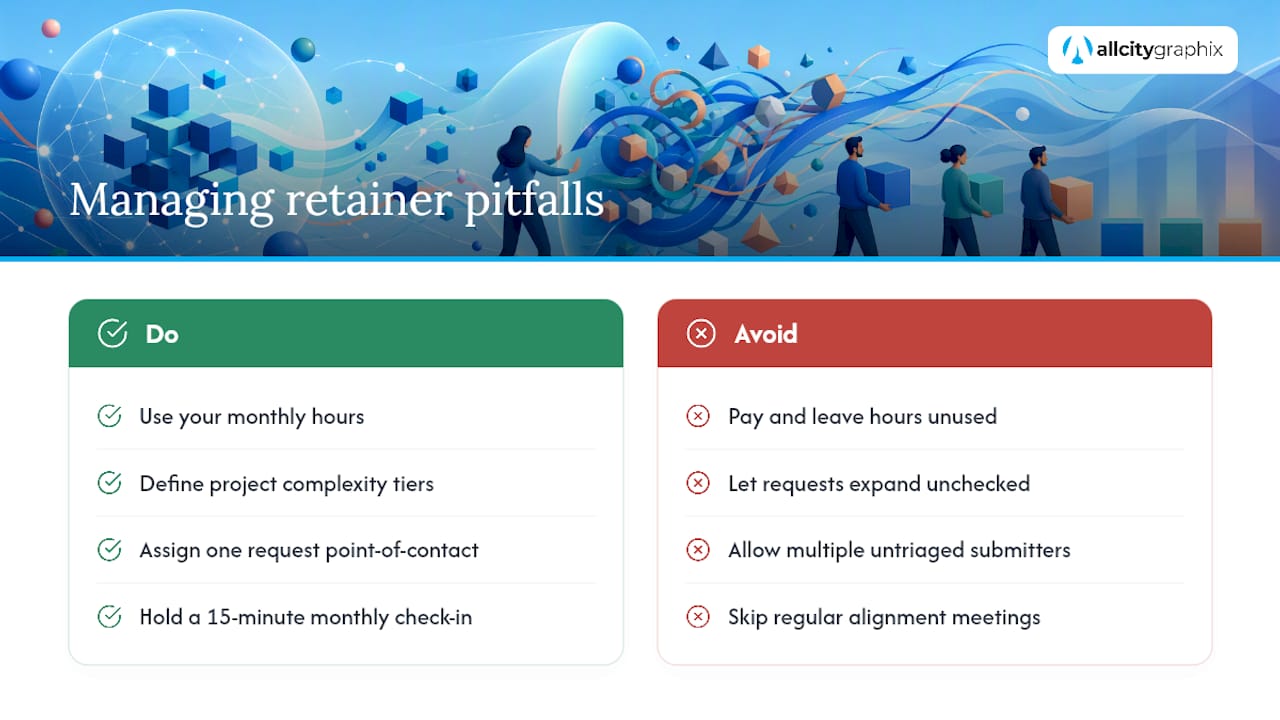
The most common failure mode is simple: businesses forget to use their hours. Paying for 20 hours a month and submitting requests worth eight is the fastest way to make a retainer look like a bad deal on paper, even though the math was fine going in.
Scope creep runs a close second. Requests that started as quick social graphics slowly expand into full campaign builds, and if the contract didn’t define project complexity tiers, arguments over “is this covered” become routine. Revisit your scope language the moment a request feels bigger than what you originally signed up for.
Unclear ownership of the request queue causes friction too. If three people on your team can submit requests independently with no prioritization, the designer ends up guessing what matters most. Assign one point of contact who triages and approves requests before they hit the queue.
Finally, treat the relationship as ongoing, not transactional. Skipping monthly check-ins because “things are running fine” is how misalignment builds quietly until a deliverable misses the mark. A 15-minute monthly call to review upcoming needs and flag anything off-track costs almost nothing and prevents most disputes before they start.
How Do You Measure ROI on a Design Retainer?
Track three numbers monthly: hours used versus hours paid for, average turnaround time per request, and revision rounds per deliverable. If utilization consistently sits below 70 percent, you’re overpaying for capacity you don’t need, and it’s worth renegotiating down to a smaller package.
Turnaround speed is the clearest quality signal. If a routine social graphic that used to take a freelancer three days now takes 24 hours because the designer already understands your brand system, that time savings compounds across every request for the life of the contract.
Beyond speed, look at output consistency: are assets landing on-brand on the first draft, or is every deliverable going through multiple rounds of “make it look more like us”? Fewer revision rounds over time is a sign the relationship is working the way it should. Businesses that never track these numbers tend to keep or cancel retainers based on gut feeling rather than actual performance, which makes it much harder to negotiate a better package later.
Agency Perspective: How All City Graphix Approaches Retainers
At All City Graphix, retainers start with a discovery conversation, not a generic package. We map monthly hours against a client’s real campaign calendar, prioritize requests against agreed goals, and report on turnaround and output monthly so nothing runs on guesswork. Flexibility matters more than rigid tiers: a slow month and a launch month shouldn’t cost the same effort.
Practical tip from that process: a one-page briefing template, covering audience, deadline, and brand references, cuts revision rounds more than almost any other single change a client can make.
— Alex
Get Started With a Design Retainer Built Around Your Brand
If you’ve been piecing together freelancers or letting design requests pile up because there’s no dedicated capacity, a retainer solves the actual problem: no more re-briefing a new person every project, no more waiting a week for a simple asset. Retainer packages are often built around branding, recurring design, and web maintenance, aiming for the team to understand your brand quickly to improve efficiency.
If you want to see how a retainer would map to your monthly workload, request a discovery call and walk through your actual request volume with our team. You can also browse our graphic design services to see the type of work a monthly retainer typically covers, from campaign assets to ongoing brand support.
Sources
- Bureau of Labor Statistics — Employment and earnings releases
- Free Graphic Design Retainer Agreement | PDF | Word — eSign
- Monthly Graphic Design Retainers Explained: Your Guide to Monthly Design Services — Artfully Graphic
FAQ
What Is a Retainer Fee for a Graphic Designer?
It’s a fixed monthly payment that prepays a set amount of design time or output, typically ranging from a few hundred to a few thousand dollars depending on scope and hours included.
Is AI Replacing Graphic Designers?
AI tools speed up parts of the design process, like generating drafts or variations, but strategic branding and client-specific creative judgment still rely on human designers. All City Graphix’s take on balancing AI and human design work covers where each tool fits.
What Is a Retainer Salary?
This term usually refers to a guaranteed minimum payment made to an independent contractor or agency regardless of workload that month, distinct from an hourly wage tied to actual hours logged.
What Is a Retainer Model?
A retainer model is any arrangement where a client prepays monthly for ongoing access to a service provider’s time or output, rather than paying per individual project as it comes up.