
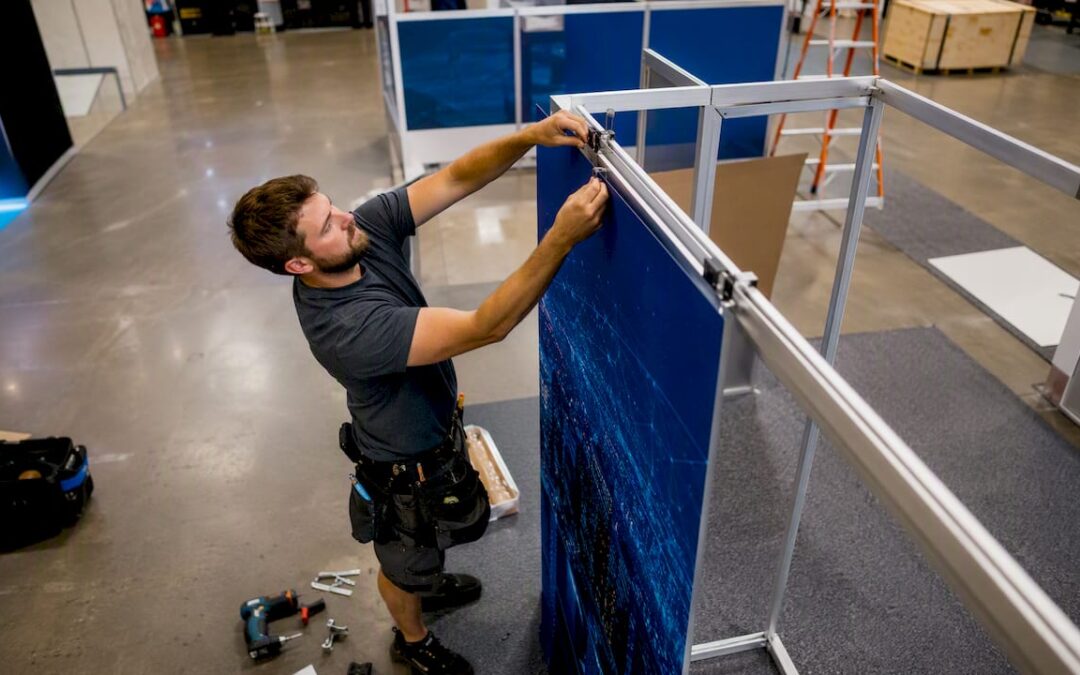
Hire a branding-first agency, not a booth builder chasing pretty renders. The right partner ties every graphic, light, and demo zone back to a measurable outcome: leads collected, meetings booked, deals closed. Freeman’s 2025 trends report found that a significant portion of trade show attendees are final decision-makers or carry real influence, so a booth that only looks good wastes much of the opportunity. All City Graphix builds trade show booth design around that math, with CMYK color proofing baked into every production run so what you approve on screen is what shows up at the venue.
Three moves before you sign anything:
- Confirm your core objective (leads, brand awareness, product launch) and set a real budget range, not a placeholder number.
- Ask for a sample CMYK proof and a written production timeline before you commit.
- Book a discovery call and bring the brief template from the practical tools section below.
Table of Contents
- Why an agency-led, branding-first approach to trade show booth design pays off
- Core booth elements a branding-first agency will deliver
- How does a trade show booth agency engagement actually work?
- What design rules actually win attention on the show floor?
- What lead capture methods actually turn a booth into a sales channel?
- Questions to ask agencies and red flags that should end the conversation
- A copy-paste brief to bring to your first discovery call
- Why All City Graphix approaches trade show booth design differently
- What the research actually says about booth hiring decisions
- Ready to brief an agency that treats your booth like a brand asset
- Frequently Asked Questions
- Sources
Why an agency-led, branding-first approach to trade show booth design pays off
A booth that just looks nice ignores who’s actually standing in front of it. With a substantial share of the crowd holding final purchase authority and many others can influence the decision, a booth has to convert attention into a conversation within seconds, not minutes.
Agencies built for branding, not just fabrication, design the whole visitor path: what someone sees from the aisle, what they read at arm’s length, and what happens when they walk up. That’s different from ordering a backdrop from one vendor and a banner stand from another. A design guide from ExhibitionsVoice makes the case plainly: a solid partner maps visitor flow and sales handoff before a single graphic gets sketched. There’s also a quieter operational payoff. Running production through one design partner instead of three vendors cuts down on mismatched brand colors and last-minute shipping scrambles, which is exactly the kind of thing that ruins a show morning.
Core booth elements a branding-first agency will deliver
Your agency should hand you a full kit, not a single backdrop and a shrug. Here’s what belongs on that list:
- Fabric backdrops or modular walls that carry your logo and message hierarchy
- Retractable banners positioned for aisle sightlines, not just booth corners
- Branded table covers and literature stands that match your color specs exactly
- Feather flags or vertical height elements that pull eyes from across the hall
- A demo zone or interaction point built into the layout, not bolted on afterward
Lighting deserves its own line item. Good agencies design for what a person notices from ten feet away in the first three seconds, since that’s realistically all the attention a passing attendee gives before deciding whether to stop. Custom Ink’s research backs up that window: minimal text, a clear logo, and a value proposition that reads instantly beat a wall of paragraphs every time.
Staff apparel and giveaways matter more than most founders assume. A mismatched polo or an off-brand tote bag undercuts everything the graphics just built.
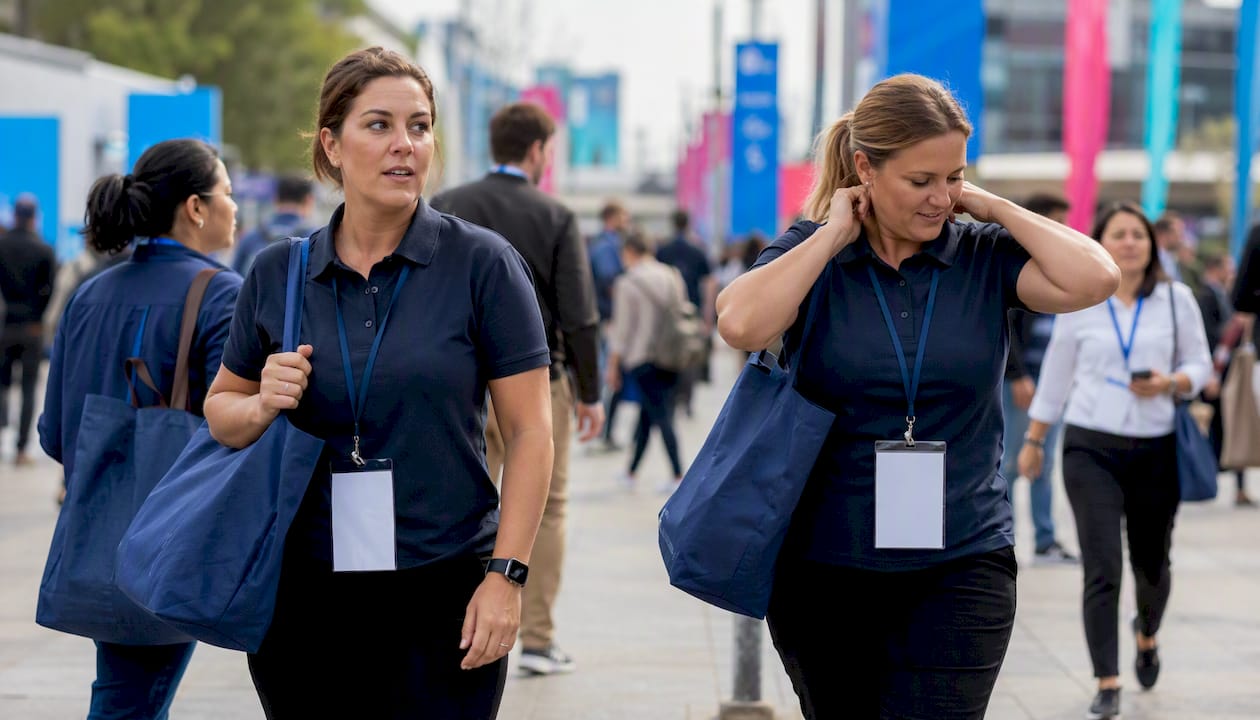
Pro Tip: Ask upfront whether 3D mockups and final print-ready files come with an asset ownership clause. You want the Pantone and CMYK source files in your hands after the show, not locked in a vendor’s archive.
How does a trade show booth agency engagement actually work?
Most engagements move through six phases: discovery, concept, revision, proofing, production, and installation, with a post-show evaluation closing the loop. Show Ready’s process breakdown puts custom full builds generally require several months, while modular or smaller-scope projects can be completed in fewer months. That gap matters for planning. If your trade show is four months out and you’re hoping for a full custom island, you’re already behind.
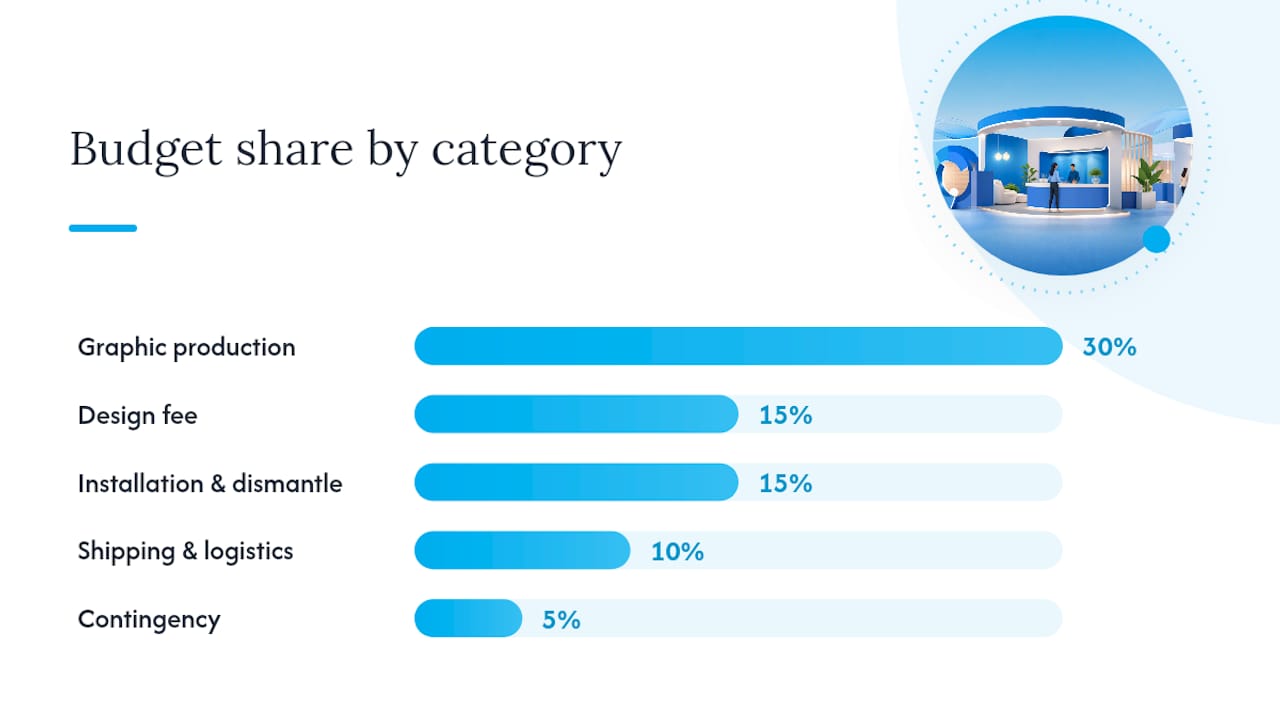
Here’s roughly how the budget breaks down by phase:
| Cost category | What it covers | Typical share of budget |
|---|---|---|
| Design fee | Concept development, 3D mockups, revisions | 15% |
| Graphic production | Large-format printing, CMYK proofing, materials | 30% |
| Shipping and logistics | Freight, crating, insurance | 10% |
| Installation and dismantle | On-site labor, union fees where required | 15% |
| Contingency | Last-minute repairs, rush changes | 5% |
A booth budget without a contingency line isn’t a budget. It’s a bet that nothing will go wrong between the loading dock and show open, and something always does.
Ask for deliverables at each milestone: a written brief after discovery, concept boards after phase two, CAD or 3D mockups before production sign-off, and a logistics plan two to three weeks ahead of the show. A post-show report should land in your inbox within two weeks of teardown.
What design rules actually win attention on the show floor?
Legibility rules aren’t a nice-to-have. They’re the difference between a booth that gets noticed and one that gets walked past. Keep primary messaging readable from ten feet, since that three-second window is what Custom Ink’s data points to as the realistic attention span of someone scanning the aisle. Logo first, one clear value statement, call to action near the bottom, minimal supporting copy.
Color proofing is where a lot of booths quietly go wrong. Convention lighting is brutal on printed color: cool overhead fixtures wash out pastels, push warm tones toward yellow, and flatten reds into something duller than what you approved on a monitor. WillWork’s research on color psychology in booth design confirms that RGB screen mockups just don’t predict what happens under those lights.
- Request a physical CMYK swatch for every large-format print before final approval
- Confirm image resolution at 100 to 150 dpi at full print size, not screen resolution
- Insist on vector or print-ready PDF files, never JPEGs stretched to booth scale
- Get explicit written confirmation of who owns the master files after the show
Pro Tip: If the show venue is known for harsh fluorescent lighting, ask your agency to test a swatch sample under similar bulbs before the final print run. It’s a five-minute check that prevents a very expensive surprise.
What lead capture methods actually turn a booth into a sales channel?
A booth without a lead capture plan is just an expensive photo backdrop. The options worth using: QR codes paired with mobile-friendly forms, tablet-based sign-up apps, badge scanning where the show provides it, and digital raffle or contest entries that double as contact capture. A tool like a QR code generator makes it easy to build a trackable code tied to a specific landing page, so you know which booth element actually drove the scan.
What should get measured and reported back to you: total leads collected, qualified conversations (not just badge scans), meetings scheduled, demo completions, and a post-show conversion rate tied directly to your CRM. Show Ready’s guidance frames these as the metrics that turn a trade show from a cost center into an actual sales channel.
- Keep sign-up forms to three fields or fewer to reduce friction at the booth
- Promise and deliver follow-up within 24 to 48 hours, stated at the point of capture
- Test every integration, from QR redirect to CRM sync, at least a week before show day
- Enrich each lead with booth context (which demo they saw, which rep they talked to)
Questions to ask agencies and red flags that should end the conversation
Ask these on the first call, before you request a proposal:
- What’s your experience in our specific industry, and can you show measurable outcomes from past booths?
- How do you handle proofs and approvals, and will we see a physical CMYK sample before production?
- Who manages freight, installation, and dismantle, and what happens if something arrives damaged?
- What does post-show reporting look like, and how soon after the event do we get it?
- Who owns the design files and physical assets once the show ends?
Contract clauses worth requesting: line-item pricing broken out by phase, a defined number of revision rounds, a written CMYK proof requirement, on-site support terms for the show days themselves, and storage or maintenance options for reuse.
Watch for these red flags:
- Vague timelines with no phase breakdown or milestone dates
- A single lump-sum quote instead of itemized pricing
- Reluctance to provide a physical color proof or client references
- No contingency plan mentioned for on-site damage or last-minute changes
ExhibitorOnline’s reporting is blunt about the cost of skipping this step: low-ball or lump-sum quotes routinely hide logistics and on-site fees that inflate the final bill by 30% or more. Standardized, line-item proposals are the only way to compare vendors honestly.
A copy-paste brief to bring to your first discovery call
Share this before the call so the conversation stays focused instead of circling back to basics.
Brief fields to fill in:
- Objective (lead generation, brand awareness, product launch)
- Target audience and industry
- Key message in one sentence
- Booth size and show location
- Required deliverables (backdrop, banners, demo zone, apparel)
- Budget range
- Deadline for production-ready files
- KPI targets (leads, meetings, demo completions)
| Deliverable to confirm | Why it matters |
|---|---|
| 3D mockups | Sets visual expectations before production |
| Production-ready files (CMYK/Pantone) | Prevents color mismatch at print |
| Logistics plan | Covers freight, crating, and arrival timing |
| Install/dismantle crew | Confirms on-site labor is handled |
| Lead-capture integration | Ensures CRM sync works before show day |
| Post-show analytics report | Delivers the KPI data you need |
Bring this list to the proposal stage and flag anything a vendor’s quote is missing. It’s the fastest way to spot a gap before you sign.
Why All City Graphix approaches trade show booth design differently
All City Graphix runs every booth project through the same sequence: discovery, a brand audit, concept-to-production oversight, and a post-show report that ties back to your KPIs. Fifteen-plus years of agency work means the CMYK checks and file-ownership clauses aren’t an afterthought. They’re standard on every proposal.
A booth is a three-day brand experience built on a six-month timeline. Treat it like a marketing investment, not a line item you fill the week before the show.
If you’re ready to move past renders and get a real production plan, book a discovery call or review past booth and event work before you commit.
What the research actually says about booth hiring decisions
Most advice on trade show booths obsesses over the visual, the backdrop color, the banner font, the flag height. That’s not wrong, but it’s incomplete. The data on decision-makers on the floor says the bigger risk isn’t a mediocre design. It’s a booth that never gets read in the first three seconds, because nobody built it around that constraint.
The conventional wisdom also underweights the operational side. Founders will spend weeks on graphic concepts and then sign a lump-sum quote without asking who owns the files or what happens if a shipment gets delayed. That’s backward. The contract terms, the proof process, the freight plan, those decide whether your booth exists on show morning at all.
If you take one thing from this: prioritize the vendor who asks about your sales pipeline before they ask about your color palette. That question order tells you whether you’re hiring a fabricator or a partner.
Ready to brief an agency that treats your booth like a brand asset
There’s no shortage of booth builders who’ll quote you a backdrop and a banner stand. All City Graphix builds trade show booth design differently: one team handles branding, graphics, and production oversight from discovery through post-show reporting, so you’re not juggling three vendors and hoping the colors match on-site.
That means one point of contact for your logo and brand assets, one production run with CMYK proofing built in, and a services page that spells out exactly what’s included at every phase. If your show is coming up and you’d rather not gamble on a vendor with no contingency plan, bring the brief from this article to a discovery call. Start there, and get a real timeline and budget before you sign anything.
Frequently Asked Questions
How much does professional trade show booth design cost?
Costs vary widely by scope, but a typical budget splits design fees generally account for a portion of the budget, with graphic production, shipping, installation, and contingency also requiring allocated funds. Modular projects run lower than full custom builds.
How far in advance should I start planning trade show booth design?
Custom full builds typically take six to nine months from discovery to installation, according to Show Ready’s process guide. Modular or smaller-scope projects can be completed in one to three months, but starting earlier always gives more room for proofing and revisions.
What’s the difference between RGB mockups and CMYK proofs?
RGB is how color displays on a screen. CMYK is how ink actually prints. Convention lighting distorts printed color further, so a screen mockup can look nothing like the finished graphic under venue lights. Always request a physical CMYK swatch before approving large-format prints.
What KPIs should I ask my agency to track?
Leads collected, qualified conversations, meetings scheduled, demo completions, and post-show conversion rate tied to your CRM. A good agency reports these back within two weeks of the show closing.
What red flags mean I should walk away from a booth design vendor?
Vague timelines with no phase breakdown, a single lump-sum quote instead of line-item pricing, refusal to provide a physical color proof, and no contingency plan for on-site issues are all reasons to keep looking.
Sources
- Trade Show Booth Design: Pop-Ups, Backdrops & Display Ideas – Custom Ink Blog
- Trade Show Booth Design Guide 2026 | ExhibitionsVoice Blog
- Trade Show Booth Design Process: A Complete Guide from Concept to Installation | Show Ready
- Psychology of color in trade show booths — WillWork
- ExhibitorOnline article on vendor quotes and post-show billing