

A small business marketing plan is a short, action-focused document that links one clear business outcome to a specific audience, a core offer, two or three channels, a weekly task list, and a budget you can actually defend. That’s it. Not a 30-page deck nobody reads after January. A working document you open every Monday.
Here’s the seven-step roadmap the rest of this article unpacks in full:
- Executive summary (write this last)
- Brand message and positioning
- Target customers and buyer personas
- Situational analysis (SWOT + competitor snapshot)
- Marketing goals and SMART KPIs
- Channels, tactics, and a 90-day calendar
- Budget, measurement, and review cadence
The SBA marketing plan example is a free, downloadable PDF you can copy right now. Adapt it by cutting every section to one paragraph and replacing annual targets with 90-day milestones. Write the executive summary after you’ve filled in every other section.
Pro Tip: Download the SBA template before you read another word. Open it in a second tab. Fill in what you already know as you work through each section below.
Key Takeaways
A focused, one-page small business marketing plan with a 90-day execution window and weekly KPI reviews is the fastest route from ideas to paying customers.
| Point | Details |
|---|---|
| One goal, one audience | Commit to a single SMART objective and one primary persona before choosing any channel. |
| 90-day sprints beat annual plans | Break goals into quarterly chunks with weekly tasks; review every Monday for 15 minutes. |
| Start with two channels | Audience fit and cost to test determine your first two channels; add a third only after one converts. |
| Budget with a kill threshold | Set a cost-per-lead ceiling before launch; pause any campaign that exceeds 2x your target after 30 days. |
| Allcitygraphixny executes the plan | For small businesses ready to run a 90-day sprint, Allcitygraphixny provides branding, web design, SEO, and campaign creative under one roof. |
Table of Contents
- What does a marketing plan actually do for a small business?
- How to write your executive summary (and why you should write it last)
- How to build your brand message and positioning
- How to define your target customers and buyer personas
- How to run a quick SWOT and competitor snapshot
- How to write SMART marketing goals and pick the right KPIs
- Which channels should you choose for a small budget?
- How to build a 90-day campaign calendar and brief
- How to set a marketing budget and estimate ROI
- What to track, which tools to use, and how often to review
- Sample marketing plan template: SBA example and a one-page version
- How a focused plan turned a restaurant’s marketing into real bookings
- How to implement, review, and update your plan
- Why a focused, reviewable plan beats a long unused document
- How Allcitygraphixny helps you build and execute your plan
- Sources
What does a marketing plan actually do for a small business?
Most small business owners already market. They post on Instagram, run the occasional Google ad, hand out cards at events. The problem isn’t effort. It’s that the effort isn’t connected to a single outcome, so nothing compounds.
A plan fixes that by forcing three decisions most owners skip:
- Which one metric matters most this quarter (leads, bookings, repeat orders)
- Which two or three channels will get you there instead of spreading thin across six
- What you’ll stop doing when a channel isn’t pulling its weight
One-page and 90-day plans outperform long annual decks for small teams because they’re reviewable. OutcomeRM’s guide to small business marketing makes the case plainly: a plan you can read and act on in 10–20 minutes weekly drives more follow-through than a comprehensive document that lives in a drawer. The SBA’s marketing and sales guidance reinforces this by framing the plan as a persuasion tool, not an internal report. It should answer: why would a customer choose you, and how will you reach them?
Predictable ROI, channel discipline, and repeatable campaigns are the practical payoffs. Accountability is the hidden one. When the plan is one page, there’s nowhere to hide a channel that isn’t working.
How to write your executive summary (and why you should write it last)
The executive summary is two to four sentences that capture the entire plan at a glance. It’s the section stakeholders, partners, and lenders read first, which is exactly why you shouldn’t write it first.
Write it last. Every other section of the plan forces a decision: who the customer is, what the offer is, which channels you’re betting on. The executive summary should reflect those decisions, not guess at them before you’ve made them. The UH SBDC Marketing Plan Template explicitly recommends this sequence.
What belongs in those two to four sentences:
- The core business outcome you’re chasing this quarter (e.g., “generate 40 qualified leads per month”)
- Who the target customer is (one sentence, specific)
- The core offer and its primary differentiator
- The top one or two channels and the headline budget
A short example for a local HVAC company:
“Our 90-day goal is to book 25 new residential service contracts in the Bronx by targeting homeowners aged 35–60 who search for emergency HVAC repair. We’ll reach them through Google Local Services Ads and a referral incentive program, with a combined monthly budget of $1,200. Success is measured by cost per booked appointment, tracked weekly.”
That’s it. Three sentences, every decision named, no filler.
Pro Tip: After you draft the summary, read it aloud to someone who doesn’t know your business. If they can’t tell you what you sell, who you sell it to, and what you want to happen in 90 days, rewrite it.
How to build your brand message and positioning
Brand messaging isn’t a tagline exercise. It’s the answer to one question your customer is silently asking: “Why you, and not the other option I just Googled?”
Start with a one-sentence position statement built on this frame:
For [specific customer], [your business] is the [category] that [primary benefit] because [proof point].
A local bookkeeper might write: “For freelancers in New York who dread tax season, we’re the accounting firm that files cleanly and on time because we specialize in self-employed clients and nothing else.”
From that sentence, pull two or three value propositions tied to real customer problems:
- Speed: “We turn around quarterly reports in 48 hours.”
- Specialization: “We only work with freelancers, so we know every deduction you’re missing.”
- Simplicity: “One flat monthly fee, no surprise invoices.”
Tone and visual cues should map to where you’re showing up. Email rewards warmth and specificity. Your website homepage needs the position statement in the first screen, no scrolling required. Social media, especially Instagram or TikTok, rewards personality over polish. A logo and brand identity that’s consistent across all three channels reduces the cognitive load on a customer who sees you in three different places before they decide to call.
The messaging template to copy:
- Headline: One benefit, not a feature (e.g., “Tax prep built for freelancers”)
- Short value statement: One sentence expanding the headline
- Proof point: A number, a credential, or a specific result
How to define your target customers and buyer personas
A buyer persona is only useful if it’s built on real signals, not guesses. The minimal fields that actually drive decisions:
- Name and basic demographics (age range, location, income bracket)
- Trigger: What specific event made them start searching for your solution?
- Where they search: Google, Yelp, Instagram, referral from a friend?
- Objection: What’s the one thing that makes them hesitate?
- Lifetime value signal: Are they a one-time buyer or a repeat customer?
Prioritize segments by three criteria: frequency of purchase, average order value, and ease of reach. The segment that scores highest across all three is the one to test first. Don’t try to serve three personas in the first 90 days.
A worked example for a local restaurant:
Lifetime value: $60–$80/month if she becomes a regular.
Validate this quickly. Run a five-question survey via Google Forms to your last 20 customers. Ask what triggered their first visit, where they found you, and what almost stopped them. Three sales calls or DM conversations will surface patterns faster than any demographic report.
How to run a quick SWOT and competitor snapshot
A situational analysis doesn’t need a full day. A focused SWOT takes about an hour if you collect the right evidence first.
For each quadrant, answer one specific question:
| Quadrant | The question to answer | Evidence to collect |
|---|---|---|
| Strengths | What do you do that customers mention unprompted? | Google reviews, repeat purchase data, referral sources |
| Weaknesses | Where do customers drop off or complain? | Refund requests, negative reviews, low-traffic pages |
| Opportunities | What demand exists that you’re not capturing? | Keyword gaps, underserved neighborhoods, seasonal spikes |
| Threats | What’s changing in your market or cost structure? | Competitor ad spend, rising supplier costs, platform algorithm shifts |
For the competitor snapshot, you don’t need to name competitors in your plan. What you need is a read on three things: where they’re showing up (channels), what they’re saying (messaging gaps you can exploit), and roughly where they’re priced. Free tools that cover this without a subscription: Google Search (search your own keywords and read the ads), Google Business Profile (check review counts and recency for nearby businesses), and Semrush’s free tier for basic traffic estimates.
Free data sources worth bookmarking:
- Google Trends for seasonal demand patterns
- Google Business Profile Insights for your own search and map visibility
- Meta Ad Library to see what competitors are running on Facebook and Instagram
- Yelp and Google Reviews for customer language you can mirror in your own copy
How to write SMART marketing goals and pick the right KPIs
Vague goals produce vague results. “Get more customers” is not a marketing goal. “Generate 30 qualified leads per month by August 31 through Google Local Services Ads and email referrals” is.
The SMART framework applied to marketing:
- Specific: Name the metric (leads, bookings, email subscribers, repeat orders)
- Measurable: State the number (30 leads, 15% open rate, $4,000 in monthly revenue)
- Achievable: Check it against your current baseline before committing
- Relevant: Tie it to a revenue outcome, not a vanity metric
- Time-bound: Set a 30, 60, or 90-day deadline
KPIs by funnel stage:
- Discovery: Organic search impressions, Google Business Profile views, social reach
- Engagement: Website sessions, email open rate, time on page, click-through rate
- Conversion: Lead form submissions, phone calls, booked appointments, purchase rate
Check discovery metrics monthly. Engagement metrics weekly. Conversion metrics every single week, because that’s where money is either appearing or disappearing.
A simple weekly scorecard has five rows: goal, current number, target, gap, and one action to close the gap. Run it in a Google Sheet. It takes 15 minutes. The discipline of doing it weekly is what separates owners who grow from owners who stay busy.
Which channels should you choose for a small budget?
The decision framework is four questions, in this order:
- Audience fit: Is your customer actually on this channel, and do they use it to find businesses like yours?
- Cost to test: Can you run a meaningful test for under $300?
- Time to conversion: How long from first touch to first purchase on this channel?
- Measurability: Can you track what happens after someone clicks or calls?
Channel roles, briefly:
Local SEO is the highest-ROI starting point for any business with a physical location or a defined service area. It’s slow (three to six months to move the needle) but compounds. Google Local Services Ads convert faster and cost per lead is trackable. Email is the best channel for repeat business. Referral programs are underused and often outperform paid ads for service businesses. Social media builds awareness but rarely converts cold audiences directly.
Three industry micro-examples:
Retail boutique: Instagram (product discovery) + Google Shopping (purchase intent) + email (repeat buyers). Skip LinkedIn entirely.
Local restaurant: Google Business Profile (maps and reviews) + Instagram (food photography) + one monthly email to the loyalty list. Restaurant marketing lives and dies on local search visibility and photo quality.
B2B service (contractor, consultant): LinkedIn + Google Search Ads + referral program. Cold social rarely works here. Warm introductions and search intent do.
Pro Tip: Pick your top two channels before you build the 90-day calendar. Every tactic in the calendar should map back to one of those two. If it doesn’t, cut it.
How to build a 90-day campaign calendar and brief
A 90-day plan forces prioritization in a way a 12-month plan never does. Ahrefs’ one-page marketing plan guide recommends breaking annual goals into quarterly chunks with specific task and cost estimates. Here’s how to do it.
Sample 90-day calendar for a local service business (goal: 30 leads/month):
- Week 1–2: Claim and optimize Google Business Profile; audit website contact page; set up call tracking.
- Week 3–4: Launch Google Local Services Ads with a $500 test budget; set up Google Analytics 4 (GA4) conversion tracking.
- Week 5–6: Send first email to existing customer list with a referral offer; collect five Google reviews.
- Week 7–8: Review ad performance; pause underperforming keywords; double budget on top performer.
- Week 9–10: Run a simple A/B test on the ad headline (benefit-led vs. price-led).
- Week 11–12: Monthly review; adjust budget allocation; plan next 90-day sprint based on what worked.
Campaign brief template (copy this into a Google Doc):
- Goal: What specific outcome does this campaign drive?
- Audience: Which persona, and what’s their trigger?
- Offer: What are you asking them to do, and what do they get?
- Creative: Headline, image or video, call to action
- Channel: Where does this run?
- Budget: Total spend and weekly allocation
- KPI: The one number that tells you if this worked
- Owner: Who is responsible for execution?
- Deadline: When does this go live, and when does it end?
Launch checklist before any campaign goes live:
- Tracking is confirmed (GA4 goal, call tracking, or UTM parameters)
- Landing page matches the ad’s promise exactly
- Mobile experience tested on an actual phone
- Budget cap set so spend can’t run away overnight
- Review date scheduled in the calendar
For A/B tests, keep it simple: one variable at a time. Test the headline first, then the image, then the offer. Never test two variables simultaneously or you won’t know what moved the needle.
How to set a marketing budget and estimate ROI
Budget rules of thumb for small businesses:
- Percent of revenue: Allocate 7–10% of gross revenue to marketing if you’re in a growth phase. Maintenance-mode businesses often run at 3–5%.
- Test budget: Before committing to a channel, run a 30-day test at the minimum viable spend (often $200–$500 for paid search or social).
- Time-cost accounting: If you’re doing the marketing yourself, count your hours at your effective hourly rate. A 10-hour-per-week social media effort at $75/hour is a $3,000/month marketing investment, even if no cash changes hands.
Prioritize spend toward channels with the shortest path to a paying customer. For most local service businesses, that’s Google Local Services Ads first, email second, and organic social third.
Worked ROI example:
That math is simple enough to run in five minutes. Do it before you commit to any channel, and again after the first 30 days to see if reality matches the estimate.
Pro Tip: *Build a “kill threshold” into every campaign before it launches.
What to track, which tools to use, and how often to review
The minimum measurement stack for a small business costs nothing:
- Google Analytics 4 (GA4): Website traffic, source/medium breakdown, goal completions
- Google Business Profile Insights: Search impressions, map views, direction requests, calls
- Email platform metrics: Open rate, click rate, unsubscribe rate (Mailchimp, Klaviyo, or Constant Contact all surface these natively)
- Ad platform dashboards: Google Ads, Meta Ads Manager, or Google Local Services Ads dashboard for cost per click and cost per lead
What to track and when:
- Weekly: Conversion metrics (leads, calls, bookings), ad spend vs. budget, email click rate
- Monthly: Organic search impressions, Google Business Profile views, website sessions by source
- Quarterly: Revenue attribution by channel, customer acquisition cost, repeat purchase rate
Simple report template (15 minutes, every Monday):
- Total leads this week vs. last week
- Top-performing channel (by leads or conversions)
- Budget spent vs. budget planned
- One thing that worked, one thing to fix
Pro Tip: Set up a shared Google Sheet with five columns: metric, last week, this week, target, and action. Share it with anyone involved in execution. Visibility alone changes behavior.
Sample marketing plan template: SBA example and a one-page version
The SBA marketing plan example PDF is the most credible free template available for U.S. small businesses. It walks through every section with field prompts and shows how a complete plan looks when filled in. Download it, then adapt it.
How to convert the SBA template to a one-page, 90-day plan:
- Cut each section to one paragraph or five bullet points maximum
- Replace annual revenue targets with 90-day milestones
- Remove sections that don’t apply to your stage (e.g., international distribution if you’re a local service business)
- Add a weekly task column to the tactics section
Condensed fillable template (copy into a Google Doc):
- Business name and date:
- 90-day goal: [One SMART objective]
- Target customer: [One persona, three sentences]
- Core offer: [What you sell and why it’s different]
- Top channels (2–3): [Named, with rationale]
- Monthly budget: [Total, broken by channel]
- Weekly tasks: [Three to five actions per week]
- KPIs: [Three metrics, with targets and review frequency]
- Executive summary: [Write this last, two to four sentences]
The Smart Insights free 3-page template organizes planning around Opportunity, Strategy, and Action (the RACE framework) and includes a 90-day action plan structure. It’s a strong complement to the SBA example if you want a second format to compare.
How a focused plan turned a restaurant’s marketing into real bookings
A New York restaurant came to Allcitygraphixny with a common problem: solid food, thin foot traffic, and no clear sense of which marketing effort was actually bringing people in. The owner was posting on Instagram daily, running occasional Facebook ads, and relying on word of mouth. None of it was connected to a single goal.
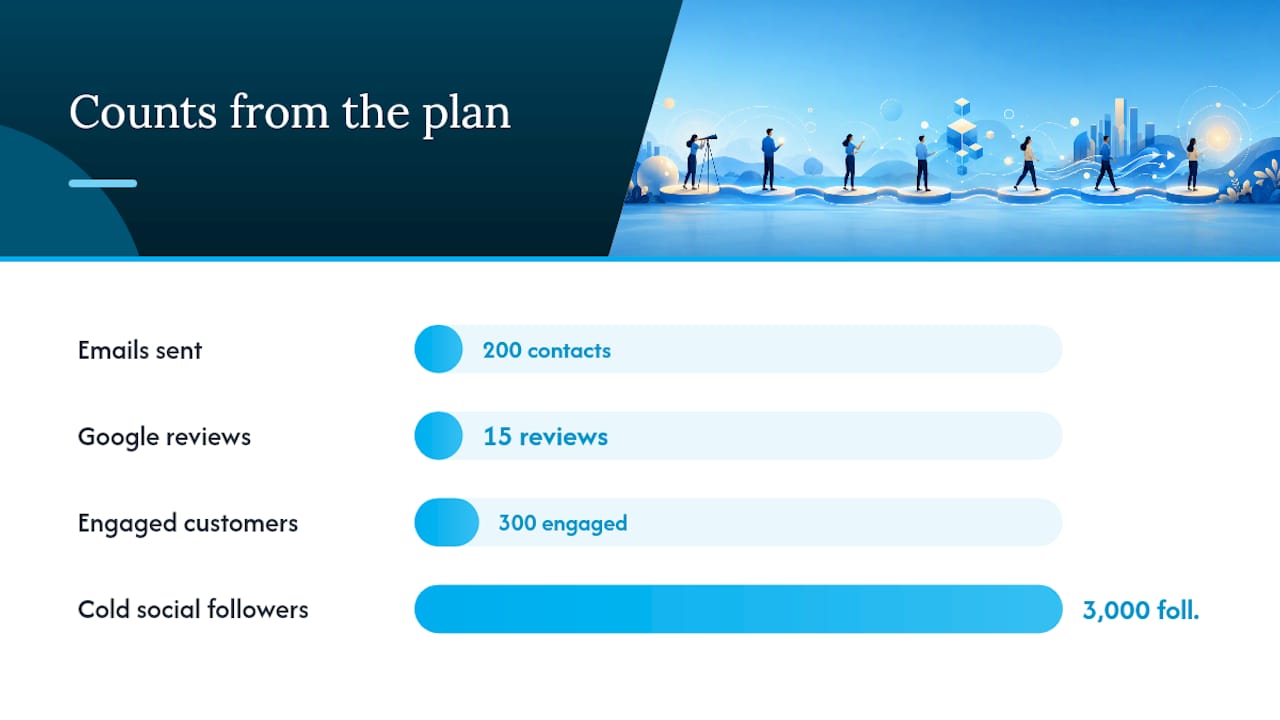
The one-page plan deployed in 90 days focused on one outcome: increase weekday dinner covers significantly. The audience was defined as local professionals within a specific age range and neighborhood radius who searched for relevant terms on Google Maps.
The 90-day actions:
- Month 1: Claimed and fully optimized the Google Business Profile with new photos, updated hours, and a response to every existing review. Set up call tracking.
- Month 2: Launched a Google Local Services presence and a simple email capture at the point of sale (a QR code on the check). Sent the first email to 200 existing contacts with a weekday dinner offer.
- Month 3: Ran one Instagram promotion tied to a specific dish, with a booking link in bio. Collected 15 new Google reviews through a post-visit follow-up text.
Three lessons for any small business owner:
- Test local SEO before paid ads. Google Business Profile optimization costs nothing and often moves faster than expected for local searches.
- Email is underused in food and retail. A list of 300 engaged customers is worth more than 3,000 cold social followers.
- The most common execution pitfall is switching channels too early. Give each tactic 30 days before you judge it.
How to implement, review, and update your plan
A plan without a governance model is just a document. Assign roles before the first week begins.
Role assignments:
- Owner: Sets the 90-day goal, approves budget, attends monthly review
- Marketer or contractor: Executes weekly tasks, manages ad platforms, writes copy
- Creative (designer or agency): Delivers assets on the campaign brief timeline
- Analyst: Pulls the weekly scorecard, flags KPI deviations
Meeting cadence:
- Weekly (15 minutes): Review the scorecard. Is spend on track? Are leads coming in? One action item per person.
- Monthly (60 minutes): Deep review. What’s working, what’s not, what needs to change in the next 30 days?
- Quarterly (half day): Full reset. New 90-day goal, updated personas, revised budget.
30/60/90 review items:
- Day 30: Is tracking working? Are early KPIs moving in the right direction?
- Day 60: Is cost per lead within range? Are any channels underperforming?
- Day 90: Did you hit the goal? What’s the next sprint?
Red flags that require an immediate pivot:
- Cost per lead is more than 2x your target after 30 days
- Click-through rate on ads is below 1% after two weeks of optimization
- Email open rate drops below 15% for two consecutive sends
- Customer feedback (reviews, direct messages) surfaces a consistent complaint about the offer or experience
Pro Tip: Put the monthly review on the calendar before the plan launches. A review that isn’t scheduled doesn’t happen. Treat it like a client meeting.
Why a focused, reviewable plan beats a long unused document
There’s a version of marketing planning that feels productive but produces nothing. It’s the 40-page strategy deck with a brand pyramid, a competitor matrix, and a five-year vision. It takes three weeks to write, gets presented once, and lives in a shared drive folder nobody opens again.
The small businesses that actually grow from their marketing plans share one habit: they review them weekly. Not because they’re disciplined by nature, but because the plan is short enough that reviewing it takes less time than avoiding it.
The real value of a one-page plan isn’t the page. It’s the constraint. When you can only name one goal, one audience, and two channels, you’re forced to make real decisions instead of listing possibilities. Most marketing plans fail not because the strategy was wrong, but because execution never started. A plan you can act on in 10 minutes is a plan you’ll actually act on.
Signs it’s time to bring in an agency: you have a plan but no time to execute it; you’ve been on the same two channels for six months with no creative refresh; or your cost per lead is rising and you don’t know why. Those aren’t signs of failure. They’re signs the business has outgrown what one person can manage alone.
How Allcitygraphixny helps you build and execute your plan
Knowing what to do and having the capacity to do it are two different problems. Allcitygraphixny works with small businesses that have a clear 90-day goal but need a team to execute it: brand identity that holds up across channels, a website built to convert, local SEO that moves Google Business Profile rankings, and campaign creative that matches the brief.
The engagement starts with a discovery call, not a proposal. Allcitygraphixny’s team maps your current position, identifies the two or three execution gaps holding back growth, and builds a creative and digital plan around your 90-day goal. Services span branding, logo design, web design and development, digital marketing, SEO, and ongoing maintenance. One team, one point of contact, no handoff between a strategy firm and a production shop.
This works best for small businesses that are ready to commit to a 90-day execution window and want measurable results, not just deliverables. Book a discovery call or review the full services overview to see where Allcitygraphixny fits your plan.
Sources
The resources below are the primary references for this article. Each serves a different stage of the planning process.
- Marketing plan example | U.S. Small Business Administration
- UH SBDC Marketing Plan Template v2
- Small Business Marketing Plan: How to Build One That Gets Customers | OutcomeRM Blog
- The Insanely Simple One-Page Marketing Plan | Ahrefs
- Free 3-page marketing plan template for a small business | Smart Insights