

A brand audit checklist gives you a scored view of visual identity, messaging, digital presence, competitive positioning, and customer perception, then turns those scores into a ranked list of fixes. Run correctly, it produces a 25-point audit and a 30/60/90 action plan with named owners. A compact version takes a small cross-functional team one to two weeks; the person who should run it is your brand lead, paired with reps from marketing, product, and customer success.
TL;DR:
- A brand audit assesses visual identity, messaging, digital presence, competitor positioning, and customer perception to identify key gaps and improvement areas.
- Internal and customer data, including website metrics, reviews, and employee feedback, are crucial for a baseline and to track progress over time.
- Visual consistency, website SEO, and third-party listing accuracy often reveal quick wins that can be fixed within a week, especially when properly inventoried.
- Comparing your brand to selected peers on messaging and visibility uncovers opportunities for differentiation and targeted digital improvements.
- A structured action plan ranks fixes by impact and effort, with clear owners and KPIs, ensuring tangible progress rather than just a report.
Table of Contents
- How to Prepare for a Brand Audit Checklist
- Gathering Internal Data and Baseline Metrics
- Reviewing Visual Identity and Collateral
- Auditing Your Digital Presence: Website, SEO, Social, and Listings
- Benchmarking Against Competitors
- Collecting Customer and Stakeholder Feedback
- Mapping Intended Brand vs. Perceived Brand
- Scoring and Prioritizing Your Findings
- Turning the Audit Into a 30/60/90 Action Plan
- How All City Graphix Runs a Brand Audit for Clients
- Legal and Trademark Review of Brand Elements
- Assessing the Financial Impact of Brand Performance
- Employee Brand Perception and Internal Alignment
- When to Run a Full Audit vs. a Quick Pulse Check
- Want the Audit Done for You? All City Graphix Runs It Start to Finish
- Templates and Frameworks Worth Bookmarking
- Sources
- FAQ
How to Prepare for a Brand Audit Checklist
Before anyone touches a logo file or pulls a spreadsheet, decide what the audit is actually for. An audit tied to a stalled rebrand looks different from one triggered by a sales slump or a new competitor eating your market share. Vague objectives produce vague action plans, so write the objective down in one sentence before you schedule a single meeting.
You also need to pick a scope. A full audit hits all 25 points across five categories: visual identity, messaging, digital presence, competitive positioning, and customer perception. A focused audit narrows to three to five areas tied to your current growth goal, and it’s usually the smarter starting point for a small team with limited bandwidth.
Here’s a rough sequence that works for most companies:
- Lock the objective and scope in a single planning meeting.
- Assign roles: one owner, one data puller, one interviewer, one designer for the visual review.
- Set a timeline. Focused audits often close in about a week; broader mid-market audits typically run two to three weeks.
- Pull your tools together: analytics dashboards, your CRM, a survey tool, and a shared asset folder.
- Block calendar time up front. Audits stall when nobody protects the hours.
Gathering Internal Data and Baseline Metrics
Score sheets are only as good as the numbers behind them. Before you evaluate anything visually or competitively, pull the internal data that tells you where the brand already stands.
- Traffic trends over the last 6 to 12 months, broken out by branded versus non-branded search.
- Conversion rates by channel, plus customer acquisition cost trends.
- Revenue signals tied to specific campaigns or product lines.
- Internal adoption measures, like the percentage of employees who completed brand training or can name your positioning statement.
- Customer metrics: NPS trends, review volume and average rating, and any churn signals tied to brand perception.
Store everything in one shared folder or dashboard so nobody hunts through five different tools mid-audit. A quick internal survey with three or four questions (“Can you describe our brand in one sentence?”) often surfaces gaps faster than a week of desk research.
Pro Tip: Pull last year’s numbers alongside this year’s. A single snapshot tells you where you stand; a comparison tells you whether you’re improving or drifting.
Reviewing Visual Identity and Collateral
Visual identity consistency is one of the most commonly failed categories in a brand audit, and it’s often the cheapest to fix once you spot it. Start with a full inventory before you judge anything.
- Logo files: correct versions, correct file types, and correct usage across every channel that uses them.
- Color palette: hex and CMYK values checked against what’s actually printed or published, not what’s written in an old style guide.
- Typography: fonts loading correctly on the website, in email, and in sales decks.
- Imagery style: photography and illustration that feels like one brand, not five vendors.
- Templates: slide decks, proposal documents, and social templates checked for outdated logos or colors.
The usual culprits are mismatched color values between print and digital, and missing master files that force teams to recreate assets from memory. Fixing both is often a half-day job once you know where the gaps are. The deliverable here is a clean asset inventory plus a short list of what’s missing, which becomes the first entry in your action plan.
Auditing Your Digital Presence: Website, SEO, Social, and Listings
Your website is usually the first place a prospective customer meets your brand, so check it like one would.
- Brand prominence: is your name and value proposition clear within three seconds of landing on the homepage?
- Meta titles and descriptions: do they match your actual positioning, or are they leftover from a redesign two years ago?
- Mobile experience and basic page speed, since both affect how long visitors stick around.
- Branded keyword visibility: are you ranking for your own name, and how does that compare to category keyword trends?
- Social profile health: consistent handles, bios, and profile images across platforms, plus engagement rate on recent posts.
- Third-party listings: accuracy on Google Business Profile and industry directories, plus review volume and sentiment.
A Google Business Profile checklist is worth running alongside this step, since listing accuracy directly affects how customers find and trust you locally. Pair that with a technical SEO audit if you suspect page speed or indexing issues are dragging down visibility. This section alone often produces five or six quick wins you can fix within a week.
Benchmarking Against Competitors
Pick three to five peers, not fifteen. Choose companies that compete for the same customer dollar, not just companies in your general industry, since a benchmarking exercise against the wrong peer set wastes everyone’s time.
Once you have your list, compare three things: positioning statements, messaging clarity, and share-of-voice indicators like search visibility and social mentions. A simple worksheet works fine here.
- List each competitor’s tagline and one-sentence positioning.
- Note where their messaging is clearer or more differentiated than yours.
- Score their digital visibility relative to yours on a rough 1 to 5 scale.
- Flag any competitor who’s clearly winning a specific keyword or audience segment.
This step converts competitor observation into opportunity. If a rival owns a message you could credibly claim, that becomes a priority item. If your visibility is falling behind on a category term, that feeds directly into your digital presence fixes.
Collecting Customer and Stakeholder Feedback
Numbers tell you what’s happening; interviews and surveys tell you why. Run both a customer survey and a short employee survey, since the gap between the two is often where the real story lives.
- Ask customers: How would you describe us to a friend? What made you choose us over an alternative? What almost stopped you from buying?
- Ask employees: Can you state our brand promise in one sentence? Do you feel proud referring us to others? Where do you see the brand fall short internally?
- Pull themes from your last 100 reviews, since that sample size gives you enough signal to spot real patterns rather than noise.
- Cross-reference qualitative themes against your quantitative scores. If NPS is dropping and interviews mention slow support, you’ve found your root cause.
Aim for at least 15 to 20 customer responses and five to eight employee interviews for a small business audit. Fewer than that, and one loud voice skews your findings.
Pro Tip: Read reviews in chronological order, not by star rating. Patterns that build over months are easier to spot that way than when you sort by “worst first.”
Mapping Intended Brand vs. Perceived Brand
Every brand has two versions: the one leadership intends and the one customers actually experience. The distance between them is usually where the audit earns its keep, and mapping that gap touchpoint by touchpoint is one of the highest-value exercises in the whole process.
Start with tone. Pull five recent pieces of content, from an email to a support ticket response, and check whether they sound like the same brand. Then walk through actual customer touchpoints: onboarding emails, packaging, the first support interaction. Note where the experience contradicts what marketing promises.
- Compare your brand voice guide, if one exists, against actual published content.
- Check whether support scripts match the tone used in marketing.
- Look at packaging or in-product messaging against your stated brand personality.
- Flag any touchpoint where a customer would reasonably feel misled.
A written brand voice guide closes a lot of these gaps once you find them, since inconsistent tone is usually a documentation problem, not a talent problem. Red flags here, like a support team openly contradicting brand promises, deserve immediate escalation rather than a spot on next quarter’s roadmap.
Scoring and Prioritizing Your Findings
Score each of the 25 checklist points on a 1 to 5 scale, then average by category. A category average below 3.0 signals a real gap that needs attention, not just polish.
- 5: best-in-class, no action needed.
- 3 to 4: functional but improvable, schedule for a later phase.
- 1 to 2: broken or missing, prioritize immediately.
Some teams weight categories by business priority. A company chasing differentiation might weight messaging and visual identity higher than digital listings. Multiply each category score by its weight, then sum for an overall brand health score, which some scoring templates express out of 100.
A radar chart or simple heatmap communicates this far better than a spreadsheet buried in tabs. One glance shows leadership exactly where the weak spots sit, which makes the case for budget a lot easier to make.
Turning the Audit Into a 30/60/90 Action Plan
The audit is only half the job. The other half is a report that gets acted on instead of filed away.
- Open with an executive summary: the overall score, the two or three biggest gaps, and the business case for fixing them.
- Present category scores in a simple table with color coding for quick scanning.
- List prioritized fixes ranked by score and effort, not just severity.
- Attach rough resource estimates: hours, budget, and any outside help needed.
- Build the roadmap in three tiers: 30 days for quick wins, 60 days for medium-effort fixes, 90 days for structural changes like a messaging overhaul.
- Assign a named owner and deadline to every item. An action plan without an owner rarely happens.
Set KPIs tied to the categories you scored: NPS movement, branded search volume, review rating trends. Check progress monthly for the first quarter, then fold a lighter pulse check into your regular marketing review.
Pro Tip: *Put dollar figures next to your top three fixes wherever you can. “Fix inconsistent packaging” gets ignored.
How All City Graphix Runs a Brand Audit for Clients
Brand audits often run in four stages: discovery, asset inventory, scoring, and action planning with implementation support built in. Discovery starts with a working session to define objectives and scope. From there, the team builds a full asset inventory, scores it against the same category structure covered above, and delivers a prioritized roadmap rather than a static report.
Deliverables typically include a scored checklist, a gap-prioritized action plan, and a sample style guide excerpt clients can build from immediately. Readers who want to see specific execution examples can check the technical SEO audit process or Google Business Profile optimization checklist for a sense of how audit findings turn into concrete fixes.
Legal and Trademark Review of Brand Elements
A brand audit that skips legal review can miss the single most expensive risk on the list: using a name, logo, or tagline you do not actually have the right to use exclusively. Check your trademark registration status for your name, logo, and any taglines you rely on heavily in marketing. If you’ve never filed, find out whether a competitor operates under a confusingly similar mark in your category or region.
Review domain ownership too. It’s common for growing companies to discover a variant of their domain, or an old domain from a rebrand, sitting unused or worse, parked by someone else. Check social handle consistency across platforms while you’re at it, since an unclaimed or squatted handle creates both a legal headache and a customer confusion problem.
Look at licensing on any stock imagery, fonts, or third-party assets baked into your visual identity. Plenty of brands unknowingly use a font or photo under a license that doesn’t cover their current use case, especially after a redesign expands where and how assets get used. A quick audit of your asset library against your original license agreements catches this before it becomes a legal notice.
If your audit surfaces a name or mark with no formal protection, treat that as a priority item in your 30/60/90 plan, not a someday task. Trademark gaps get more expensive to fix the longer a brand operates without protection, particularly if a competitor files first.
Assessing the Financial Impact of Brand Performance
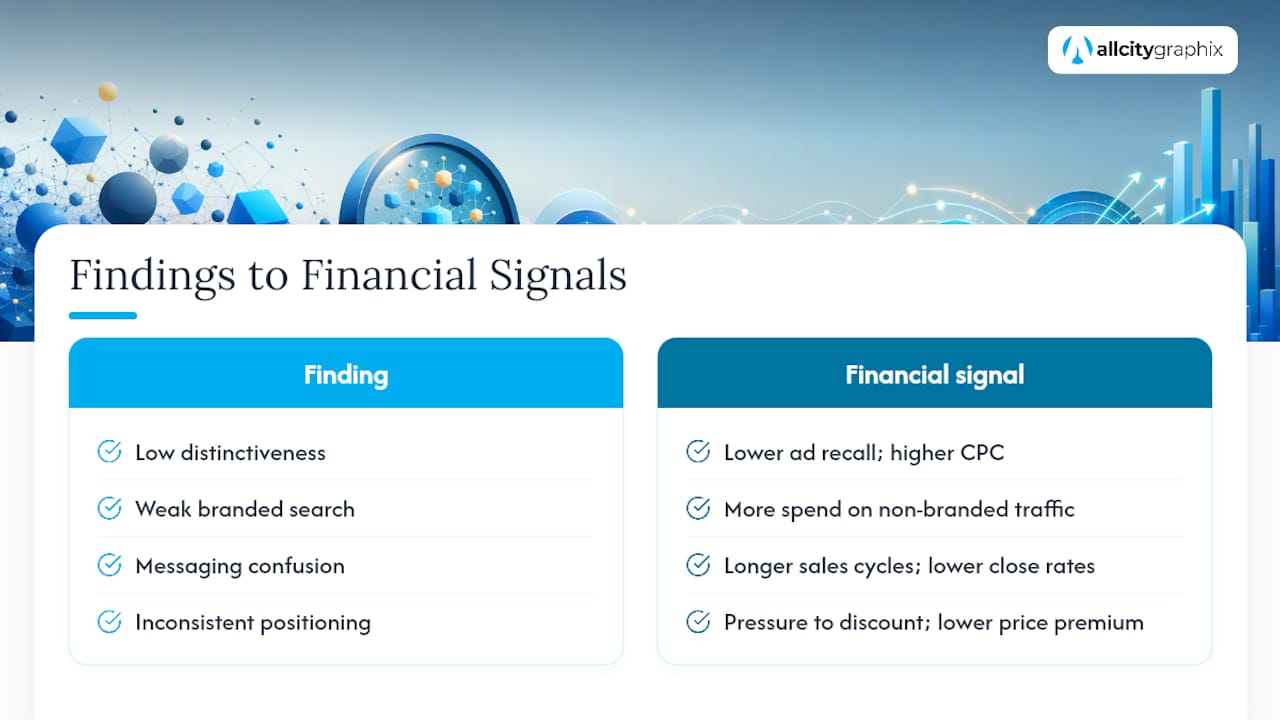
Brand audits often live in the marketing department, but the findings should reach the finance conversation. A messaging gap that confuses buyers doesn’t just look bad. It extends sales cycles, lowers close rates, and increases the customer acquisition cost you pulled during data gathering.
Connect each major audit finding to a financial signal where you can. If your visual identity scored low on distinctiveness, check whether that correlates with lower ad recall or higher cost-per-click on paid campaigns. If digital presence scored weak on branded search visibility, that often shows up as more dollars spent chasing non-branded traffic to make up the difference.
Price premium is another useful lens. Brands with clearer, more consistent positioning tend to support higher prices without losing customers, while inconsistent or confusing brands often compete on discounting instead. If your audit surfaces messaging confusion, check whether your win rate against competitors correlates with the parts of your pitch that customers found unclear in interviews.
This is also where the distinction between an audit and a formal brand evaluation matters. An audit diagnoses gaps qualitatively and directionally. A formal evaluation under a standard like ISO 20671 quantifies brand value for board reporting or a potential acquisition. Most small and mid-size companies only need the audit. Larger organizations facing an investment round or sale may need both.
Build the financial case into your executive summary. A category score of 2.1 out of 5 sounds abstract. Tied to a specific revenue or cost impact, it becomes a budget conversation instead of a design conversation.
Employee Brand Perception and Internal Alignment
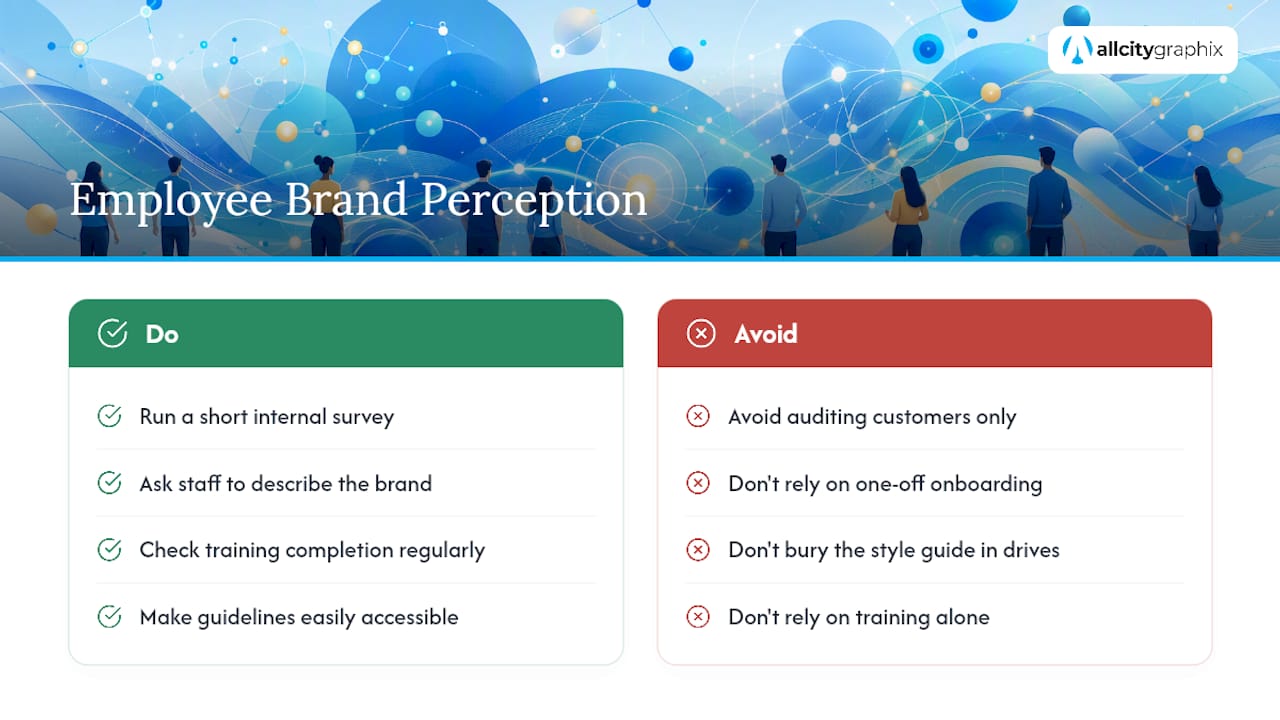
Most audits focus outward, on customers and competitors, and miss the fact that employees are often the first ambassadors or the first source of brand drift. If your team can’t describe your positioning in one consistent sentence, customers won’t experience it consistently either.
Run a short internal survey alongside your customer research. Ask employees to describe the brand in their own words, rate how proud they feel referring the company to others, and identify one place where they think the brand falls short internally. The gap between how leadership describes the brand and how frontline staff describe it is often wider than anyone expects, and it’s a gap that customer-facing roles pass straight through to buyers.
Training completion is a useful proxy metric here. If new hires never receive brand training, or if it happened once during onboarding and never again, that shows up months later as inconsistent tone in support tickets and sales calls. Check whether your brand guidelines exist somewhere employees can actually find them, since a style guide buried in a shared drive nobody opens might as well not exist.
Sales and support teams deserve particular attention, since they’re translating brand promises into live customer conversations every day. A quick review of call recordings or support chat transcripts against your intended tone often reveals more than a formal survey. Where you find a mismatch, the fix is rarely more training alone. It’s usually a clearer, more accessible reference document the team will actually use.
When to Run a Full Audit vs. a Quick Pulse Check
My honest read: run a full audit annually and quarterly pulse checks on whatever scored weakest last time. Trigger an unscheduled audit after a rebrand, an acquisition, or a sudden drop in a KPI you can’t otherwise explain.
The biggest mistake I see isn’t skipping audits. It’s running one so broad that nobody finishes the resulting to-do list. Limiting scope to three to five high-impact areas tied to your actual growth goal beats a comprehensive audit that stalls at the report stage. A finished narrow audit beats an unfinished thorough one every time.
— Alex
Want the Audit Done for You? All City Graphix Runs It Start to Finish
Running this checklist yourself takes real hours away from a small team. All City Graphix offers the same process as a managed engagement: branding review, a working style guide, and web design fixes mapped directly to whatever your audit uncovers, so findings turn into shipped work instead of a report sitting in a shared drive.
A typical engagement runs a few weeks: a discovery session to align on scope, an audit and scoring pass, then implementation support on the highest-priority fixes, whether that’s a rebuilt style guide or a website that finally matches the brand it’s supposed to represent. Clients receive a clear roadmap, rather than another spreadsheet to manage internally.
If your last audit produced a list nobody had time to act on, that’s exactly the gap this closes. Visit the All City Graphix site to see the full process, or check the Services page to scope out what a managed audit and implementation engagement would look like for your business.
Templates and Frameworks Worth Bookmarking
- Brand Audit Checklist: 25 Points to Evaluate Any Brand
- Brand Audit Template: A Scoring Framework
- Brand Audit Templates: Reports, Checklists and Presentations
- Brand Voice Consistency Tools
Sources
- Brand Audit Checklist: 25 Points to Evaluate Any Brand
- Brand Audit Template: A Scoring Framework for Your Entire Brand
- Brand Evaluation: A strategic practice (Brand Finance)
- Brand Audit Templates: Reports, Checklists and Presentations – Smartsheet
FAQ
What should a brand audit include?
A thorough audit covers visual identity, messaging and tone, digital presence, competitive positioning, and customer perception, typically scored across 25 checklist points on a 1 to 5 scale.
What are the six steps to conduct a brand audit?
Prepare and scope the audit, gather internal data, review visual identity and digital presence, benchmark competitors, collect customer and employee feedback, then score everything and build a prioritized action plan.
What are the five audit checklist categories?
The five core categories are visual identity, messaging, digital presence, competitive positioning, and customer perception, each scored separately before rolling into an overall brand health score.
What are the parameters of a brand audit?
Key parameters include logo and visual consistency, messaging clarity, website and SEO performance, social and listing accuracy, competitor benchmarks, and customer sentiment from reviews and surveys.
How long does a brand audit take?
A focused audit on three to five areas often finishes in about a week, while a full 25-point audit for a mid-market company typically takes two to three weeks.
How is a brand audit different from a formal brand evaluation?
A brand audit diagnoses gaps and gives direction for fixes, while a formal evaluation under a standard like ISO 20671 quantifies brand value, usually for board or acquisition purposes.