

Keyword mapping is the process of assigning groups of related search terms to the single page best suited to satisfy their intent, and it stops multiple pages from fighting for the same ranking. The practical benefit is clear: it prevents cannibalization and tells you exactly which pages to optimize and which to build. Start by copying a keyword mapping template and running a quick one-page audit of your current site.
TL;DR:
- Properly updating and reviewing your keyword map every three months ensures it accurately reflects current search behavior and prevents overlooked opportunities.
- Clustering keywords based on actual user intent rather than search volume alone improves ranking potential and reduces ineffective content duplication.
- Assigning each keyword cluster to a specific page and monitoring its status helps avoid cannibalization and clarifies internal linking priorities.
- Prioritizing clusters by relevance, difficulty, and actual search volume maximizes impact and keeps efforts aligned with business goals.
- Incorporating automation tools for large-scale clustering and maintaining a clear process for regular updates maximizes efficiency and maintains map accuracy.
Table of Contents
- What is keyword mapping and what belongs in a working map
- Why keyword mapping matters for structure and rankings
- How to build a keyword map step by step
- Clustering and intent: how to group keywords correctly
- Turning the map into optimized and new pages
- Tools, templates, and when to automate
- Keeping the map current without losing track of changes
- How agencies put keyword mapping into practice
- What I’ve learned watching keyword maps succeed and fail
- When it makes sense to bring in a content and design partner
- Sources
- FAQ
What is keyword mapping and what belongs in a working map
A keyword map is a working document that connects search demand to your site’s structure. It sits underneath your pillar and cluster strategy: pillar pages cover a broad topic, cluster pages handle specific subtopics, and the map is the ledger that keeps track of which keywords belong where.
A functional map needs four elements tied together. According to Search Engine Land’s guide to keyword mapping, those elements are the search query cluster, the defined user intent behind it, the target page URL, and the current page status, whether that page needs to be created, optimized, or consolidated with another. Miss any one of these and the map turns into a keyword list with no direction.
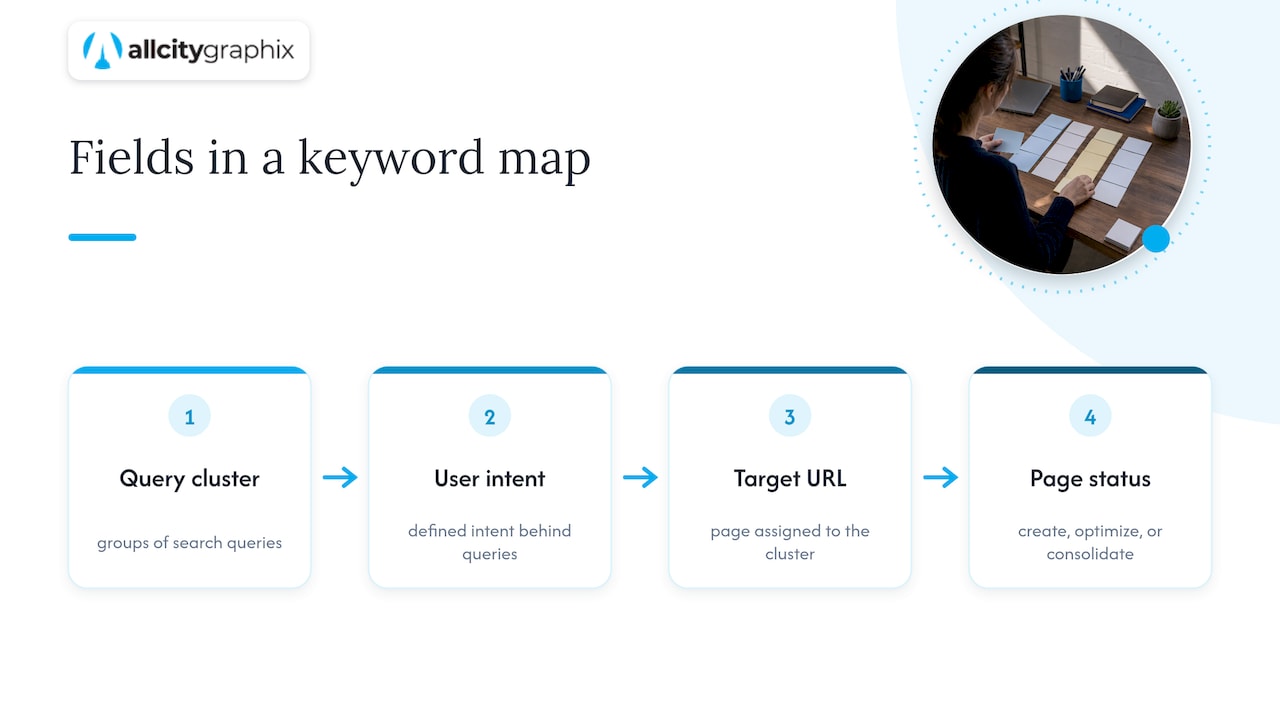
The map is not something you build once and file away. Search behavior shifts, algorithms update, and your own site changes as you publish. Search Engine Land recommends reviewing and updating the map at least every three months, and tying that review to actual Search Console performance data so the map reflects the queries your pages already rank for, not just the ones you originally targeted. A map that never gets reopened is worse than no map at all, because it gives you false confidence about coverage you may have lost months ago.
Think of the map as a bridge between search demand and site architecture. When it stays current, every new piece of content has a clear reason to exist and a clear job to do.
Why keyword mapping matters for structure and rankings
The most immediate problem keyword mapping solves is cannibalization: two or three pages quietly competing for the same query, splitting authority and confusing Google about which one to rank. A map forces you to make a single, deliberate choice about which URL owns each cluster.
Beyond that, mapping shapes how well your site holds together.
- It clarifies which pages deserve internal links from your pillar content, strengthening topical authority instead of scattering it.
- It gives you a way to prioritize work by combining business relevance with realistic difficulty and volume, so you are not chasing every keyword with a pulse.
- It reduces thin content, since each page is built to fully answer a defined cluster of intent rather than a single narrow phrase.
- It supports semantic coverage for AI-driven search results, where Google’s guidance on AI-era search suggests that covering the full range of questions inside a topic matters more than chasing exact-match phrases one at a time.
None of this happens by accident. A site with dozens of overlapping blog posts and no map usually finds out about its cannibalization problem only after rankings start sliding, and by then the fix costs far more time than the map would have.
How to build a keyword map step by step
Building a map is a five-step process, and skipping steps is where most teams get into trouble. Follow the sequence in order rather than jumping straight to keyword lists.
- Set up your template. Copy or build a spreadsheet with columns for keyword cluster, search volume, keyword difficulty, intent, total cluster volume, target URL, status, and last-updated date. Each column earns its place: volume and difficulty inform priority, intent prevents mismatched content, and the status and date columns keep the document alive instead of static.
- Map your site’s topic areas. List the broad subjects your business needs to own and propose a pillar page for each one. This step happens before you touch a keyword tool, because it keeps your research anchored to business goals instead of whatever a keyword tool happens to surface.
- Gather keywords and cluster by intent. Pull keyword ideas from research tools, tag each one with its intent (informational, commercial, transactional, navigational), then group them. Search Engine Land recommends the SERP similarity test here: if two keywords return substantially the same top results, they belong in one cluster; if the results diverge, split them into separate clusters.
- Assign each cluster to a URL and set its status. Match clusters to existing pages wherever a strong fit exists. Where nothing fits, mark the cluster “to create.” Add a review date so the assignment gets revisited rather than forgotten.
- Prioritize by relevance, difficulty, and volume. Rank your action items using three factors: does the cluster align with revenue or lead goals, is the keyword difficulty realistic for your site’s authority, and how much total volume does the cluster represent. Backlinko’s keyword mapping guide recommends weighing business relevance and realistic difficulty over raw volume, since a high-volume term you have no shot at ranking for wastes a slot better used elsewhere.
Pro Tip: Run the crawl-walk-run approach: target long-tail variations first to build early rankings and Search Console data, then move to head terms once you have proof the page performs.
Once the map is built, it becomes the single reference point for content requests, on-page updates, and internal linking decisions. Anyone on the team can open it and know exactly what a given page is supposed to rank for and why.
Clustering and intent: how to group keywords correctly
Volume-only clustering is the fastest way to build a map that looks organized but performs poorly. Two keywords with similar search volume can have completely different intent, and forcing them onto the same page usually means neither ranks well.
Intent-based clustering fixes this by grouping keywords around what the searcher actually wants, not just how the words look on paper.
- Run the SERP similarity test on any ambiguous pair: search both terms live and compare the top five organic results.
- Strong overlap across those results means the keywords share intent and belong in one cluster.
- Little to no overlap means Google sees them as separate questions, and you should build separate pages.
- Watch for edge cases like “buy running shoes” versus “best running shoes,” which look related but often pull entirely different result types, one transactional and one comparison-driven.
Pro Tip: When two existing pages already rank for overlapping queries, check Search Console before touching either one. Consolidating the weaker page into the stronger one, or applying a canonical tag, usually recovers more ranking power than leaving both live.
Cannibalization typically shows up as two pages trading places in search results week to week, or both stuck below page one when either alone might rank higher. Once you spot it, you have three real options: merge the content into a single stronger page and redirect the other, apply a canonical tag if both pages need to stay live for other reasons, or clearly differentiate the intent each page serves if they truly are distinct enough to coexist.

Turning the map into optimized and new pages
A finished map is only useful once it drives real page work. For each row, decide between optimizing an existing page or creating a new one by weighing business relevance, realistic keyword difficulty, and current impressions in Search Console. A page already pulling impressions for a cluster, even without ranking well, is usually a better investment than starting from scratch.
For pages marked “optimize,” update the elements that most directly signal relevance:
- Title tag and meta description reflecting the primary cluster keyword and intent.
- H1 and opening paragraph that answer the core query within the first few sentences.
- Subheadings that cover the secondary questions inside the cluster.
- Body content expanded to close any semantic gaps between what ranks and what your page currently covers.
Internal linking should follow the same logic as the map itself. Pull anchor text from the cluster’s own keyword variations rather than generic phrases like “click here,” and place links from pillar pages down to the cluster pages that support them, and from cluster pages back up to the pillar. This reinforces the hierarchy Google needs to understand which page carries the most authority on a topic.
Once changes go live, measure results through Search Console impressions and position data, along with periodic cannibalization checks to confirm the map’s assignments are holding.
Tools, templates, and when to automate
A basic keyword map can run entirely on a spreadsheet, but most teams combine a handful of tool categories: a keyword research tool such as Google’s Keyword Planner for volume and difficulty estimates, a clustering tool for grouping at scale, manual SERP checks for intent verification, a rank tracker for ongoing position data, and a shared spreadsheet or database to hold it all together.
Automation earns its place when you are clustering hundreds or thousands of keywords, since no team can run manual SERP comparisons at that volume. Manual review still matters for ambiguous or high-value clusters, where an automated grouping tool might miss an intent distinction a quick search would catch immediately.
A reusable template should include:
- Keyword cluster and total cluster volume, so priority is visible at a glance.
- Intent and keyword difficulty, side by side for quick sorting.
- Target URL and status, kept current with every review cycle.
- A last-updated column, so nobody wastes time re-auditing a row someone else already handled.
Smaller teams generally do fine with a spreadsheet and a single research tool. Larger sites with hundreds of URLs tend to need dedicated clustering software just to keep the map from becoming unmanageable, along with a clear owner responsible for keeping it current.
Keeping the map current without losing track of changes
A keyword map decays the moment you stop touching it. Search Engine Land recommends reviewing the full map at least every three months, with additional reviews triggered by major algorithm updates or significant product changes on your own site.
A map that goes untouched for longer than three months tends to drift out of sync with actual Search Console performance, missing long-tail queries the site has already started ranking for without anyone noticing.
Watch for a handful of signals between scheduled reviews:
- Sudden shifts in Search Console queries or impressions for a given page.
- A competitor publishing new content that reshuffles the SERP for one of your clusters.
- Noticeable changes in how AI-driven search features summarize your topic area.
When something breaks, triage fast: confirm the drop with Search Console, check whether a second page on your site is now competing for the same query, and decide between a consolidation, a canonical tag, or a content refresh before the ranking slide compounds. Log every change with a date and a short reason so the next person reviewing the map understands what happened and why.
How agencies put keyword mapping into practice
Keyword mapping works best when it is built into a client’s discovery process from day one rather than bolted on after a site launches. At All City Graphix, discovery conversations surface a client’s real business goals first, and the resulting keyword map gets built around those goals rather than around whatever keywords happen to have the highest search volume.
From there, a clean handoff process keeps the work moving without gaps:
- Each map row becomes a content brief, spelling out the intent, target keywords, and page status.
- The content brief informs a design brief when a new page or a template update is involved.
- Finished pages go through a QA pass against the original map row before launch.
- Post-launch tracking gets logged back into the map so the next review starts from real data, not guesswork.
This kind of process depends on direct collaboration between strategy and design, which is part of what makes mapping useful beyond a purely technical exercise: it becomes the shared reference point for everyone touching the page.
What I’ve learned watching keyword maps succeed and fail
The maps that fail almost always share the same three mistakes: nobody schedules a review, so the document goes stale within months; clusters get built around volume alone, ignoring whether the intent actually matches; and Search Console data never gets pulled back into the map, so teams keep missing queries they already rank for.
If you do nothing else this week, try three fixes. Find one pair of pages competing for the same query and consolidate them. Update the title tag and H1 on your highest-impression page that still ranks outside the top five. Add two internal links from a pillar page pointing at a cluster page that needs more authority.
None of these take more than an hour, and each one produces a visible change in Search Console within a few weeks.
— Alex
When it makes sense to bring in a content and design partner
Building and maintaining a keyword map is manageable for a small site with a handful of pages, but it gets harder fast once you are juggling dozens of URLs, a content calendar, and a design system that needs to stay consistent across every new page. That is the point where a partner starts to save more time than it costs.

Some agencies build keyword mapping into their discovery process and carry that work through content briefs, design execution, and ongoing optimization instead of handing over a spreadsheet and walking away. If your team needs mapping paired with the actual page production and design work to act on it, our services page outlines the digital strategy, content, and web design support available to get a map turned into finished, ranking pages.
Sources
For the mapping framework and SERP similarity test referenced throughout, Search Engine Land’s guide and Backlinko’s keyword mapping guide both walk through template structure and prioritization in more depth. Google’s own guidance on people-first content and spam policies is worth reading before you finalize on-page copy, since both warn against building pages that chase search intent without genuinely serving the reader. For cluster rollout planning, the 30/60/90 topic cluster framework offers a practical cadence for larger sites.
- Keyword mapping: A step-by-step guide to better SEO
- Keyword Mapping: A Step-by-Step Guide to Better SEO
FAQ
What is keyword mapping?
Keyword mapping is the process of assigning clusters of related search terms to the page best positioned to satisfy their intent, tracked alongside the page’s status and target URL. It gives a site a clear structure for deciding what to optimize, what to build, and what to consolidate, based on the core framework Search Engine Land outlines.
Can a beginner do SEO?
Yes, a beginner can learn core SEO practices like keyword research, on-page optimization, and basic keyword mapping using free tools and published guides. The learning curve is steepest around intent clustering and technical issues, so starting with a template and a small set of pages keeps the process manageable.
Is Google’s Keyword Planner free?
Google’s Keyword Planner is available at no cost through a free Google Ads account, though some data displays as broader ranges rather than exact figures unless you have active ad spend. It remains one of the standard starting points for pulling volume estimates into a keyword map.
What is the 80/20 rule in SEO?
In SEO, it is common to focus the bulk of your effort on the small share of pages or keywords that drive most of your traffic or conversions, rather than spreading effort evenly across everything. In keyword mapping, that usually means prioritizing clusters with strong business relevance and realistic ranking potential over chasing every possible keyword variation.