

Local link building means earning backlinks from websites tied to your city, neighborhood, or industry niche, and it remains one of the strongest levers in climbing the Map Pack and local organic results. The fastest first move is a citation audit: check your business name, address, and phone number across your top 10 directory listings, fix any mismatches, then commit to pitching three high-value local editorial or partnership links every month.
TL;DR:
- Local backlinks from geographically relevant sites like local news outlets and community organizations carry more ranking weight than generic or national sites, especially for ranking in the Map Pack.
- Fixing inconsistent and outdated citations across directories like Google, Yelp, and industry-specific listings is crucial before pursuing new links, as poor NAP data damages local visibility.
- Building relationships with local press, partnering with nearby businesses, and sponsoring community events are efficient ways to generate high-value local links quickly.
- Publishing localized content such as neighborhood guides and original local data can continually attract organic links and establish authority in your area.
- Keeping citations and links consistent and authoritative is especially vital in the AI search era, where structured data and correct mentions directly affect business visibility in automated responses.
Table of Contents
- What Local Link Building Actually Means for Search Engines
- Why Local Backlinks Drive Real Business Results
- The Local Link Building Playbook: Tactics That Actually Work
- Tools and Templates for Running a Local Link Campaign
- Prioritizing Link Targets and Measuring What Works
- How All City Graphix Approaches Local Link Building for Clients
- The AI Search Era Rewards Consistency Over Cleverness
- Get Hands-On Help With Local Link Building
- Sources
- FAQ
What Local Link Building Actually Means for Search Engines
A local SEO backlink is a link from a site with genuine geographic or topical ties to your market, think a city newspaper, a neighborhood association, or a business two doors down. Citations are different: they’re mentions of your name, address, and phone number on directories like Yelp or the Better Business Bureau, with or without a clickable link. Both matter, but they serve different roles.
Google weighs three local ranking factors when it decides who shows up in the Map Pack: relevance, distance, and prominence. Links feed directly into prominence, but not all links carry equal weight. A link from a national blog with zero connection to your city tells Google very little about your local authority. A link from your town’s chamber of commerce or a local news outlet tells Google exactly where you operate and who vouches for you.
That’s why locally relevant links typically outperform generic backlinks for local search queries, even when the generic link comes from a bigger, more authoritative site. A hardware store in Austin gets more ranking value from the Austin Monitor than from a marketing blog with ten times the traffic. Search engines read local links as a proxy for real-world community presence, which is precisely the signal a national domain can’t fake.
Why Local Backlinks Drive Real Business Results
Local link building isn’t an abstract ranking exercise. It’s the mechanism connecting your website to phone calls, bookings, and foot traffic. Every locally relevant link that pushes you higher in the Map Pack puts your business in front of someone actively searching “near me” with intent to buy today, not browse someday.
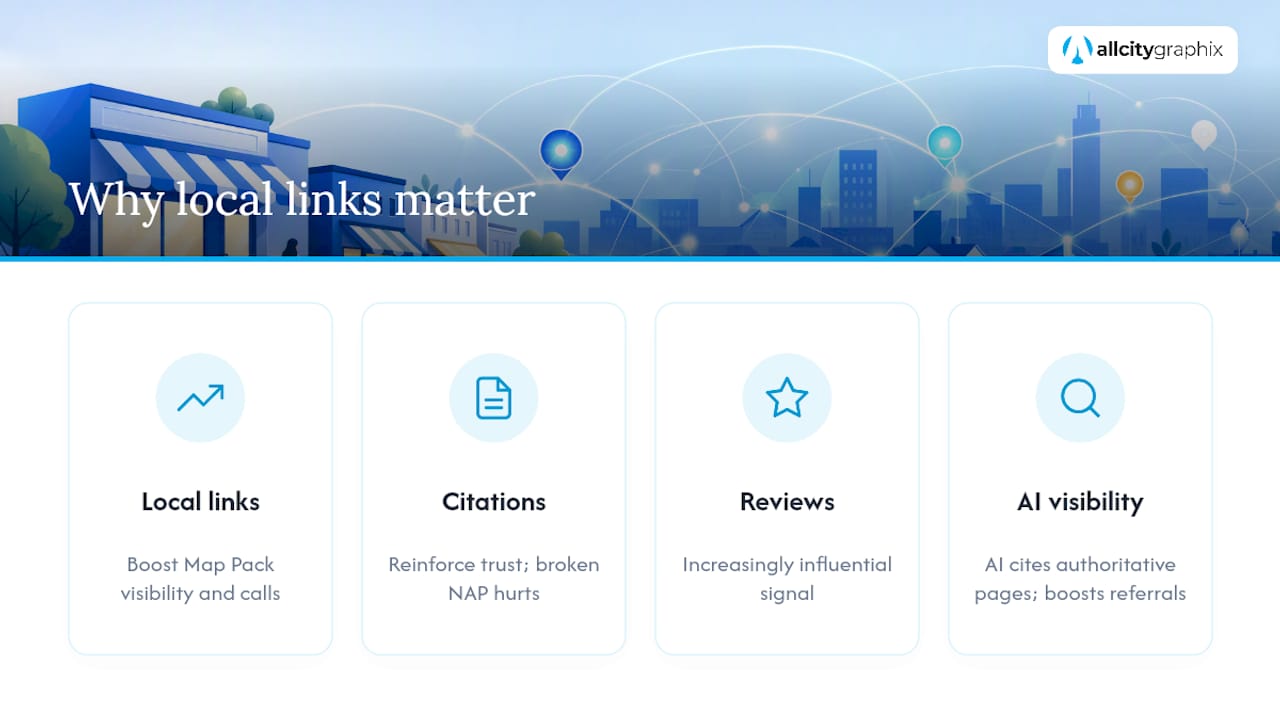
Links and your Google Business Profile work together, not separately. A well-optimized profile with strong reviews and a steady stream of local citations reinforces the same trust signal from multiple directions. Industry data from BrightLocal confirms links and citations remain core local ranking signals, and that reviews have grown more influential alongside them, not instead of them. Treat the two as partners: a directory citation with a broken NAP entry undercuts the value of every link you’ve built.
There’s a newer wrinkle worth understanding. AI-driven search tools and generative answer engines increasingly cite businesses the way a researcher cites sources, pulling from pages that are structured to answer a question directly and from third-party mentions that reinforce credibility. Consistent, authoritative citations increase the odds an AI system will recommend a business when someone asks a chatbot “who’s a good plumber near me.” The old SEO game and the new AI-visibility game are converging around the same fundamentals: clean citations, credible links, clear answers.
The Local Link Building Playbook: Tactics That Actually Work
Not every tactic deserves equal time. Some produce one solid link after hours of outreach. Others produce a dozen with a single afternoon of work. Here’s how to sequence the effort, starting with the tactics that pay off fastest.
1. Audit and Fix Your Core Citations First
Before chasing new links, clean up what already exists. Pull your listings from Google Business Profile, Yelp, Apple Maps, Bing Places, and any industry-specific directories relevant to your trade. Compare name, address, and phone number across every listing. Inconsistent NAP data actively harms local visibility, so a mismatched suite number or an old phone line isn’t a cosmetic problem, it’s a ranking one. Fix duplicates and outdated entries before you build anything new on top of a shaky foundation.
2. Pitch Local Press With a Story, Not a Sales Pitch
Local reporters need story angles, not press releases about your grand opening. Offer something they can use: a local trend you’re seeing in your data, a free expert quote for a story they’re already writing, or a genuinely newsworthy event. A short email works better than a formal pitch deck.
Pro Tip: Email a local reporter something like: “I noticed you cover small business trends in [city]. We just pulled data on [specific, interesting number] from our customers this quarter, happy to share if it’s useful for a story.” Specific numbers get replies. Vague offers to “chat” don’t.
3. Sponsor or Host Local Events
Youth sports leagues, charity 5Ks, school fundraisers, and neighborhood festivals almost always list sponsors on their websites with a link back. This is one of the most reliable link sources available because event organizers want to publicly thank supporters, and a modest sponsorship often earns a link that would otherwise take weeks of outreach.
4. Build Cross-Promotional Links With Complementary Businesses
A wedding photographer and a florist aren’t competitors, they’re natural referral partners. Partnering with businesses that serve the same customers at a different stage of their buying journey earns both a relevant link and a qualified lead source. This works especially well when you mirror the partnership patterns of your most successful local competitors, looking at who links to them and asking whether those same relationships make sense for you.
5. Publish Localized Content Worth Linking To
Neighborhood guides, original local survey data, and community resource pages consistently earn organic links because they solve a problem nobody else has solved for that specific area. Original local data and editorial-quality resource pages reliably attract high-value local links because journalists and bloggers need something concrete to cite. Building a neighborhood-specific content strategy gives you a repeatable asset you can pitch to press, partners, and community sites simultaneously.
6. Reclaim Unlinked Mentions and Fix Broken Backlinks
Search your business name in Google News and standard search results. You’ll often find articles or blog posts that mention you by name with no link at all. A polite email asking the writer to add one converts a mention into an asset for almost no effort. Broken backlinks, where a site once linked to a page you’ve since moved or deleted, deserve the same treatment: find them, then ask the site owner to point the link at your current URL.
7. Study Competitor Backlinks for Prospecting Ideas
Look at where your top three local competitors get linked from. If a competing restaurant has links from three neighborhood food blogs and a local farmers market page, those same sites are plausible targets for you. This kind of link intersect analysis, finding sites that link to multiple competitors but not to you, surfaces prospects you’d never find through generic outreach.
8. Get Included in Local Roundups
“Best coffee shops in [neighborhood]” or “top-rated contractors in [city]” roundup posts are common on local blogs and lifestyle sites. A short, specific pitch highlighting what makes you distinct, a specialty, an award, a unique story, often earns inclusion. High-value sources worth targeting for this tactic include chambers of commerce, industry associations, and local news coverage, all of which tend to publish these lists regularly.
One channel worth a mention: community forums like Reddit rarely hand out a direct backlink, but active, honest participation builds the kind of trust and word-of-mouth relevance that leads to indirect referrals and mentions elsewhere. Don’t count it as a link source. Count it as a trust source that feeds your other efforts.
Tools and Templates for Running a Local Link Campaign
You don’t need an expensive stack to run this well. A handful of tools cover the core jobs: citation cleanup, competitor research, and outreach tracking.
- Citation auditing: Use a citation-scanning tool whenever you launch a new location, rebrand, or notice a ranking dip, to catch NAP mismatches before they spread across dozens of directories.
- Backlink and competitor research: A backlink-discovery platform lets you see exactly who links to your competitors, which is the fastest way to build a realistic prospect list instead of guessing.
- Outreach tracking: Even a simple spreadsheet or a lightweight CRM keeps your pitches organized by status (contacted, replied, linked) so nothing falls through after week one.
Three short templates worth adapting:
Unlinked mention request: “Hi [name], I noticed your article on [topic] mentions [business name] but doesn’t link to us. Would you mind adding a link to [URL]? Happy to return the favor with a mention in our next roundup.”
Sponsorship inquiry: “Hi [organizer], we’d love to sponsor [event name] this year. Could you send details on sponsorship tiers and whether sponsors are listed with a link on your event page?”
Partner outreach: “Hi [business owner], we serve a lot of the same customers in [neighborhood] and I think a cross-promotion could work well for both of us, want to grab 15 minutes to talk it through?”
Prioritizing Link Targets and Measuring What Works
Not every link opportunity deserves the same amount of time. Weigh each prospect against three factors: the effort it takes to land, the local relevance of the site, and the editorial value of appearing there.
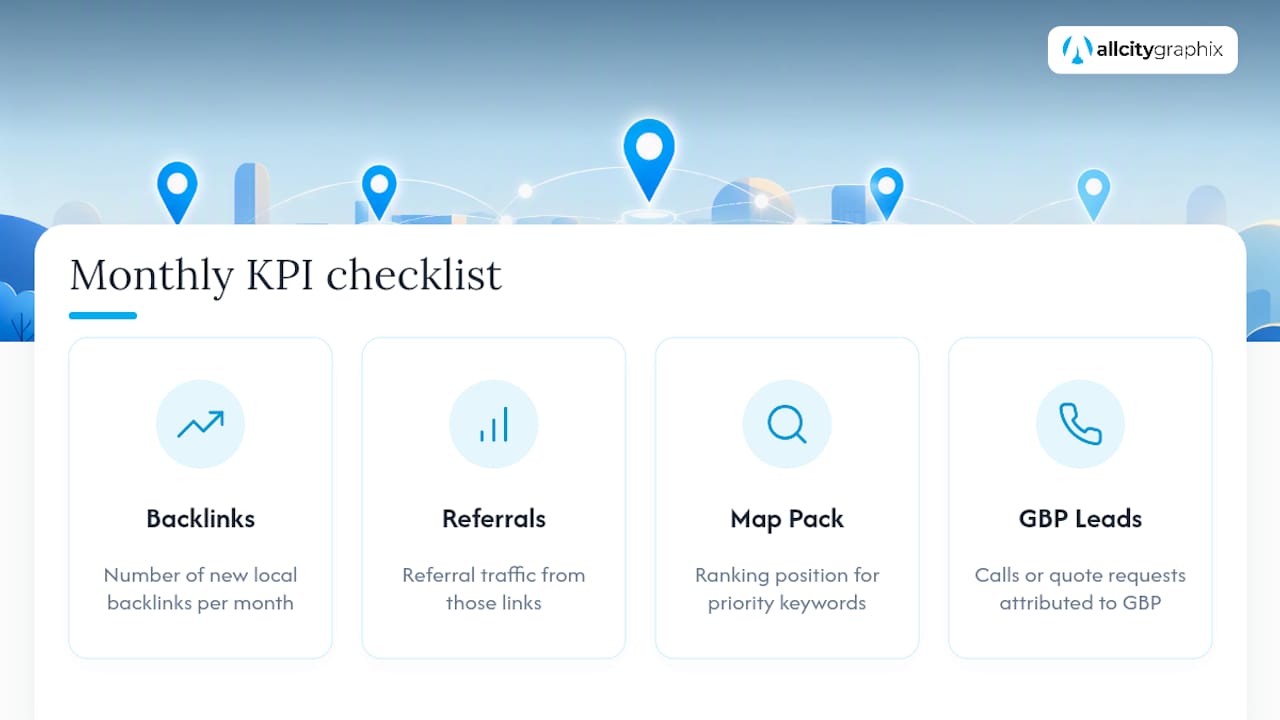
Track a small set of KPIs rather than everything you can measure: number of new local backlinks per month, referral traffic from those links, Map Pack ranking position for your priority keywords, and calls or quote requests attributed to your Google Business Profile. Check progress monthly rather than daily, link building moves slowly and daily checks just create noise.
In the first 90 days, aim for quick wins you can point to: a cleaned-up citation profile, two or three sponsorship or partnership links, and one piece of localized content live and pitched to at least five local sites. If you want a broader framework for sequencing this alongside other marketing priorities, a structured small business marketing plan helps keep link building from competing with everything else on your plate.
How All City Graphix Approaches Local Link Building for Clients
The workflow stays consistent across projects: audit existing citations and backlinks first, build localized content assets second, run targeted outreach third, then measure and adjust monthly. A neighborhood guide built for a client’s service area, for instance, becomes the anchor asset pitched to local press and community sites rather than a one-off blog post nobody finds.
A quick checklist you can run today:
- Pull your top 10 citations and check for NAP mismatches.
- List three local businesses you could cross-promote with this month.
- Draft one pitch to a local reporter or blogger using a specific, current detail about your business.
Pro Tip: Start with whichever tactic requires the least outreach and the most existing relationship, a current customer, a neighboring business, a vendor you already work with. Warm links close faster than cold ones.
The AI Search Era Rewards Consistency Over Cleverness
Editorial citations and clean NAP data matter more now than they did five years ago, not less. Generative answer engines pull from pages that state a clear answer up front and from third-party mentions that back up the claim, which means answer-first content and consistent citations increase the odds an AI system names your business in a generated response.
The mistake I see most often is chasing volume: a dozen weak directory links instead of three strong local ones. Balance reviews, citations, and links as one system rather than three separate to-do lists. If you only have time for one strategic move this quarter, fix your citations before you build a single new link. Everything else compounds on top of that foundation, and nothing built on inconsistent NAP data holds up for long.
— Alex
Get Hands-On Help With Local Link Building
Running outreach campaigns, auditing citations across a dozen directories, and building localized content on top of everything else you do to run a business is a lot to take on alone. All City Graphix is the alternative to hiring a full in-house SEO team: you get a discovery call, a citation and backlink audit, and a localized content plan built around your actual neighborhood and customer base, without the overhead of a full-time hire.
Our SEO services cover exactly the ground this article walks through: citation cleanup, outreach for editorial and partnership links, Google Business Profile optimization, and localized content built to earn links on its own. A typical engagement starts with an audit of where you stand today, followed by a prioritized plan targeting the highest-impact opportunities first, not a generic checklist copied across every client. If you’re ready to see where your citations and backlink profile stand right now, start with a discovery call and get a clear picture of what to fix first.
Sources
The core claims in this guide draw from BrightLocal’s local link building research, Moz’s guide to local citations, Semrush’s breakdown of local SEO backlink tactics, and Cited’s analysis of AI search citation behavior. Each is worth revisiting directly for deeper detail on citation tools and backlink discovery platforms.
FAQ
What Is Local Link Building in SEO?
Local link building is the practice of earning backlinks from websites with a genuine connection to your city, neighborhood, or local industry, such as news outlets, chambers of commerce, and community organizations, to boost visibility in local search and Map Pack results.
How Much Should I Pay for Link Building?
Costs vary widely depending on scope, but link building is typically priced as part of a broader local SEO retainer rather than sold per link, since paying directly for links violates search engine guidelines; agencies typically price it around audit, content, and outreach hours.
What Is Meant by Link Building?
Link building is the ongoing process of earning hyperlinks from other websites back to your own, which search engines use as a signal of trust, relevance, and authority when ranking pages.
Is Doing Local SEO Worth It?
Yes: links and citations remain core local ranking signals, and consistent local SEO work directly improves Map Pack visibility, which translates into more calls, bookings, and foot traffic from nearby customers actively searching to buy.