
Expect to pay between $5,000 and $50,000 for professional packaging design, depending on complexity, materials, and how many SKUs you need. That’s the fee. It rarely matches your true cost, since tooling, per-unit materials, and freight usually outweigh the design invoice once you factor in landed cost per order. The benchmarks and category ranges below show exactly where your budget should land.
TL;DR:
- Packaging design costs significantly increase with complexity, custom structural engineering, compliance, and larger SKU counts, often exceeding $20,000 for involved projects.
- Fixed tooling and die development costs create higher per-unit expenses for small orders, emphasizing the importance of order size and total landed cost.
- Design fees should include clear deliverables such as dielines, mockups, and revision limits, while ownership and approval terms are crucial to prevent reprint disputes.
- Most packaging projects fall into the $5,000 to $20,000 range, but total cost per order typically averages around $1.80, depending on category and order quantity.
- Getting separate quotes for structure and graphics helps identify cost drivers and negotiate effectively, especially when planning for compliance and production timelines.
Table of Contents
- How Much Does Packaging Design Cost? Price Ranges Explained
- What Actually Drives Packaging Design Cost
- Freelancer, Agency, or In House: Who Should Design Your Packaging?
- True Packaging Cost Per Unit: 2026 Category Benchmarks
- What You Should Actually Get for Your Design Fee
- Estimating Your Packaging Budget: A Simple Formula
- Hidden Costs That Turn a Cheap Quote Into an Expensive Mistake
- Questions to Ask Before You Hire a Packaging Designer
- How All City Graphix Approaches Packaging Budgets
- Get a Packaging Design Quote That Actually Reflects Your Budget
- Sources
- FAQ
How Much Does Packaging Design Cost? Price Ranges Explained
Packaging design pricing splits into four rough tiers, and knowing which one you need before you call a designer saves you from either overpaying or underbuying.
Under $5,000 gets you a template-based structure with custom graphics: a single-SKU label or box redesign using a stock dieline, one or two concept directions, and print-ready files. This works fine for a single product launching on a tight runway, but don’t expect custom structural engineering or a full brand system.
The $5,000 to $20,000 range is where most small brands land. DesignRush reports this bracket typically covers multiple concept rounds, a small SKU family (think three to six variants), custom dieline work, and mockups for retail or e-commerce presentation. Agencies in this tier usually bill between one and two hundred dollars per hour.
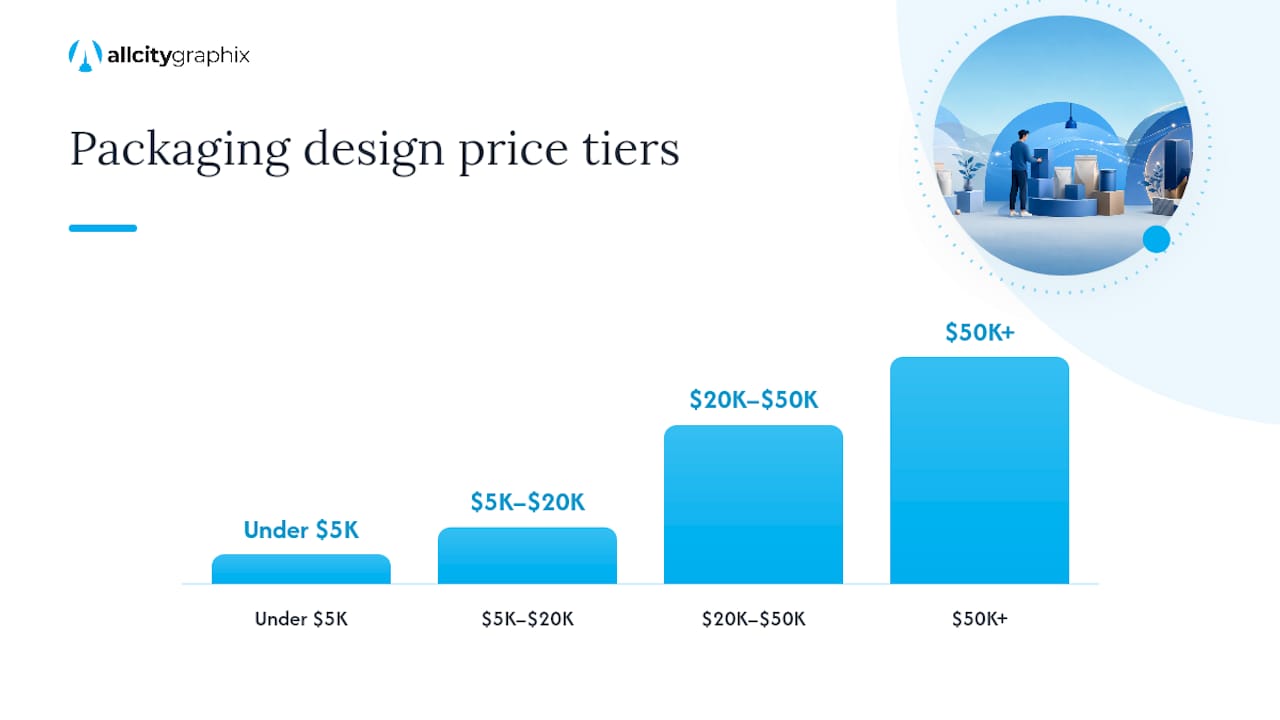
Above $20,000, you’re paying for complexity: regulated categories (supplements, food, cosmetics with claims), custom structural packaging requiring mold or die development, or a full multi-SKU system with matching secondary packaging. Clutch’s pricing data shows many agency projects in this range can be quite costly depending on compliance and formats, particularly when compliance labeling and multiple production-ready formats are involved.
What buys you which tier:
- Under $5K: one to two concepts, stock dieline, basic print files, minimal revisions
- $5K to $20K: custom dieline, multiple SKUs, brand-consistent mockups, two to three revision rounds
- $20K to $50K: structural engineering, tooling coordination, compliance review, full photography-ready mockups
- $50K+: multi-SKU systems, custom molds or dies, regulatory sign-off, ongoing production support
A single-SKU snack brand launching on Amazon doesn’t need the $50K tier. A supplement company selling in Whole Foods almost certainly does, given FDA labeling requirements alone.
What Actually Drives Packaging Design Cost
Five variables move the number up or down more than anything else, and most first-time buyers only think about one of them: the artwork.
Structure and tooling. A stock box or pouch format costs far less than a custom structure requiring a new die or mold. PlusPackaging’s cost analysis notes that custom tooling creates a fixed cost that gets amortized across your run, meaning small orders absorb a much higher per-unit hit than large ones.
Printing method. Digital printing suits short runs and frequent SKU changes but costs more per unit at volume. Flexographic and gravure printing require higher minimum order quantities but drop unit price significantly once you clear those thresholds.
SKU count. Every additional variant multiplies design, proofing, and file-prep work. A five-SKU launch isn’t five times the cost of one SKU, but it’s not far off.
Compliance and labeling. Regulated categories need nutrition panels, warning statements, or claims substantiation built into the design, which adds legal review time and revision cycles.
Timeline. Rush jobs compress proofing and often skip a sampling round, which raises both the design fee and your production risk.
- Custom structure and tooling: higher fixed cost, better at scale
- Printing method: digital favors flexibility, flexo/gravure favor volume
- SKU count: each variant adds proofing and file work
- Compliance labeling: adds legal review and revision time
- Rush timelines: raise fees and skip risk-reducing sample rounds
Pro Tip: Ask your designer to quote structure and graphics separately. Bundled quotes hide which line item is actually driving your total, and you can’t negotiate what you can’t see.
Freelancer, Agency, or In House: Who Should Design Your Packaging?
Your sourcing decision matters as much as your budget, because each model carries a different risk profile.
- Freelancers typically charge $50 to $125 an hour or flat fees starting around $500 to $3,000 per SKU. You get low overhead and fast turnaround, but coordination, compliance checks, and production liaison usually fall on you.
- Agencies run typically between one and two hundred dollars per hour or project fees from $5,000 into six figures, per DesignRush. You’re paying for strategy, structural expertise, compliance experience, and a team that manages pre-press and printer communication.
- In-house designers cost a salary (often $55,000 to $85,000 annually plus benefits) rather than a project fee, which only pencils out if you’re launching new packaging continuously across many SKUs.
Fixed-fee pricing suits well-scoped single-SKU projects. Packaged pricing (a set number of concepts, revisions, and file formats for one price) fits growing brands launching several products a year. Value-based pricing, where the fee reflects the packaging’s expected sales impact, tends to show up on agency-level projects for established brands with revenue history to justify the premium.
True Packaging Cost Per Unit: 2026 Category Benchmarks
Your design fee is a one-time cost. Your per-unit landed cost repeats on every single order, and that’s the number that actually determines your margin.
Speed Commerce breaks this into seven layers: materials, labor, transportation, inventory carrying cost, expected damage, third-party logistics fees, and compliance. Materials and labor are the two most underestimated. Packing labor alone is calculated as pack seconds times your fully loaded labor rate divided by 3,600, and shaving even a few seconds off a repetitive pack process compounds into real annual savings at volume.
Margin Lab’s benchmarking data puts the median packaging cost per order at $1.80 across categories, with meaningful spread by product type.
| Category | Median cost per order |
|---|---|
| Beauty | typical cost per order for beauty products |
| Food (ambient) | typical cost per order for ambient food products |
| Apparel | typical cost per order for apparel |
| Overall median (all categories) | $1.80 |
Benchmark to remember: if your packaging cost per order sits well above your category’s median, you’re either overengineering the box or leaving margin on the table through inefficient materials or labor.
Order quantity changes this math directly. Tooling and setup costs get amortized across your run, so a 500-unit order absorbs a much higher fixed-cost share per unit than a 20,000-unit order using the same die.
What You Should Actually Get for Your Design Fee
A packaging design invoice should come with a defined deliverables list, not just “final art.” Ambiguity here is where scope creep and reprint costs start.
At minimum, expect:
- Print-ready dielines in vector format (AI or EPS)
- Full-resolution print files with correct color specs (Pantone or CMYK breakdown)
- Physical or digital mockups for internal and retailer approval
- A defined revision count in writing (typically two to three rounds)
Higher fees justify additional value: structural prototypes, a physical proof review before mass production, and coordination directly with your printer on press checks.
Before signing, get written terms on file ownership (you should own the final files outright), acceptable revision windows, and who approves the physical sample before a full production run. That last point alone prevents most expensive reprint disputes.
Estimating Your Packaging Budget: A Simple Formula
Run this formula before you request quotes, so you know whether a proposal is realistic:
Total landed cost = design fee + tooling/setup + (per-unit material cost × units) + freight-in + amortized sampling + contingency
- Get your design fee quote (use the tiers above as a sanity check)
- Add one-time tooling or die costs if your structure is custom
- Multiply your per-unit material cost by your order quantity
- Add freight-in from your supplier or printer
- Add sampling costs, divided across your first production run
- Add a 10% to 15% contingency for the reprints or delays covered next
Worked example: 5,000 folding cartons. Design fee: $8,000. Custom die: $1,200. Material and print at $0.35/unit: $1,750. Freight-in: $400. Sampling amortized: $150. Total landed cost: roughly $12,650, or about $2.53 per unit once you fold the one-time design fee into the run.
Hidden Costs That Turn a Cheap Quote Into an Expensive Mistake
The lowest bid rarely stays the lowest once production starts; exploring sustainable skincare packaging brands can help you evaluate material and sustainability trade-offs that impact cost. Reprints from dieline errors, finish incompatibility (a matte coating that won’t take foil stamping, for instance), or missed compliance language are the most common budget killers, and industry practitioners point to early oversight failures as the root cause more often than the printer’s execution.
Seasonal SKUs and multi-variant lines also create inventory obsolescence risk. Order too much printed packaging for a limited-run flavor and you’re either eating the cost or scrambling to reformulate a product to use it up.
Pro Tip: Always request a physical proof and a small pilot run before committing to full production, even if your designer’s digital mockup looks perfect. Screen colors and printed colors are never identical.
- Dieline fit errors: catch with a physical die-cut sample, not a PDF
- Finish incompatibility: confirm coating and print method compatibility before final art
- Compliance gaps: have labeling reviewed against current regulations, not last year’s template
- Seasonal overprinting: order printed stock in smaller batches for limited runs
Questions to Ask Before You Hire a Packaging Designer
A short brief and a consistent question list let you compare quotes on equal footing instead of guessing why one number is triple another.
Ask every designer or agency:
- Can you show three packaging projects in my product category?
- Who manages pre-press file prep and printer communication?
- What’s included in tooling or die development, and who owns it?
- What’s your typical timeline from concept to print-ready files?
- How many revision rounds are included before additional fees apply?
- What’s your sample approval process before a full production run?
For your brief, include: product category, target retailer or channel, SKU count, budget range, timeline, and any compliance requirements (FDA, sustainability certifications, allergen labeling).
- Send the same brief to every designer or agency you’re evaluating
- Flag any quote missing tooling, revisions, or file-ownership terms in writing
- Compare hourly-equivalent cost, not just the headline number
How All City Graphix Approaches Packaging Budgets
Most packaging projects often fall into that $5,000 to $20,000 middle tier: a brand with a few SKUs that needs a custom dieline and a system designed to hold up on a shelf next to bigger competitors. The recurring problem isn’t the design fee. It’s clients discovering tooling and reprint costs after production starts, which is why it’s important to walk through total landed cost before finalizing scope. Readers weighing material trade-offs might find our breakdown of sustainable packaging design useful, and our food packaging design piece walks through a real production timeline start to finish.
— Alex
Get a Packaging Design Quote That Actually Reflects Your Budget
Packaging projects are ideally scoped around total landed cost, not just a design invoice, to avoid being blindsided by tooling or reprint expenses weeks into production. Handling branding, packaging artwork, pre-press file prep, and print-management coordination directly with your printer reduces handoffs and chances for dieline errors.
Consumer research backs the investment: Ipsos found that most Americans say packaging design often influences their purchase decisions, which makes the fee less of an expense and more of a lever on sales. When you request a quote, come with your SKU count, target channel, and rough timeline. We’ll respond with a scoped proposal that separates design, tooling, and production coordination so you can see exactly where your budget goes. Check out our full service offerings or start the conversation on our homepage.
Sources
The pricing tiers, hourly rates, and category benchmarks in this guide come from a handful of primary references worth bookmarking if you want to dig deeper.
- Packaging Design Costs: Breakdown, Factors, and 2026 Trends
- Packaging Design Pricing Guide June 2026
- Packaging Cost Per Order: 2026 Industry Benchmarks by Category | Margin Lab
- Packaging cost guide (2025) with format price ranges and levers
FAQ
Is $500 too much for a logo design?
No. Solid freelance logo design fees vary, and $500 sits comfortably in a fair range for a small business needing a clean, usable mark rather than a full brand identity system.
How much does it cost to make custom packaging?
Custom packaging design alone typically runs $5,000 to $20,000 for small brands, but total landed cost per unit, including materials, tooling, and freight, is usually the bigger number to budget for.
How much does packaging cost per order?
Margin Lab’s benchmarks put the median packaging cost per order at $1.80 across categories, ranging from about typical cost per order for apparel for apparel to typical cost per order for ambient food products for ambient food products.
How much should I charge per design?
Freelance designers commonly charge $50 to $125 an hour or flat fees of $500 to $3,000 per SKU, while agencies bill typically between one and two hundred dollars per hour depending on project complexity and compliance needs.