

For most startups, the highest-leverage SEO move is publishing a small set of durable, buyer-intent pages, comparisons, integrations, use-case docs, and confirming Google can actually crawl and index them. Do this after product-market fit, or with minimal defensive moves before it. The payoff is compounding organic traffic that also functions as sales collateral, not a vanity metric you check once a month.
TL;DR:
- Early SEO efforts should focus on publishing a few high-intent, comparison, or integration pages after achieving product-market fit, to maximize long-term organic traffic.
- Verify your website’s crawlability and indexing setup with Search Console and incomplete pages or technical errors before scaling content production.
- Target narrow, problem-specific keywords aligned with user queries that indicate buying intent, rather than broad head terms, for higher conversion rates.
- Build authority through genuine integrations and customer case stories, avoiding mass outreach and focusing on targeted, relevant partnerships.
- Expect organic traffic growth to take months, with initial signals seen in impressions and clicks, and prioritize technical fixes and defensive pages early on to ensure indexing success.
Table of Contents
- Why Startups Should Invest in SEO for Growth
- When Should Startups Start SEO Work?
- Technical SEO Basics Every Startup Website Needs
- How Do You Choose the Right Startup Keywords?
- What Content Actually Converts for Early-Stage Companies?
- Authority Building and Link-Earning Tactics for Startups
- How Long Does SEO Take to Show Results?
- The 10-Step Startup SEO Playbook
- Who’s Behind This Playbook
- What Founders Get Wrong About SEO Most Often
- How All City Graphix Executes This Playbook for You
- Sources
- FAQ
Why Startups Should Invest in SEO for Growth
SEO for startups pays off differently than paid acquisition does. A Google Ad stops sending traffic as soon as you stop paying. A ranking page keeps working for months or years after you publish it, which is the entire argument for treating organic search as an asset instead of a campaign.
The PostHog engineering team’s SEO research makes a point that founders underrate: the marginal cost of an additional visitor from an already-ranking page approaches zero. You wrote it once. Google keeps serving it. Contrast that with a Google Ads budget, where visitor 10,001 costs the same as visitor one.
The bigger insight is about which pages matter most. Comparison pages (“Us vs. Competitor”), integration docs, and pricing FAQs aren’t just top-of-funnel education, they’re sales enablement that happens to rank. A prospect googling “[Your Product] vs [Competitor]” is closer to a buying decision than someone searching a generic industry term, and that page can do the work a sales rep would otherwise handle on a call.
That said, SEO isn’t always the right use of a founder’s week. Before you have product-market fit or consistent retention, content built around today’s positioning can become dead weight after a pivot. The strategic call is:
- Compounding math favors early starters on narrow, buyer-intent terms rather than broad head terms.
- Defensive pages protect branded searches once competitors and review sites start targeting your name.
- Opportunity cost is real: a week spent on SEO before you’ve nailed messaging is a week not spent finding out if anyone wants what you’re building.
- Content built pre-PMF risks becoming unusable if your positioning shifts, so keep early investment light and low-cost to reverse.
When Should Startups Start SEO Work?
Start seriously investing once you have product-market fit. Before that, do the minimum defensive work and put your real hours into messaging and retention.
This is the single biggest mistake founders make with SEO strategy for startups: treating it as a day-one priority when the business itself hasn’t found its footing yet. According to PostHog’s guidance for early-stage teams, content built around a shaky value proposition often needs a full rewrite after a pivot, wasting the hours spent producing it.
Here’s a practical sequence to follow:
- Pre-PMF: run the quick technical checks. Verify Google Search Console, confirm your sitemap is submitted, and make sure your homepage and core product pages actually render for Google. This takes an afternoon, not a sprint.
- Pre-PMF: publish one defensive page. If competitors or review sites are already ranking for your brand name, put up a simple “why choose us” or comparison page so you’re not ceding that search to someone else’s narrative.
- Pre-PMF: document product facts lightly. A changelog, a features page, or FAQ entries with your actual defaults and pricing give you content that’s cheap to produce and unlikely to go stale with a pivot.
- Post-PMF: set a content cadence. Once your ideal customer and messaging are stable, move to a regular publishing rhythm tied to buyer-intent keywords, not just to a content calendar for its own sake.
- Post-PMF: decide on hiring or contracting. At this stage, weigh a part-time specialist, a contract SEO relationship, or an agency retainer against continuing to DIY, based on how much revenue is riding on organic search.
The rule underneath all of this: messaging and retention come first, because SEO built on the wrong positioning is SEO you’ll redo.
Technical SEO Basics Every Startup Website Needs
None of your content strategy matters if Google can’t see the pages. This is where founders lose the most invisible ground, publishing good pages that quietly never get indexed.

Start with Google’s own Search Central starter guide, which lays out the baseline: verify your site in Search Console, submit an XML sitemap, and use the URL Inspection tool on representative pages, especially after any redesign or framework migration. This isn’t optional infrastructure. It’s the difference between a page existing and a page being findable.
Work through this checklist before you scale content production:
- Verify Search Console ownership and confirm your sitemap is submitted and processing without errors.
- Run URL Inspection on your top five commercial pages (homepage, pricing, comparisons, key product pages) to see exactly how Googlebot renders them.
- Audit robots.txt for accidental blocks on pages you want indexed.
- Check for stray noindex tags, often left over from staging environments that got pushed to production.
- Fix canonical tag errors, particularly duplicate or self-referencing canonicals pointing to the wrong URL.
- Repair broken internal links and 404s that waste crawl budget and frustrate visitors.
- Confirm JavaScript-rendered content is visible to Google, not just to a browser with JavaScript enabled.
That last point deserves its own attention. Startups built on React, Vue, or similar frameworks frequently ship pages where the marketing copy loads client-side, invisible to a crawler that doesn’t execute JavaScript the way a browser does. The fix is server-side rendering or static generation for your key marketing and commercial pages, even if your app itself stays a client-rendered single-page application. All City Graphix’s web design work often starts exactly here, making sure the pages meant to rank are built in a way search engines can actually parse.
Page experience matters too, but don’t let it become an excuse to delay launching. Fix severe UX blockers, broken layouts, intrusive pop-ups, pages that take ten seconds to load, but don’t hold a revenue-generating comparison page hostage to a perfect Core Web Vitals score. Ship the page, then iterate.
Pro Tip: Before you publish any batch of new pages, especially after a site redesign, run URL Inspection on a sample of them first. Catching a rendering problem on five pages is a quick fix. Catching it on 200 pages three months later is a lost quarter.
How Do You Choose the Right Startup Keywords?
Skip the broad head terms. A startup competing for “project management software” against companies with a decade of domain authority is fighting a battle it can’t win. The better play is narrower: problem-led queries and commercial-intent phrases that map to something you actually sell.
The CXL playbook for startup SEO makes this explicit: prioritize queries tied to specific use cases, product comparisons, integrations, and buying questions like pricing or “best for [use case].” These terms have lower search volume individually, but they convert at a much higher rate because the searcher already knows roughly what they need.
A few rules for building this list:
- Anchor keywords to use cases, not features. “How to track freelance invoices” beats “invoicing software” because it matches an actual moment in someone’s day.
- Include comparison and alternative queries like “[Competitor] alternatives” or “[Your Category] vs [Competitor],” which sit close to a purchase decision.
- Cover integration and pricing questions directly, since these searches often come from someone actively evaluating tools.
- Check the SERP manually before writing anything. Keyword tools assign a difficulty score, but that score doesn’t tell you the top ten results are all forums, review sites, or entrenched competitors with years of backlinks. Look at what’s actually ranking, then decide if you can realistically compete.
- Map every keyword to one page with one conversion goal. A comparison page should drive a trial signup. A docs page should drive activation. If a keyword doesn’t map to an action, it’s probably not worth the hours.
On tools, resist the urge to buy five subscriptions in month one. Google Search Console gives you real query and click data for free. Pair it with one all-in-one platform for keyword research and rank tracking, plus a couple of lightweight browser extensions for quick SERP checks. That’s enough tooling for a team of one or two to run a serious keyword strategy for startups without burning budget better spent on the product.
What Content Actually Converts for Early-Stage Companies?
Most startup blogs fail for the same reason: they publish generic explainers that any competitor could have written, and neither readers nor Google have a reason to prefer yours. The content that actually earns its keep does one of two things: it defends territory a competitor might otherwise take, or it sits directly in a buyer’s path.
- Build defensive comparison pages first. An honest “[Your Product] vs [Competitor]” page, written fairly rather than as a hit piece, captures searchers who were already going to compare options. If you don’t own that page, a review site or the competitor’s own marketing will shape that narrative instead.
- Document integrations thoroughly. If your product connects to other tools, a dedicated integration page ranks for a very specific, high-intent query and doubles as technical documentation for prospects mid-evaluation.
- Write use-case and service landing pages tied to jobs-to-be-done. Instead of one generic “features” page, build separate pages for each distinct way customers actually use the product.
- Make answers extractable for AI Overviews, but keep them original. Google’s own guidance on AI features confirms that the fundamentals for showing up in AI-generated answers are the same as classic SEO: indexable, textual, people-first content. The differentiator is specificity, exact pricing tiers, real default settings, actual changelog entries, not a paraphrased summary of what a competitor already published.
- Set a maintenance rhythm. Refresh comparison and pricing pages whenever your product or a competitor’s offering changes, keep internal links flowing from blog content into these commercial pages, and retire or merge posts that never gained traction rather than letting a bloated site drag down your domain’s overall quality signals.
Pro Tip: When you write a comparison page, include one detail about your own product that a competitor’s marketing team couldn’t fake, an exact API rate limit, a specific onboarding time, a real support response window. That kind of concrete fact is what gets pages pulled into AI-generated summaries instead of ignored.
A handful of pages built this way tends to outperform months of unfocused blog output, because each one is doing double duty: informing and converting.
Authority Building and Link-Earning Tactics for Startups
Links still matter, but the mass-outreach model built for agencies with ten writers on staff doesn’t fit a five-person startup. The better path is smaller, slower, and considerably more durable.
Real integrations are an underused authority source. If your product connects with another platform, that platform’s own directory or documentation often links back to you, and that link comes from a relevant, high-trust domain without you sending a single cold email. Customer case stories work similarly: a client willing to go on record about results gives you a page worth linking to, and gives partners or press a reason to reference you.
- Pursue documented partnerships and integrations that naturally produce a backlink from the partner’s site.
- Turn customer wins into case stories rather than generic testimonials, specific outcomes attract more organic links than a quote block.
- Favor targeted outreach over mass outreach. A handful of relevant, relationship-based placements beats a hundred generic guest post pitches that all land in the same inbox.
- Let your defensive pages do double duty. A fair, well-researched comparison page often gets referenced by review sites and forums simply because it’s more useful than a marketing blurb.
- Treat sponsorships and paid placements as a calculated bet, not a default. Weigh the cost against the referral traffic and domain relevance you’d actually get, not just the vanity of a logo on someone’s site.
If you’re weighing whether to bring in outside help for any of this, understand what you’re signing up for. A guide to SEO contract agreements for freelancers is worth reading before you hire, since scope creep on SEO retainers is common and a clear agreement upfront saves both sides friction later.
How Long Does SEO Take to Show Results?
Set your expectations early: SEO for startups is not a 30-day channel. Meaningful organic traffic typically takes several months to build, and the timeline stretches further in competitive categories.
Track a small set of KPIs rather than drowning in a dashboard:
- Impressions and clicks in Search Console, your earliest signal that pages are being seen at all.
- Rankings for your priority terms, tracked weekly or biweekly rather than obsessively daily.
- Organic conversions, meaning trial signups, demo requests, or purchases attributed directly to organic sessions.
- Assisted conversions, where organic search played a role earlier in a longer buying journey.
Time investment should scale with your stage. Pre-PMF, the goal is minimal: a few hours total for the technical checklist and one defensive page. Post-PMF, budget something like two to four hours a week for a founder or marketer running this solo, scaling to ten or more hours once you’ve got budget or a hire dedicated to it.
Prioritize using a simple impact versus effort lens: fix cheap technical issues first (high impact, low effort), publish defensive commercial pages second (high impact, moderate effort), and treat broad content marketing or heavy digital PR campaigns as later-stage work once the fundamentals are solid. Before scaling any tactic, run it as a small experiment, publish two comparison pages and watch how they perform over six to eight weeks before committing to twenty more.
The 10-Step Startup SEO Playbook
Here’s the concrete sequence, with rough time estimates and who typically owns each step on a small team.
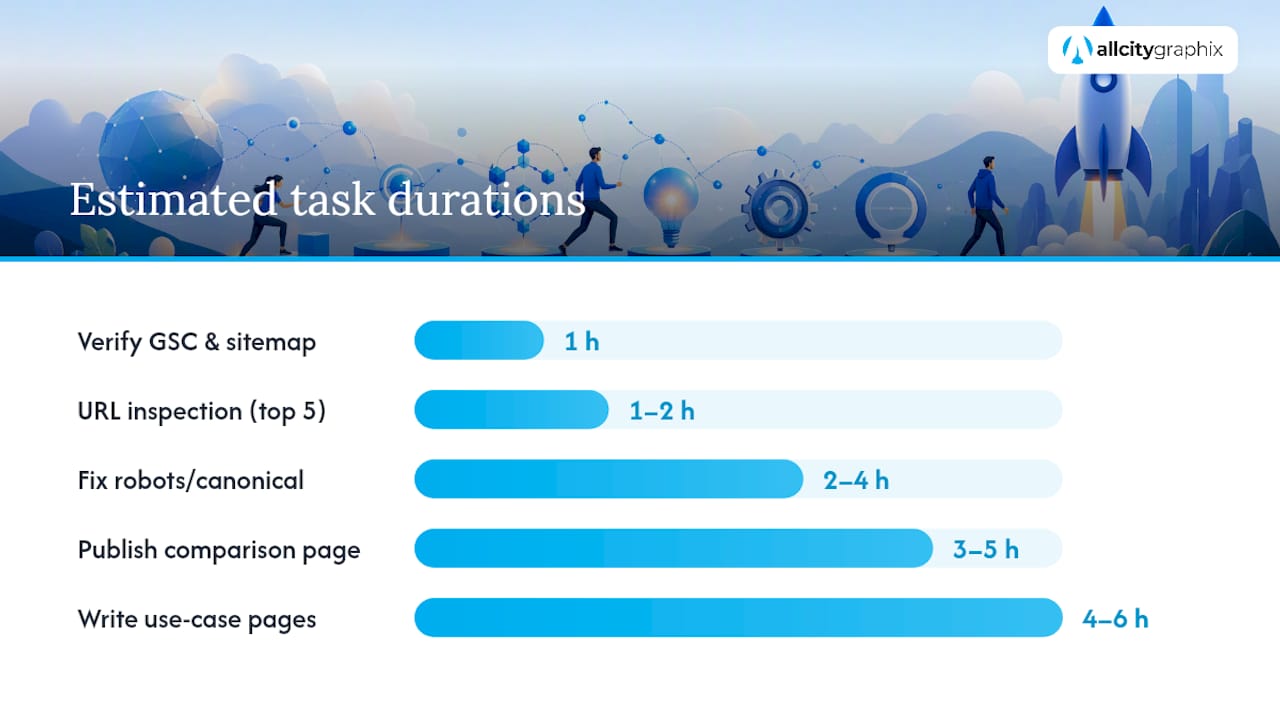
- Verify Google Search Console and submit your sitemap. (Founder or developer, 1 hour)
- Run URL Inspection on your five most important commercial pages. (Developer, 1 to 2 hours)
- Fix robots.txt, noindex, and canonical errors found in step 2. (Developer, 2 to 4 hours depending on issues found)
- Confirm key marketing pages render without JavaScript dependency issues. (Developer, variable, often a half-day for a framework migration fix)
- Publish one defensive comparison or “why choose us” page. (Marketer or founder, 3 to 5 hours to research and write)
- Build your narrow, buyer-intent keyword list. (Marketer, 2 to 3 hours using Search Console plus one keyword tool)
- Map each keyword to a specific page and conversion goal. (Marketer, 1 to 2 hours)
- Write and publish two to three use-case or integration pages. (Marketer, 4 to 6 hours each)
- Reach out to two to three integration partners or customers for a case story or link opportunity. (Founder or marketer, ongoing, 2 to 3 hours per outreach cycle)
- Review Search Console data monthly and decide whether to scale, hire, or contract. (Founder, 1 hour monthly)
The decision points worth flagging: once you’re spending more than four to five hours a week on this and still falling behind, that’s your signal to either bring in a contractor for specific technical work or consider a retainer arrangement, rather than letting SEO quietly eat time meant for product work. A technical SEO audit at this stage often surfaces exactly which steps above need outside expertise versus which your team can keep handling in-house.
Pro Tip: Run steps 1 through 4 as a hard gate before you publish anything else. A common failure mode is writing great content on pages Google never actually indexes because nobody checked rendering first.
Who’s Behind This Playbook
The team has spent many years building brands, websites, and marketing systems for companies ranging from early-stage startups to established businesses, working through a discovery-led process that pairs strategic positioning with hands-on execution. Their services map directly onto the playbook above: technical audits that catch crawlability problems before they cost months of invisible pages, landing pages and comparison content built around real buyer intent, and content refreshes that keep defensive pages current as products and competitors change.
Project types the team regularly delivers include use-case landing pages built for conversion, technical SEO reviews for sites migrating to new frameworks, and ongoing content strategy work for companies moving from a handful of pages to a structured content library. [Specific case studies and client results are available directly.]
What Founders Get Wrong About SEO Most Often
The most expensive mistake isn’t a bad keyword choice. It’s publishing content before confirming Google can actually index it, then wondering months later why traffic never showed up. A close second is chasing a perfect Core Web Vitals score while a revenue-generating comparison page sits unpublished in a queue, or starting an aggressive content push before product-market fit, then rewriting half of it six months later.
The habit that actually works is boring: publish, measure, refresh. Repeat that loop consistently and you’ll outperform teams chasing the next SEO trick.
— Alex
How All City Graphix Executes This Playbook for You
This option is for startups who’d rather hand the checklist above to a team that’s already run it, instead of learning technical SEO by trial and error while also trying to ship product. Where a DIY approach means a founder splitting attention between Search Console errors and everything else on their plate, They run the technical audit, build the defensive comparison and use-case pages, and keep the refresh cadence going as an ongoing part of the work.

That starts with a discovery conversation to see where your site actually stands: what’s indexed, what’s missing, and which pages would move the needle fastest if built correctly. From there, the path typically runs through a technical SEO audit to catch crawlability issues, then into an ongoing SEO service arrangement built around the buyer-intent pages this guide walks through. If you’re ready to see what a discovery audit would surface for your site, check out All City Graphix’s full services and get started.
Sources
- SEO Starter Guide: The Basics | Google Search Central
- Non-obvious SEO advice for startups – PostHog
- SEO for Startups: A Stage-by-Stage Playbook | CXL
FAQ
Do Startups Need SEO?
Yes, but timing matters more than urgency. Startups benefit most from SEO once they have product-market fit and stable messaging, since content built on positioning that later changes often needs a rewrite, according to PostHog’s guidance for early-stage teams. Before that point, a handful of defensive technical checks and one comparison page are usually enough.
What Is the 80/20 Rule for Startup SEO?
The highest-return 20% of effort is technical crawlability plus a small set of buyer-intent pages, comparisons, integrations, and use-case docs, rather than broad blog content. Following the Google Search Central starter guide for indexability and the CXL narrow-keyword approach covers most of that leverage.
How Do You Start SEO As a Beginner Founder?
Start by verifying Google Search Console, submitting your sitemap, and checking that your key pages render properly using URL Inspection. Once that’s confirmed, build one defensive comparison page and a short list of narrow, problem-led keywords tied directly to what you sell.
How Much Does SEO Cost for a Startup?
Costs vary widely depending on scope, from a founder handling technical checks solo to a full retainer covering content, technical audits, and ongoing link outreach. All City Graphix’s SEO pricing is available directly through its services page, since scope depends on what a given site actually needs.
How Long Until Startup SEO Shows Results?
Meaningful organic traffic typically takes several months to build, longer in competitive categories, since new pages need time to be crawled, indexed, and to earn ranking signals. Tracking impressions and clicks in Search Console early gives you the first signal that pages are being seen before rankings or conversions follow.