

Expect to pay between $500 and $6,000 to launch a basic Shopify store yourself or through a freelancer, $2,000 to $6,000 for an agency-built small business site, and $20,000 or more for custom or headless enterprise builds. Running costs typically add tens to several hundreds of dollars per month in apps, plan fees, and payment processing. Start by validating your concept on a paid theme before you commit budget to custom development.
TL;DR:
- The first-year total cost for a Shopify store varies widely from under $1,000 for DIY setups to over $30,000 for custom or headless builds, plus ongoing monthly expenses.
- Custom themes, design, integrations, and advanced functionalities significantly increase one-time costs, with custom themes costing up to $15,000 and complex integrations tripling initial expenses.
- Most ongoing costs come from platform fees, plus a growing app stack that can reach several hundred dollars monthly, and payment processing fees that depend on sales volume and gateway choice.
- Budgeting should focus on total first-year expenses, including recurring app, fee, and maintenance costs, rather than just initial build prices.
- Validating demand on a paid theme and lean app stack helps control costs and ensures custom development is justified by actual revenue.
Table of Contents
- How Much Does Shopify Development Cost? A Quick Comparison
- One-Time Build Costs: Theme, Design, Custom Code, and Integrations
- Ongoing Costs: Plans, Apps, Fees, and Maintenance
- Who Should Build Your Store: Freelancer, In-House, or Agency?
- Your Pre-Quote Checklist and Realistic Timelines
- How All City Graphix Scopes Shopify Projects to Control Cost
- Where the Real Budget Risk Hides
- Ready to Get a Real Quote for Your Shopify Store?
- Where to Verify These Numbers Yourself
- Sources
- FAQ
How Much Does Shopify Development Cost? A Quick Comparison
The number you land on depends almost entirely on which of three paths you take, and the gap between them is bigger than most first-time store owners expect.
A DIY starter build runs lean. Pick Shopify’s Basic plan, buy a domain for around $15 a year, add one or two apps for reviews or email, and you’re looking at a few hundred dollars in setup time plus roughly $39 a month in platform fees. Do it over a weekend and your entire Year 1 cost might land under $1,000, not counting your own labor.
An agency-built store sits in a different tier. Industry breakdowns put a realistic small business build between $2,000 and $6,000 one time, with Year 1 recurring costs — plan fees, apps, and payment processing — commonly adding another $500 to $2,500 depending on how many apps you run.
Custom or headless enterprise builds are their own category entirely. Once you need ERP integration, a custom checkout, or a fully decoupled frontend, one-time costs commonly exceed $20,000, and that’s before you factor in the Shopify Plus subscription starting at $2,300 a month.
Quick Year 1 snapshot:
- DIY store: roughly $600–$1,200 total (platform, domain, two apps, your own time)
- Agency-built store: roughly $4,000–$10,000 total (build cost plus a year of hosting, apps, and fees)
- Custom/headless build: $30,000–$60,000+ total in the first year, including platform and developer retainer costs
Pro Tip: Add up 12 months of app and platform fees before you sign off on any proposal — the “cheap” one-time build price often hides a substantial monthly app stack that triples your real first-year number.
One-Time Build Costs: Theme, Design, Custom Code, and Integrations
Every Shopify project starts with the same basic decision: how much of the store gets built from scratch versus assembled from existing parts. That decision drives most of your one-time cost.
Themes are the cheapest lever you control. A free theme from Shopify’s library costs nothing and works fine for a straightforward catalog. A premium theme typically runs a low to mid triple-digit amount one time and buys you better layout options and built-in features like quick-view modals or advanced filtering. A fully custom theme, coded from a blank canvas, usually costs $3,000 to $15,000 depending on how many unique page templates you need.
Design and photography matter more than most new store owners budget for. Product photography, custom graphics, and a cohesive visual identity commonly add $500 to $3,000 to a project, and skipping this step tends to show up later as a conversion problem rather than a line item. Given that mobile traffic dominates most e-commerce sessions, design work that isn’t tested on a phone screen first is money spent in the wrong order.
Custom development scales in three rough tiers:
- Small customizations (custom sections, minor layout tweaks, third-party app integration): $500–$2,500
- Full custom theme build with unique templates for collections, product pages, and landing pages: $5,000–$15,000
- Advanced checkout or subscription functionality, which usually requires Shopify Plus: $10,000–$30,000+
Integration complexity is the multiplier that surprises the most first-time budgeters. Connecting an ERP system, a product information management platform, or multiple marketplace channels (Amazon, Walmart, eBay) doesn’t just add a flat fee. Each integration point adds testing time, error handling, and often a monthly sync fee on top of the development cost. A store selling on Shopify alone might spend $3,000 on integrations; the same store syncing inventory across three marketplaces and an ERP could see that number triple.
The pattern across most agency guides is consistent: platform fees are a small fraction of total spend once you add up design, custom code, and integration work. The build itself is where the real budget goes.
Ongoing Costs: Plans, Apps, Fees, and Maintenance
Shopify’s subscription tiers set the floor for your monthly bill, but they’re rarely the biggest number on it.
Shopify currently prices Basic at $39 a month on a monthly cycle, with a lower effective rate if you commit annually. The Grow and Advanced tiers step up from there, both offering a discount for annual billing, and Shopify Plus starts at $2,300 a month for high-volume or highly customized stores. Choosing annual billing over monthly can meaningfully cut your effective monthly rate, which matters if you’re planning a multi-year run rather than testing the waters.
App subscriptions are where costs quietly climb. A brand-new store might run one email app and one review app for $30–$50 a month combined. A growing store juggling inventory sync, upsells, loyalty, and advanced SEO tools commonly lands in the low to mid triple-digit range per month, and established stores with complex operations can push past $400 monthly once you count every subscription.
Payment processing is the line item most new merchants underestimate. Here’s the math on a $100 sale: with Shopify Payments, you pay only the card processing rate, typically around 2.9% plus $0.30 for online transactions on the Basic plan. If you use a third-party payment gateway instead, Shopify adds its own transaction fee on top of whatever your gateway charges, meaning that same $100 sale can cost you noticeably more in combined fees. The fix is simple: using Shopify Payments removes the extra platform fee entirely, which is why almost every agency recommends it unless you have a specific reason not to.
Maintenance is the ongoing cost most new store owners forget to plan for. A basic store needs a few hours a month for bug fixes, app updates, and small tweaks, often around a few hundred dollars monthly if you’re paying a freelancer or agency for it. A more complex store with custom code and multiple integrations can need 10–20 hours a month, which starts to look like a part-time developer relationship rather than an occasional favor.
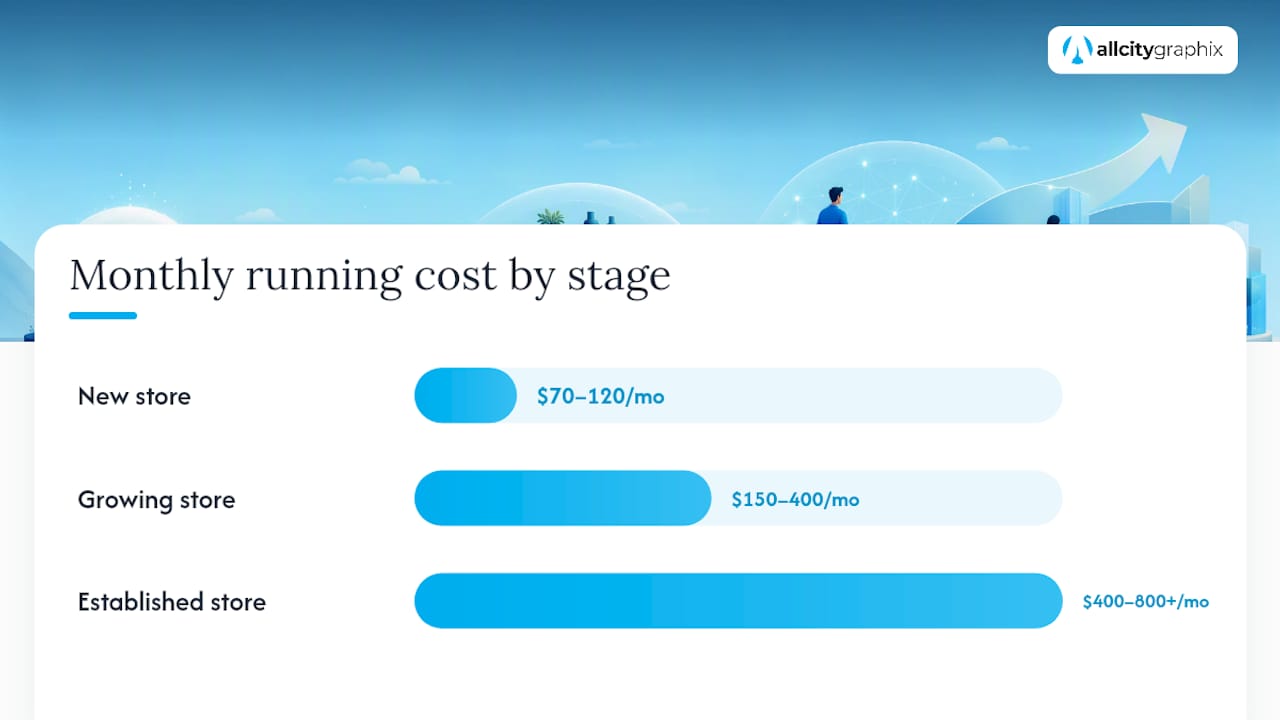
Typical monthly running cost by store stage:
- New store, minimal apps: $70–$120/month (plan + 2 apps + processing)
- Growing store, moderate app stack: $150–$400/month
- Established store with custom features: $400–$800+/month
Who Should Build Your Store: Freelancer, In-House, or Agency?
The right resourcing model depends less on your budget and more on how much ongoing complexity your store actually has, and getting this wrong is the single most common way small businesses overspend.
- Junior freelancers ($25–$50/hour) work well for simple theme customizations, small bug fixes, or basic app setup. Expect slower turnaround and more back-and-forth on scope, since junior talent often needs clearer direction to hit the mark.
- Mid-level freelancers or small studios ($50–$100/hour) handle full theme builds, moderate custom development, and straightforward integrations. This tier is where most $2,000–$8,000 projects live.
- Senior developers or specialized Shopify Plus partners ($100–$200+/hour) take on complex checkout customization, headless architecture, and multi-system integrations. Projects here routinely start at $15,000 and climb from there.
- Full-service US agencies typically blend rates across a team, meaning you pay a blended hourly rate that covers design, development, project management, and QA together rather than a single developer’s time.
The trade-off isn’t just price. A freelancer at $40 an hour might look cheaper than an agency quote, but if there’s no project manager checking their work against your requirements, you inherit the QA burden yourself, and technical debt from rushed code tends to surface six months later as an expensive fix. A retainer relationship, whether with a freelancer or an agency, tends to make sense once your store needs monthly attention, roughly 8 or more hours, rather than occasional one-off requests. Below that threshold, a project-based freelancer engagement usually costs less over a year.
Your Pre-Quote Checklist and Realistic Timelines
A workable budgeting formula looks like this: baseline build cost, plus a 15–25% contingency for scope changes, plus your estimated first-year recurring costs for apps, plan fees, and processing. Skip the contingency and you’ll almost certainly renegotiate mid-project when “just one more feature” requests start arriving.
Timelines vary by build type:
- Lean DIY or template launch: 1–2 weeks, mostly limited by how fast you can gather product photos and copy.
- Agency-built small business store: 4–8 weeks, with milestones typically at discovery/wireframes, design approval, development, and QA before launch.
- Complex or headless project: 3–6 months, often broken into phases so early revenue can help justify later integration spend.
Before you request quotes, gather your product data, final images, shipping rules, and tax setup requirements. Vendors who quote without asking about these details are usually guessing, and guessed quotes rarely survive contact with reality.
Standard questions to ask any developer or agency:
- What’s included in the one-time price, and what counts as a change request?
- Is there a maintenance plan, and what does it cost after launch?
- What’s the warranty or bug-fix window post-launch?
- How many rounds of design revision are included?
Pro Tip: A proposal with a vague deliverables list, no mention of a post-launch warranty, or no maintenance plan at all is a red flag. Ask for specifics before you sign, not after.
How All City Graphix Scopes Shopify Projects to Control Cost
Every Shopify engagement at All City Graphix starts with a discovery conversation, not a price quote. We ask about your product catalog, your growth plans, and what “done” actually looks like for your business before we scope anything, because a proposal built on guesses is a proposal that gets renegotiated later.
From there, clients typically receive a scoped proposal covering design, development, and basic SEO setup as a package, followed by design mockups, build, QA, and launch, with retainer options available for ongoing maintenance and small updates after the store goes live.
Our advice mirrors what the wider industry increasingly recommends: validate demand on a paid theme and a lean app stack before committing to expensive custom development. Real sales data makes a far stronger case for a $15,000 custom checkout feature than a hunch does. Staging the work this way, template first, custom features once revenue justifies them, keeps upfront spend proportional to actual demand instead of projected demand.
Where the Real Budget Risk Hides
Most Shopify budgeting advice focuses on the wrong number. Business owners fixate on the one-time build price because it’s the biggest single figure on a quote, but the number that actually determines whether your store is profitable in Year 1 is the recurring cost stack: apps, payment processing, and maintenance hours that compound month after month.
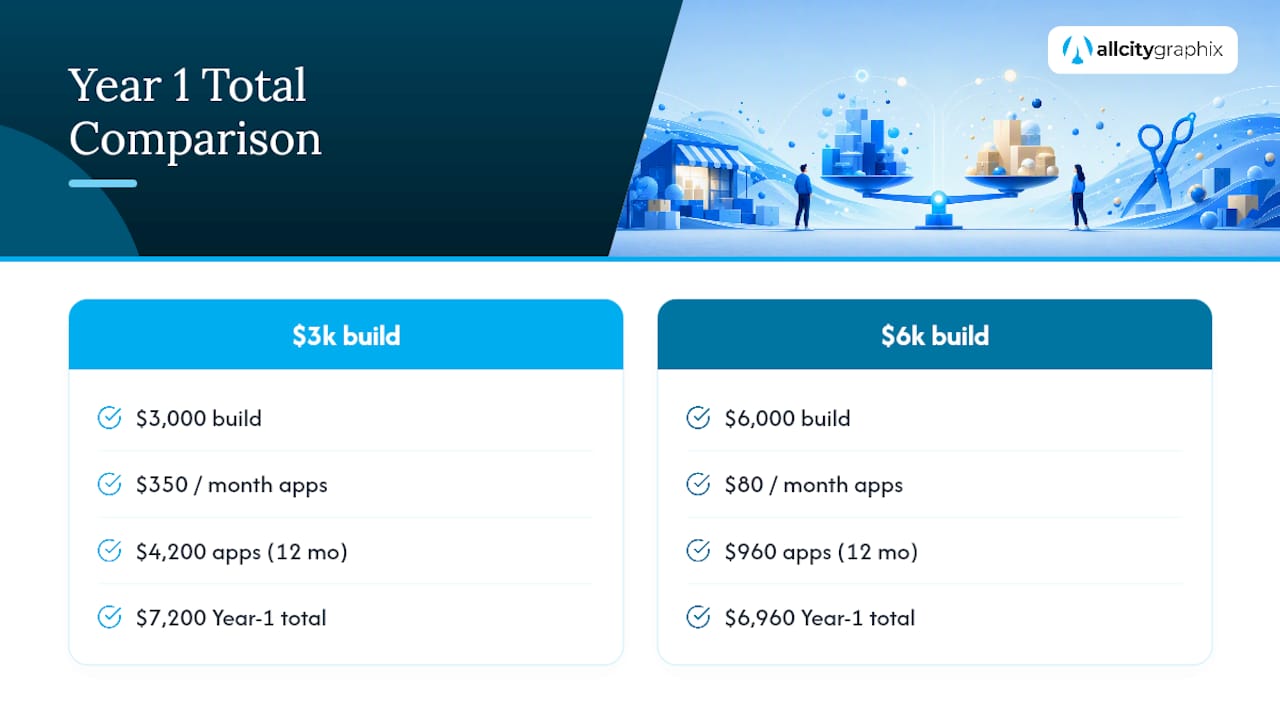
The conventional advice to “get three quotes and pick the middle one” misses this entirely. A $3,000 build with a bloated $350-a-month app stack can cost more over 12 months than a $6,000 build with a lean $80-a-month stack. Compare total cost of ownership, not the headline number.
Here’s where I’d push back on common practice: too many small businesses build the full custom vision on day one instead of testing on a paid theme first. That instinct to launch “right” the first time is understandable, but it’s usually the more expensive path when demand is still unproven. Validate first. Spend the custom development budget once your sales data tells you where it will actually pay off, not before.
If there’s one number worth memorizing from all of this, it’s not the build price. It’s your projected Year 1 total, build cost plus twelve months of apps, fees, and upkeep, because that’s the figure that actually predicts whether your store is a good investment.
— Alex
Ready to Get a Real Quote for Your Shopify Store?
Some Shopify stores are built with a clear scope, transparent pricing, and staged feature implementation to avoid overspending before sales data supports custom development.

A discovery call with our team covers your product catalog, growth goals, and current pain points, and it leads to a scoped proposal, not a generic price sheet. Typical starting packages for Shopify stores may include design, development, and basic SEO setup bundled together, along with defined timelines and potential maintenance options after launch. If your store needs custom theme work or a full brand refresh alongside the build, our web design portfolio shows the range of projects we’ve delivered for small businesses. Ready to see what a scoped proposal looks like for your store? Visit our services page and request a quote to get a real number instead of a guess.
Where to Verify These Numbers Yourself
For live plan pricing and transaction fee rules, check Shopify’s own pricing page directly, since rates change. For broader platform cost context, Shopify’s 2026 website cost guide and comparative breakdowns from platform review sites like Polsia’s platform alternatives guide offer useful secondary reference points.
Sources
- Shopify Pricing: Find the Right Plan for Your Business – Shopify
- How Much Does Shopify Cost in 2026? Agency Breakdown | Echovyn Labs
FAQ
How much does a Shopify developer cost?
Hourly rates typically range from $25–$50 for junior freelancers to $100–$200+ for senior developers or specialized agency talent, with most small business projects landing between $2,000 and $8,000 total for a mid-level build.
How much does Shopify take from a $100 sale?
With Shopify Payments, you pay only the card processing rate, commonly around 2.9% plus $0.30 online on the Basic plan; using a third-party gateway instead adds an extra platform transaction fee on top of your gateway’s own rate.
Is Shopify still worth it in 2026?
For most small and mid-size businesses, yes. Shopify’s plan fees remain a small fraction of total running costs compared to apps and processing, and the platform’s ecosystem of themes and integrations still outpaces most alternatives for speed to launch.
How much does it cost to build a Shopify store?
Budget $500–$6,000 for a DIY or freelancer build, $2,000–$6,000 for an agency-built small business store, and $20,000 or more for custom or headless enterprise projects, plus $40–$400+ a month in ongoing app and platform costs.