

Fix your Google Business Profile, publish one neighborhood landing page that backs it up, and start a compliant review program. Do these three things first and you’ll improve local visibility in New York City within weeks, not months. Everything else in local search optimization for New York businesses builds on that foundation.
Here’s the quick start:
- This week: Audit your Google Business Profile categories, hours, and photos; fix anything outdated.
- Next two weeks: Draft one neighborhood-specific page tied to a real service area, not a generic city-wide page.
- Ongoing: Launch a review request workflow tied to your point-of-sale or booking system.
Measure progress through calls, direction requests, and form fills, not just where you rank on a screenshot. Rankings shift by block in a city this dense. Leads don’t lie.
Key Takeaways
Local visibility in NYC comes down to fixing Google Business Profile accuracy, building genuinely local neighborhood content, and running a consistent review program measured by calls and leads, not just rankings.
| Point | Details |
|---|---|
| Fix GBP first | Correct categories, hours, services, and photos before investing in new content or links. |
| Build real neighborhood pages | Include local landmarks, specific service angles, and LocalBusiness schema to avoid thin doorway pages. |
| Track geo-grid rankings | Measure visibility from multiple points across your service area, since NYC rankings shift block by block. |
| Report leads, not just rankings | Tie performance to calls, direction requests, and form fills using call tracking and separate Maps versus organic metrics. |
| Work with a unified team | All City Graphix combines web design, GBP cleanup, and local content under one roof for NYC businesses. |
Table of Contents
- Google Business Profile Optimization for NYC Businesses
- Why Does NAP Consistency Still Break NYC Rankings?
- Building Review Velocity Without Breaking the Rules
- Do Neighborhood Landing Pages Actually Help Rankings?
- Technical Fixes That Quietly Suppress Local Rankings
- What Should NYC Local SEO Reporting and Pricing Look Like?
- How Local Competitor Analysis Works in a Dense Market
- Local Link Building Strategies Specific to NYC
- Community Engagement as a Content Strategy
- Voice Search and Mobile Behavior in Local Queries
- A 30-Day Starter Plan for a Small NYC Business
- How All City Graphix Can Help Your NYC Business Get Found
- Sources
- FAQ
Google Business Profile Optimization for NYC Businesses
Your Google Business Profile is the single highest-leverage asset in local seo nyc work, and most NYC businesses have one that’s quietly sabotaging them. A dentist in Astoria with the wrong secondary category, stale hours, or zero photos loses Map Pack visibility to a competitor three blocks away who filled theirs out correctly.
Start here:
- Pick precise categories. Your primary category should match the exact service someone searches for, not the broadest option available. A “Bakery” that only does custom cakes should list “Cake Shop” or “Custom Cake Shop” as primary, then add secondary categories for volume.
- Fill in services and attributes completely. Google uses these fields to match your listing against long-tail neighborhood queries you’ll never rank for on your website alone.
- Keep hours accurate, including holidays. A wrong “closed” status on a Sunday costs you the call before the searcher ever reaches your site. Mark “temporarily closed” status promptly if you’re renovating or between locations.
- Post weekly and answer every Q&A entry. Profiles with regular photo uploads and posts tend to show more engagement signals than static listings.
- Confirm your service-area setup matches reality. Storefront businesses should show an address; service-area businesses (plumbers, cleaners, contractors) should hide the address and list boroughs served instead of faking a storefront.
Pro Tip: Audit your GBP quarterly. Categories and attributes get reset or duplicated more often than owners realize, especially after Google rolls out profile updates.
Fixing these fundamentals often moves the needle faster than any content project, since GBP optimization and citation work sit at the center of most NYC local search programs.
Why Does NAP Consistency Still Break NYC Rankings?
Your business name, address, and phone number (NAP) need to match, character for character, across every directory that lists you. Search engines treat mismatched data as a trust problem, and inconsistent citations and duplicate listings are one of the most common reasons NYC businesses stay invisible for “near me” searches.
Run this audit:
- Search your business name plus each borough you serve and check every result for old addresses or dead phone numbers.
- Prioritize Google Business Profile, Bing Places, Apple Maps, Yelp, and industry-specific directories like Angi or Avvo depending on your sector.
- Look for duplicate GBP listings created by movers, franchise changes, or old marketing vendors. These are common in NYC where businesses relocate between boroughs frequently.
- Fix the master record first (usually GBP), then work outward to secondary directories.
- Document every correction in a simple spreadsheet with the directory name, date fixed, and old versus new data, so the next audit takes an hour instead of a week.
A paid citation cleanup service makes sense once you’re juggling more than 20 to 30 listings or multiple locations. For a single storefront, a focused afternoon usually gets you most of the way there.
Building Review Velocity Without Breaking the Rules
Review count, recency, and average rating all factor into how Google ranks you against nearby competitors, and in a market as saturated as New York, a two-month-old review beats a two-year-old one every time.
Do this consistently:
- Ask at the moment of highest satisfaction, not three days later in a generic email blast. A text sent right after checkout or service completion converts far better than a follow-up newsletter.
- Use a short, specific script. Something like: “If you have 30 seconds, a Google review helps other neighbors in [borough/neighborhood] find us.” Naming the neighborhood makes the ask feel personal instead of automated.
- Respond to every review within 48 hours, positive or negative. A thoughtful response to a one-star review, addressing specifics without getting defensive, often does more for conversion than five generic five-star replies.
- Tie the request into your existing workflow. Point-of-sale systems, booking software, and invoicing tools can often trigger an automatic review request after a transaction closes.
Pro Tip: Track review velocity monthly, not just total count. A business with 40 reviews gained steadily over a year usually outranks one with 40 reviews all posted in a single week, because sudden spikes read as unnatural.
Report review growth alongside call volume. The correlation between the two is usually obvious within a quarter.
Do Neighborhood Landing Pages Actually Help Rankings?
Yes, but only when they contain real local substance. A page that swaps “Brooklyn” for “Queens” and changes nothing else is a doorway page, and Google treats it that way. A neighborhood page earns its rank when it reads like it was written by someone who has actually worked in that neighborhood.
Include on every page:
- A specific service angle tied to that area (basement waterproofing in flood-prone parts of Red Hook, storefront signage compliance near landmark districts in Greenwich Village).
- References to real landmarks, transit lines, or building types common to that neighborhood.
- Testimonials or project mentions specific to that area, not recycled boilerplate.
- LocalBusiness schema markup with the correct service area, geo-coordinates, and business hours, so search engines can parse the page’s local relevance without guessing.
- Internal links connecting each neighborhood page back to a central service page and sideways to adjacent neighborhood pages, forming a coherent local network instead of orphaned pages.
Aim for at least 400 to 600 words of genuinely unique content per page. A template is fine as a starting structure, but every section needs neighborhood-specific detail swapped in, not just the name. If you serve 15 neighborhoods and can only write real detail for six, publish six strong pages first. Neighborhood pages built on real local context hold up far better against future algorithm scrutiny than a rushed batch of a dozen thin ones.
Technical Fixes That Quietly Suppress Local Rankings
A beautifully optimized GBP profile can’t save a website that loads slowly or hides its own neighborhood pages from search engines. Technical hygiene is unglamorous, but it’s often the difference between a local page ranking and one that never gets indexed.
Work through this list:
- Check mobile page speed first. The majority of “near me” searches happen on a phone standing on a sidewalk, and Core Web Vitals scores directly affect how Google treats a page on mobile.
- Confirm every neighborhood page is actually indexed. Search “site:yourdomain.com [neighborhood name]” and see if it appears. Pages buried in navigation or blocked by a stray robots.txt rule never show up in results no matter how good the content is.
- Resolve duplicate content and canonical tags. Multiple neighborhood pages with near-identical text confuse search engines about which one to rank, and they may rank none of them.
- Place LocalBusiness schema on your homepage and every neighborhood page, including accurate service area, phone, and hours that match your GBP exactly.
- Check your hosting response time. A shared hosting plan that spikes load times during traffic bursts can quietly tank both user experience and crawl frequency.
A website redesign often surfaces several of these issues at once, since older sites tend to accumulate technical debt that nobody notices until rankings stall.
What Should NYC Local SEO Reporting and Pricing Look Like?
Rankings alone don’t tell you whether the phone is ringing. A useful local seo nyc report separates Maps performance (profile views, calls, direction requests) from organic website performance (keyword position, sessions, form fills), because they respond to different fixes.
Watch for these signals:
- Geo-grid rank tracking, which measures your rank from dozens of simulated points across a service area rather than one central address. This method reveals blind spots a single rank check would never show, since a business can rank well in Midtown and be invisible ten blocks north.
- Call tracking with a dynamic number so every lead source, GBP, organic search, or paid, gets credited correctly.
- A written 30/60/90 day plan naming specific deliverables for each phase, not a vague promise of “ongoing optimization.”
Agencies working in NYC generally recommend structuring monthly work around clear deliverables tied to leads rather than vanity metrics, and pricing typically reflects that structure. Expect the low end for a single-location business in a less competitive category, climbing well past that for competitive fields like law, medical, or real estate, where dense competition and higher stakes push costs up across the market.
How Local Competitor Analysis Works in a Dense Market
Studying competitors in NYC means more than checking who ranks first citywide. It means checking who ranks first from your customer’s actual location, since Map Pack results shift block by block in a market this dense.

Pull the top three to five competitors that appear consistently across the neighborhoods you serve, not just downtown or midtown. For each one, note their GBP category selection, review count and velocity, whether they have neighborhood-specific pages, and how their site performs on mobile. A competitor with 200 reviews and a slow, generic website is beatable. A competitor with 40 reviews and six sharp neighborhood pages targeting exactly your service area is the one to study closely.
Pay attention to gaps, not just strengths. If every competitor in your category has ignored a neighborhood you could realistically serve, that’s an opening. If they’ve all built the same thin, templated location pages, a genuinely detailed one gives you room to outrank them without a massive budget.
Check citation overlap too. If a competitor shows up on ten directories you’re missing, that’s a quick, low-cost fix rather than a mystery to solve. And revisit this analysis every quarter, since NYC’s competitive set shifts fast. New businesses open, old ones close, and a competitor that dominated a neighborhood last year might have let their profile go stale since.
The goal isn’t to copy what works for someone else. It’s to understand the baseline you’re competing against so your GBP work, review program, and neighborhood pages target real gaps instead of guesses.
Local Link Building Strategies Specific to NYC
Local links carry more weight than generic ones because they signal geographic relevance search engines can’t fake with content alone. A link from a Brooklyn Chamber of Commerce directory or a Manhattan business improvement district page tells Google something a national directory listing never will.
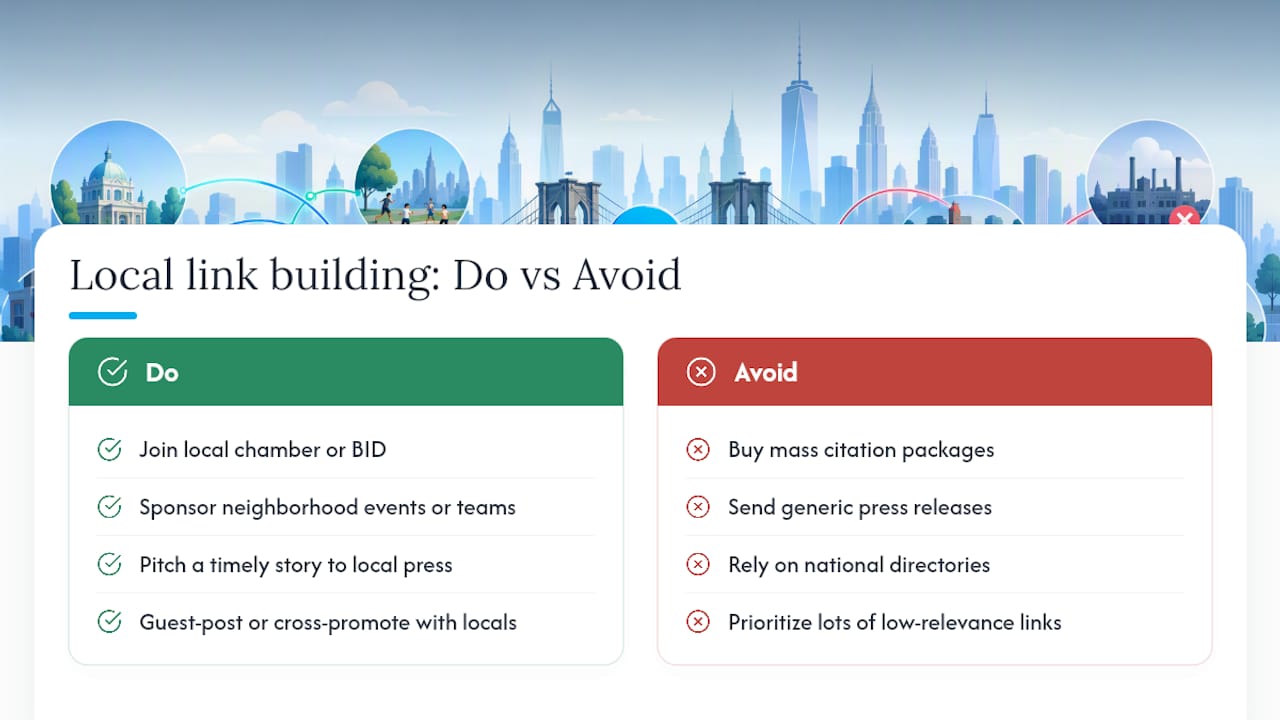
Start with organizations you already belong to or could join: your local chamber of commerce, a Business Improvement District (BID), a trade association chapter, or a neighborhood merchants group. Most of these maintain member directories with a link back to your site, and the application process is usually just a membership fee.
Sponsorships work well in NYC’s dense community structure. Sponsoring a local little league team, a block association event, or a school fundraiser often earns a link from that organization’s site, along with real community goodwill that supports your review program.
Local press is more accessible than most business owners assume. Neighborhood blogs, borough-specific news sites, and community Facebook groups with active moderators sometimes cover small business openings, renovations, or milestones if you pitch a specific, timely angle rather than a generic press release.
Guest contributions to local industry associations or partnering with complementary (non-competing) local businesses for cross-promotion both work here too. A contractor and an interior designer serving the same neighborhood can link to each other’s project pages without stepping on each other’s customer base.
Avoid mass-purchased citation packages that promise dozens of links overnight. They rarely hold up, and NYC’s local search environment rewards a smaller number of genuinely relevant, geographically tied links over a large pile of generic ones.
Community Engagement as a Content Strategy
Localized content works when it reflects something real happening in the neighborhood, not a rewritten version of a national blog post with a borough name inserted. A HVAC company writing about how NYC’s building codes affect boiler replacements in prewar walk-ups tells a more useful story than a generic “signs you need a new furnace” post.
Cover neighborhood events, local regulation changes that affect your industry, and seasonal issues specific to your service area. A landscaper writing about rooftop garden permits in Queens co-ops, or a bakery covering a local street fair they’re vending at, both generate content that real neighbors search for and share.
Community engagement extends beyond content. Sponsoring a block party, participating in a local farmers market, or partnering with a neighborhood school on a fundraiser generates the kind of organic mentions, photos, and social shares that reinforce your local relevance in ways a blog post alone can’t. A restaurant that ties its marketing calendar to neighborhood events tends to build a more loyal, locally engaged following than one that only posts about its menu.
This content also feeds your review program and neighborhood pages. A blog post about a local event can link directly to the neighborhood landing page for that area, and satisfied attendees are prime candidates for a review request while the experience is still fresh.
Voice Search and Mobile Behavior in Local Queries
Voice search queries tend to be longer and more conversational than typed ones. Someone typing might search “plumber Astoria,” but someone using voice search on their phone is more likely to ask “who’s the best plumber near me open right now.” That shift toward natural language rewards businesses with complete, accurate GBP data far more than it rewards clever website copy.
Since most voice queries in NYC happen on a phone while someone is already out and moving, mobile page speed and clear calls to action matter more here than almost anywhere else in local search optimization. A neighborhood page that takes six seconds to load loses that searcher before they see your phone number.
Structure content to answer direct questions naturally. A construction company page written for a specific project type reads more naturally to both readers and voice assistants than one stuffed with keyword variations. Structured content that clearly states hours, services, and location, the same kind of detail-forward approach used in vertical-specific landing pages, tends to surface more reliably when a voice assistant is pulling a direct answer.
Keep your GBP hours and phone number perfectly synced with your website, since voice assistants often pull directly from whichever source seems most current and consistent. Any mismatch there doesn’t just confuse readers. It can cause the assistant to surface an outdated number instead of the one that actually rings your desk.
A 30-Day Starter Plan for a Small NYC Business
Week one: fix every GBP field, categories, hours, services, and photos. Week two: publish one genuinely detailed neighborhood page tied to your best service area. Weeks three and four: launch a review request workflow and respond to every incoming review within 48 hours.
At day 30, measure calls, direction requests, and form fills, not rankings alone. The owner handles day-to-day review responses; an agency handles technical fixes, schema, and reporting. Expect modest, real movement, not overnight dominance.
How All City Graphix Can Help Your NYC Business Get Found
All City Graphix is the alternative to hiring a generic SEO vendor and a separate web design shop for the same local visibility problem. Because branding, web design, and digital marketing all happen under one roof, your neighborhood pages, GBP cleanup, and site performance get built to work together instead of arriving as three disconnected projects from three different vendors.

Our team handles the technical side of local seo nyc work directly: website design and redesign built around mobile speed and clear conversion paths, neighborhood landing pages with real local content and schema markup, GBP profile cleanup, and reporting tied to calls and form fills rather than screenshots of rankings. With 15-plus years working with New York small businesses and startups across every borough, we’ve seen which fixes move the needle fast and which ones are a waste of a client’s budget.
A first consult typically starts with a quick audit of your GBP, citations, and site to flag the highest-impact fixes before any contract gets signed. If you want that audit for your business, visit All City Graphix or explore the full range of services to see where your site and profile currently stand.
FAQ
How much does local SEO cost in NYC?
Pricing varies by competitive category and cleanup scope, but NYC pricing tends to run higher than the national average because of dense competition and the extra citation and content work most profiles need.
What’s the best local SEO agency in New York City?
The best fit is an agency that ties deliverables to a written 30/60/90 plan and reports on calls and form fills rather than rankings alone. All City Graphix structures engagements this way, combining GBP cleanup, neighborhood pages, and site work under one team.
How much should I pay for local SEO?
Expect pricing to scale with your industry’s competitiveness and how much citation cleanup your business needs; a single-location business in a low-competition category pays less than one in a crowded field like law or real estate.
How do I get started with local SEO in NYC?
Start with a full Google Business Profile audit, fix any NAP inconsistencies across directories, and publish one detailed neighborhood landing page before expanding to link building or broader content.