

Early signals show up in four to eight weeks. Meaningful traffic and ranking gains typically land in three to six months. The bigger, authority-driven wins, the kind that change revenue, usually take six to 12 months or longer. This isn’t guesswork. Search Engine Land’s timeline guide and Google’s own developer guidance both point to the four-month-to-one-year range for seeing real benefit from SEO work, and that guidance has held up for years because the mechanics behind it (crawling, indexing, ranking, then clicking) haven’t changed.
“Results” isn’t one thing. It’s a sequence: Google indexes your pages, then those pages start generating impressions in Search Console, then some of those impressions turn into ranking positions worth watching, then positions produce clicks, and eventually clicks convert into leads or sales. Judging your SEO timeline by traffic alone in month two is like judging a marathon by the first mile split.
A few things stretch or compress that sequence:
- Domain age and authority. A five-year-old site with an established backlink profile moves faster than a brand-new domain.
- Technical health. Crawl errors, slow rendering, or blocked pages delay everything downstream.
- Competition. Ranking for “best coffee shop near me” in a small town is a different timeline than ranking for “business insurance.”
- Resources. A dedicated content and dev team compresses months into weeks; a solo owner working nights stretches the same plan out.
If you need faster visibility than organic search can deliver, paid search or local directory listings buy you time while SEO compounds in the background. But there’s no shortcut that replaces the sequence above.
TL;DR:
- Early indexing and impression signals generally appear within four to eight weeks, but meaningful ranking and traffic gains often take three to six months.
- Authority, site size, technical health, competition, and resource availability significantly influence how quickly a site moves through the SEO timeline.
- Tracking crawl errors, index coverage, and impressions in Search Console is crucial in the first two months before expecting notable ranking improvements.
- Significant organic revenue growth typically starts after six to 12 months, with authority-driven results requiring up to a year or more.
- Regular biweekly reporting on indexing and impressions helps maintain realistic expectations and guides strategic adjustments early in the process.
Table of Contents
- SEO Timeline Overview: What Happens in Each Phase
- What Should an SEO Implementation Schedule Look Like Month by Month?
- What Factors Speed Up or Slow Down Your SEO Timeline?
- What Should You Measure at Each Stage of Your SEO Timeline?
- How Fast Do Different SEO Tasks Actually Show Results?
- When Should You Reassess Your SEO Timeline?
- How All City Graphix Structures an SEO Engagement
- The Part of SEO Timelines Nobody Wants to Hear
- Get Your SEO Timeline Moving With a Structured 90-Day Plan
- Key Takeaways
- Sources
- FAQ
SEO Timeline Overview: What Happens in Each Phase
Every realistic SEO strategy timeline breaks into four bands, and the work in each one looks different because the goal in each one is different.
| Phase | Primary focus | What you should see |
|---|---|---|
| 0 to 3 months | Technical audit, fixes, foundational content | Indexing improves, impressions rise, no major ranking movement yet |
| 3 to 6 months | Content scaling, on-page refinement, early link building | Keyword positions shift, CTR improves on winning pages |
| 6 to 12 months | Authority building, content clusters, conversion optimization | Organic traffic grows meaningfully, some revenue attribution possible |
| 12+ months | Compounding, competitive keyword pursuit, brand search growth | Sustained rankings, branded search lift, AI citation visibility |
The first phase is mostly invisible work. You’re fixing crawl errors, cleaning up duplicate content, setting up proper redirects, and publishing the pages that should have existed already. None of this shows up as traffic yet. It shows up as fewer errors in Search Console and a cleaner index.
The 3 to 6 month band is where quick wins and compound investments start to diverge. A quick win might be rewriting five thin product pages that were already close to ranking. A compound investment is a content cluster you won’t see full value from until month nine, when internal links and topical depth start reinforcing each other.
Here’s the part most timeline charts skip: new domains and established domains do not move through these bands at the same speed. A site with zero backlink history often spends its entire first three months just earning enough trust signals to get crawled reliably. An established domain with existing authority can skip straight to content and link work in month one because the technical trust is already there. If you’re building an seo timeline for beginners on a brand-new site, add roughly one extra month to every band above.
What Should an SEO Implementation Schedule Look Like Month by Month?
A timeline is only useful if you can turn it into a task list. Here’s a practical seo planning phases breakdown, from week one through month 12.
Week 1 to Month 0: Audit and baseline
- Run a full technical audit: crawl errors, broken links, duplicate content, page speed, mobile usability.
- Set up or verify Google Search Console and Google Analytics, and confirm goal tracking is actually firing.
- Fix anything blocking crawlers outright: bad robots.txt rules, incorrect canonical tags, missing or broken sitemaps.
- Document your baseline: current rankings, current traffic, current conversion rate. You cannot measure progress without this.
This phase takes one to three weeks solo, or about a week for a small team. Skipping it is the single most common reason SEO timelines blow up later, because you end up fixing foundational issues in month five that should have been caught in week one.
Months 1 to 3: Fix, publish, connect
This is where the bulk of the technical debt gets cleared and the first real content goes live.
- Implement the critical fixes flagged in the audit: redirect chains, index bloat, slow-loading templates.
- Publish or substantially refresh four to eight priority pages, the ones targeting your highest-intent keywords.
- Build internal links between new and existing content so crawlers (and users) can find everything.
- Start light outreach: guest posts, partnerships, directory listings relevant to your industry.
- Watch indexing status and impression counts weekly. Rankings are not the metric here yet.
Pro Tip: Track “impressions per indexed page” in Search Console during this phase instead of raw traffic. A rising ratio means Google is starting to trust your content even before it ranks anywhere near page one.
Months 4 to 6: Scale and refine
By now you should have data telling you what’s working. Use it.
- Scale content production toward the topics and formats that generated impressions in months 1 to 3.
- Run a focused link-building push, prioritizing quality editorial links over volume. Link-building effects compound slowly, and links earned now typically show measurable ranking influence between months four and 12, not immediately.
- Revise thin or underperforming pages instead of abandoning them; often a rewrite outperforms a brand-new page.
- Track keyword position movement and click-through rate changes on pages that are now ranking in positions 20 to 50, since these are your best near-term opportunities.
SiteGround’s six-month tracking framework recommends this exact sequencing: indexing and impressions in months one and two, keyword positions in months three and four, and traffic and page performance in months five and six. If your numbers don’t roughly match that order, something upstream needs attention.
Months 7 to 12: Compound and convert
- Build out content clusters around your strongest topics rather than publishing isolated pages.
- Identify which pages already get solid traffic but convert poorly, and rework their calls to action and page structure.
- Scale outreach into real partnerships, not just one-off link placements.
- Start planning next year’s content calendar based on what’s actually ranking, not what you assumed would rank in January.
Semrush’s guidance frames this stretch in 90-day planning chunks and recommends tracking leading indicators like branded search growth and AI citation appearances alongside traditional rankings, since full revenue outcomes from a strategy reset often take two to four quarters to materialize.
Time investment, roughly: a solo operator should plan on 8 to 12 hours a week sustained across all 12 months. A small in-house team of two or three can compress the content and technical work into 15 to 20 combined hours a week and see months 4 to 6 progress arrive slightly earlier. An agency engagement, with dedicated strategists, writers, and developers running in parallel, often reaches the months 4 to 6 milestones by month three, simply because the workstreams aren’t competing for the same person’s time.

What Factors Speed Up or Slow Down Your SEO Timeline?
Two sites can run the identical seo project timeline and land in very different places by month six. Here’s why.
- Backlink profile and domain authority. A site with years of earned links doesn’t need to build trust from zero. It needs to add relevant content on top of existing authority, which moves faster.
- Site size and architecture. Large catalogs, JavaScript-heavy frameworks, and messy internal linking all slow crawling. Search Engine Land reports that large or JS-heavy sites can take up to nine times longer to process changes than simpler, well-structured sites, because rendering and indexing lag behind the crawl itself.
- Resource bottlenecks. A great SEO plan stuck behind a six-week developer queue moves at the speed of the queue, not the plan.
- Competition and query intent. Ranking for a low-competition local service term might take eight weeks. Ranking for a broad commercial term with a dozen well-funded competitors can take a year or more, if it happens at all without significant investment.
- Algorithm updates. Google rolled out multiple core updates in 2026, including changes in March and May. A core update landing mid-campaign can shift rankings independent of anything you did, which is exactly why short-term dips shouldn’t trigger a full strategy reversal.
None of these factors are fixed. A poorly structured site can be rebuilt. A thin backlink profile can be strengthened. But pretending they don’t affect your timeline is how expectations get set wrong from day one.
What Should You Measure at Each Stage of Your SEO Timeline?
Vanity metrics kill SEO patience. Watching the wrong number in month two convinces people the strategy isn’t working when it’s actually right on schedule.
Months 0 to 2, leading indicators: crawl stats, index coverage reports, and impression counts in Search Console. None of these predict revenue directly, but a flat impression count after eight weeks is a real warning sign worth investigating.
Months 3 to 4, intermediate indicators: keyword position shifts (even movement from position 45 to position 22 counts), click-through rate on ranking pages, and on-page engagement like time on page and scroll depth.
Months 5 to 6 and beyond, lagging indicators: organic sessions, goal completions, and, where attribution allows, revenue tied to organic channels.
| Stage | What to track | Tool |
|---|---|---|
| Months 0–2 | Crawl errors, index coverage, impressions | Google Search Console |
| Months 3–4 | Keyword position, CTR, engagement | Search Console + Analytics |
| Months 5–6+ | Sessions, conversions, revenue attribution | Google Analytics |
Set milestone KPIs before you start, not after. Check indexing and impressions weekly, review positions and content performance monthly, and revisit overall strategy quarterly. Reporting more often than that just creates noise; reporting less often means you miss the window to course-correct.
How Fast Do Different SEO Tasks Actually Show Results?
Not every task on an SEO to-do list pays off at the same speed, and knowing which is which changes how you prioritize your time.
- Technical fixes (broken redirects, fixed canonical tags, resolved crawl errors) often show indexing and ranking effects within days to a few weeks, once Google re-crawls and reprocesses the pages.
- Title tag, meta description, and on-page copy updates typically take weeks to a couple of months to move rankings, depending on how often Google crawls the page and how competitive the target term is.
- New content publication takes months to build traction on average. It moves faster on high-authority domains and for lower-competition long-tail terms, and slower everywhere else.
- Link acquisition and outreach takes months to show its full ranking effect. The right way to measure early progress isn’t rankings, it’s tracking links actually acquired and any referral traffic or indexing behavior that follows.
The mistake most people make is expecting content and link-building to behave like technical fixes. They don’t. A fixed redirect can show up in the index within a week. A genuinely good article competing for a real keyword might need four months before it earns a top-20 position, and that’s normal.
When Should You Reassess Your SEO Timeline?
Stalled progress isn’t always a strategy failure. Sometimes it’s a diagnosis problem.
- No impressions or indexing by month one or two: check robots.txt, canonical tags, your sitemap submission, and whether crawl budget is being wasted on low-value pages.
- Positions flat at four to six months: re-evaluate whether your content actually matches search intent, whether it’s deep enough to compete, and whether your backlink strategy has produced anything of substance.
- Traffic is growing but conversions aren’t: the SEO is working. The problem is likely UX, page speed, or unclear calls to action, not rankings. A site redesign often fixes this faster than more content does.
- Nothing has moved by month six despite consistent execution: that’s the point to bring in an external audit rather than keep guessing internally.
Pro Tip: Before touching your content strategy, check whether a recent Google core update coincided with your stall. If rankings dropped across an entire content category at once, that’s an algorithm shift, not a content problem.
How All City Graphix Structures an SEO Engagement
Every engagement starts with a month zero audit: technical crawl, content gap analysis, and a baseline report the client can actually read, not just a spreadsheet of jargon. Months one through three get broken into weekly workstreams: fix, publish, link, repeat, with a report every two weeks showing indexing and impression movement specifically, because that’s the honest signal available that early.
Clients rarely ask “are we ranking yet” once they understand the sequence. They ask “is Google finding more of our pages than last month,” because that question actually has a useful answer in week six.
Deliverables typically include:
- A documented technical audit with prioritized fixes
- A content calendar tied to keyword and intent research
- Search Console and Analytics reporting set up correctly from day one
- A month four to six checkpoint review comparing actual movement against the original projection
The Part of SEO Timelines Nobody Wants to Hear
Most SEO advice sells patience as a virtue. It’s actually a math problem. Indexing, crawling, and trust accumulation take the time they take, and no amount of urgency compresses that physics. What conventional advice gets wrong isn’t the timeline, it’s the metrics people use to judge it. Businesses check their overall traffic in week six, see nothing, and conclude SEO doesn’t work, when the correct metric at that point is indexing coverage, not sessions.
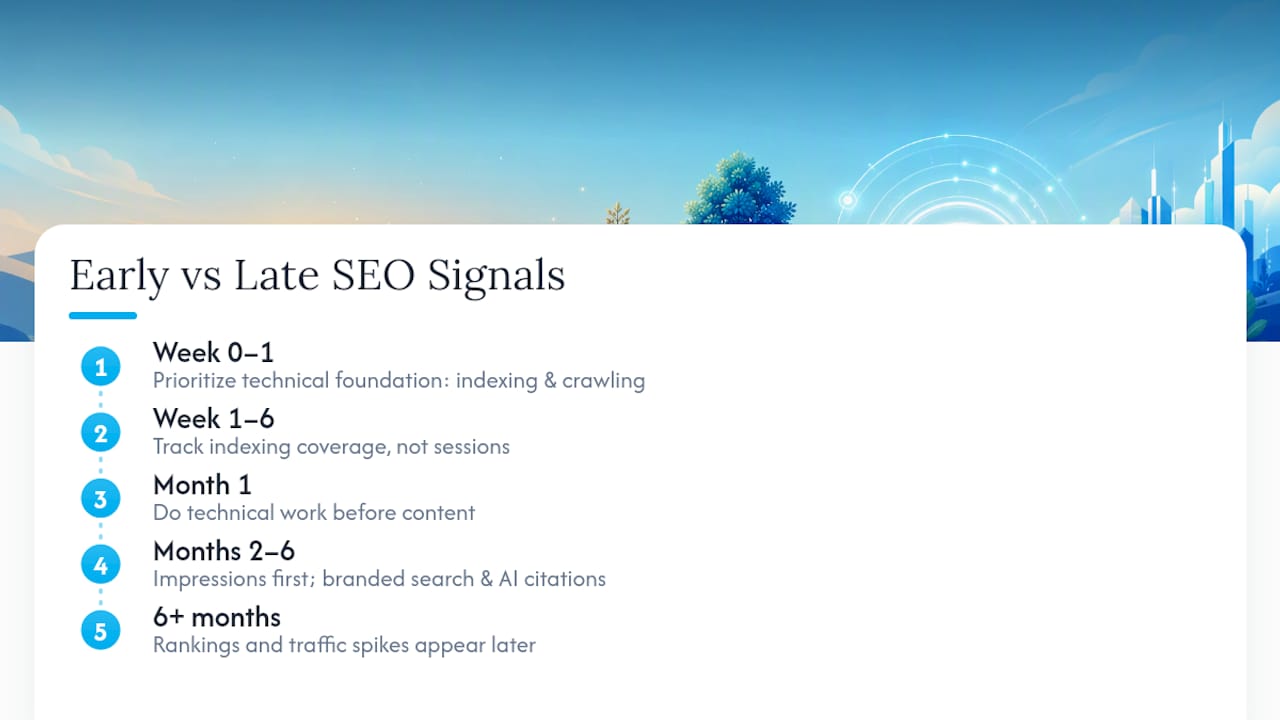
The bigger blind spot is watching only rankings and traffic while ignoring branded search growth and AI citation appearances, both of which now signal that your content is becoming a trusted reference before it shows up as a traffic spike. If you’re only tracking one number, track impressions first. It’s the earliest honest signal you’ll get, and it tells you whether the foundation is working before rankings ever confirm it.
Prioritize the boring technical work in month one over the exciting content ideas. Every stalled SEO timeline I’ve seen traces back to a foundational issue that got skipped because content felt more urgent.
— Alex
Get Your SEO Timeline Moving With a Structured 90-Day Plan
Most businesses lose their first two months to guesswork: unclear priorities, no baseline metrics, and content published without a technical foundation underneath it. Allcitygraphixny runs a structured process instead, starting every engagement with the audit and measurement setup that most timelines skip entirely, so your first 90 days produce real signal instead of noise.

In an initial engagement, clients typically get:
- A full technical and content audit with prioritized fixes
- Search Console and Analytics configured correctly, with a documented baseline
- Four to eight priority pages built or rewritten around real search intent
- A month one to three reporting cadence tracking indexing and impressions, not vanity traffic numbers
If your site also needs structural work (slow load times, confusing navigation, outdated design pulling down conversions) that gets addressed alongside the SEO plan rather than as an afterthought six months later. Check out Allcitygraphixny’s services or start with a project conversation on the agency’s main site to see what a structured 90-day plan looks like for your business specifically.
Key Takeaways
Measurable SEO results follow a predictable sequence: indexing and impressions in weeks four to eight, ranking and traffic shifts in three to six months, and significant revenue impact in six to 12 months or beyond.
| Point | Details |
|---|---|
| Early signals arrive fast | Indexing and impression growth typically show up within four to eight weeks of foundational fixes. |
| Meaningful gains take a quarter or two | Ranking and traffic movement commonly appear in the three to six month range, per Search Engine Land’s guidance. |
| Big wins need patience | Significant authority-driven results often require six to 12 months, matching Google’s own four-month-to-one-year guidance. |
| Track leading indicators first | Watch crawl stats and impressions before rankings, and rankings before traffic, to judge progress accurately. |
| Structured process compresses uncertainty | Allcitygraphixny builds engagements around month zero audits and biweekly reporting so clients see real signal within the first 90 days. |
Sources
- How long does SEO take to work? Understanding ranking timelines and the truth behind “quick results”
- SEO strategy framework: Building search visibility on a 6-month timeline
- SEO strategy in 2026: how to build one (+ free workbook)
- Timeline of Google Search
FAQ
How Long Does SEO Usually Take?
Early signals like indexing and impressions typically appear in four to eight weeks, meaningful ranking and traffic gains commonly show up in three to six months, and significant revenue impact often takes six to 12 months, according to Search Engine Land.
Is SEO Dead Now With AI?
No. Search behavior has expanded to include AI summaries and AI citations alongside traditional results, but Semrush’s 2026 guidance treats branded-search growth and AI citation visibility as additional signals to track, not a replacement for ranking fundamentals.
How Long Does SEO Take to Show Results in 2026?
The core timeline hasn’t shifted: expect early indexing signals within weeks, ranking movement within three to six months, and larger gains within six to 12 months, though frequent algorithm updates in 2026 mean short-term fluctuations should be read cautiously rather than as final outcomes.
What Should I Track First in an SEO Timeline?
Start with Search Console data: indexed pages and impressions. These move before rankings or traffic do, and a stall here in months one and two usually points to a technical issue worth fixing immediately.