

Social media branding is the deliberate practice of keeping your visuals, voice, and values consistent across every platform so people recognize you before they read your name. It differs from social media marketing, which pushes offers and campaigns. Start with a 15-minute audit of your profiles and top posts to spot where your identity is fuzzy, then build content pillars. Do that this week and you’ll have a documented brand foundation within 30 days.
TL;DR:
- Consistent documentation of visual, voice, and content pillars is crucial to maintain brand recognition and prevent identity drift over time.
- Creating a social media brand guide, including templates, approval processes, and non-negotiables, ensures brand consistency despite team changes.
- Batching content creation and repurposing assets across platforms significantly improve efficiency and visual coherence, supporting long-term sustainability.
- Tailoring your brand voice to each platform enhances engagement, as LinkedIn favors professional tone, while TikTok and Reels thrive on native, casual, and faster content.
- Key indicators of branding success include positive sentiment, share of voice, branded search growth, and engagement quality, rather than follower count alone.
Table of Contents
- What Makes Up a Social Media Brand Identity?
- How Do You Build a Social Media Branding Strategy Step by Step?
- Building a Content System You Can Actually Sustain
- How Should Your Brand Voice Change by Platform?
- What KPIs Actually Prove Your Branding Is Working?
- What Legal and Compliance Guardrails Should Every Team Follow?
- Your 30-Day Plan to Activate Your Social Media Branding Strategy
- How All City Graphix Approaches Social Media Branding for Clients
- What Marketers Consistently Get Wrong About Social Branding
- Let All City Graphix Build the System for You
- Sources
- FAQ
What Makes Up a Social Media Brand Identity?
Most businesses treat their profile setup as a one-time task. That’s the first mistake. Social media branding works because it’s maintained, not because it’s installed once and forgotten. Every post either reinforces the identity or chips away at it.
A workable brand identity for social has four parts, and skipping any one of them is why so many small business feeds look competent but forgettable.
Visual identity components. Your profile image, banner, color palette, typography, and photo or illustration style need to be locked down and written somewhere everyone on your team can find them. This isn’t about picking pretty colors. It’s about repetition doing the recognition work for you. If your Instagram grid uses a warm filmic look and your LinkedIn banner uses stock corporate blue, you’re training your audience to see two different companies.
Voice and tone rules. Pick two to four traits, not ten. A regional bakery might land on “warm, a little cheeky, never corporate.” A B2B software company might land on “direct, confident, occasionally funny in the caption but never in the CTA.” Write down what that sounds like in practice: sentence length, whether you use exclamation points, how you handle customer complaints publicly. Vague traits like “friendly” and “professional” mean nothing without examples attached.
Content pillars. These are the three to five recurring themes your content rotates through, and they’re the difference between a content calendar and a content dumping ground. A common structure includes educational insight, brand point of view, proof or credibility (reviews, results, behind-the-scenes), human stories, and community engagement, based on how brands build recognizable identities over time. Map each pillar to a specific audience need. If your audience keeps asking pricing questions in DMs, one pillar should directly answer that in public content.
Trust signals. Verified badges where available, consistent bios across platforms, a link that goes to a real landing page instead of a generic homepage, and visible proof (client logos, review counts, years in business) all tell a new visitor this is a real, stable operation before they’ve read a single caption.
Here’s what to document for each element so it survives employee turnover and freelancer handoffs:
- Exact hex codes and font names, not “our blue” and “the clean font”
- Three to five approved caption openers and three banned phrases (jargon, over-hedging, whatever doesn’t sound like you)
- A one-line description of each content pillar and how often it should appear in the calendar
- Bio copy pre-written for each platform’s character limit
- A short list of non-negotiables (no stock photos of people shaking hands, no walls of hashtags, whatever applies to your brand)
Skipping the documentation step is the single biggest reason branding falls apart the moment a second person starts posting. Verbal agreement about “our vibe” doesn’t survive a new hire’s first week.
How Do You Build a Social Media Branding Strategy Step by Step?
Building this doesn’t require a rebrand or a six-figure agency retainer. It requires sequence. Do these in order, because skipping the audit to jump straight to content production is why most rebrands drift back to inconsistency within two months.
-
Audit what exists. Pull up every active profile and check for mismatched bios, outdated links, and inconsistent profile images. Then look at your last 20 posts per platform and flag which three performed best by engagement rate, not raw likes. Do the same for two or three competitors, not to copy them but to see what’s saturated in your space and what’s open. This audit alone usually takes under an hour and reveals more than most people expect.
-
Define your audience by channel, not just once. The people who follow you on LinkedIn are often researching you professionally; the people who find you on TikTok are often discovering you cold. Write a short persona for each platform you’re active on: what they want from you there, what tone they respond to, what time they’re actually scrolling. A construction company’s LinkedIn audience wants project credibility. Its Instagram audience wants to see the finished result and the crew behind it.
-
Choose your pillars and assign them a ratio. Decide the split, something like 40% educational, 25% proof, 20% brand personality, 15% community, and adjust after a month of data. Don’t chase five pillars if you only have the resources to feed three well. A thin pillar posted twice ever is worse than three pillars posted consistently.
-
Pick your channels deliberately. Being everywhere with a skeleton crew produces worse branding than being excellent on two platforms. Choose based on where your actual customers spend time and where your content format matches your capacity. If you can’t produce short-form video weekly, don’t commit to a channel that runs on it.
-
Write it all down in one guide. Your brand guidelines document should include the visual specs, voice rules, pillar breakdown, hashtag conventions, approval process, and a short list of what never gets posted. Top-performing brands treat this document as a living reference, not a PDF that gets written once and buried in a shared drive.
The audit step is the one businesses skip most often because it feels like busywork instead of “real” strategy work. It isn’t. You can’t fix inconsistency you haven’t identified, and most brands are inconsistent in ways they don’t notice until they lay all their posts side by side.
Building a Content System You Can Actually Sustain
A strategy without production infrastructure is a document nobody follows past week three. The fix is treating content creation like a repeatable system instead of a fresh creative sprint every week.
Start with reusable templates for your recurring formats: a quote-card template, a carousel template, a behind-the-scenes video intro, a testimonial layout. Build these once in Canva or Adobe Express and store them alongside your photo library and brand assets in a shared folder everyone on the team can access. This is your asset library, and it’s what turns “someone needs to make a post” into “grab the template and drop in today’s content.”

Batching is the operational habit that makes consistency possible without daily creative pressure. Set aside one focused block, a morning or afternoon, to shoot, write, and schedule a month’s worth of content at once. Small business owners who build repeatable content systems around batching and templates avoid the burnout that comes from trying to create fresh content every single day, and they keep visual consistency intact because it’s produced in one focused sitting instead of piecemeal.
Repurposing stretches that single batch further. One client testimonial video can become a LinkedIn post, an Instagram Reel, a quote graphic, and a caption snippet, four native pieces from one asset instead of four separate shoots.
Assign clear roles even if your team is small: who drafts, who approves, who publishes. A two-person team still benefits from a five-minute check before anything goes live.
- Build five to eight templates covering your most-used formats
- Batch a full month of content in a single sitting, ideally the same week every month
- Repurpose every major asset into at least three platform-native versions
- Assign one person as the final brand check before publishing, even if that person is you
Pro Tip: Templates aren’t just a time-saver, they’re a consistency control. Batching and reusable formats keep your visual identity intact even when different people are creating the content, which is exactly why they function as branding tools, not just productivity hacks.
How Should Your Brand Voice Change by Platform?
Your core identity stays fixed. Your expression of it should flex per platform, because posting the identical asset everywhere usually means it’s optimized for none of them.
LinkedIn rewards substance and a professional register with room for personality. A founder posting a lesson learned from a failed project performs better than a polished announcement graphic. Instagram rewards visual polish and community voice, think a behind-the-scenes Reel showing how a product gets made, paired with a caption that sounds like a person, not a press release. TikTok and Shorts punish anything that looks like an ad; native, slightly rough, fast-cut content built for the platform outperforms repurposed commercials almost every time. X rewards quick, opinionated takes and real-time reactions more than evergreen brand content.
- Repurpose static graphics and long-form proof (testimonials, data, case studies) across LinkedIn and Instagram feed posts
- Create natively for TikTok and Reels: film in the app’s format, use trending audio when it fits your voice, skip anything that looks pre-produced
- Use X for quick commentary, customer service replies, and timely industry reactions rather than polished campaign content
- Keep your visual identity’s colors and typography consistent even when the format changes dramatically
A landscaping company’s LinkedIn post might break down a project budget for other business owners. Its TikTok might be a 15-second time-lapse of the same job with no voiceover at all. Both are on-brand. Neither would work swapped.
What KPIs Actually Prove Your Branding Is Working?
Follower count tells you almost nothing about whether your branding is working. With more than 5 billion people active on social platforms globally, reach is cheap and easy to fake with ads. Recognition and trust are not.
Track sentiment (are comments and mentions trending positive), share of voice relative to competitors, branded search growth (are more people googling your business name), and saves or shares rather than likes. Sentiment, share of voice, and branded search growth are stronger indicators of brand health than follower counts, because they measure whether people are actually forming an impression of you, not just scrolling past.
Score engagement quality, not just volume. A comment that says “just booked this for my wedding” is worth more than fifty heart-reacts. Track saves and shares separately from likes since they signal content people intend to act on or pass along.
Connect brand activity to business outcomes by watching for spikes in direct and branded search traffic after high-performing posts, and tag social links so you can see which content actually drives site visits.
- Monthly sentiment check across comments and mentions
- Share of voice against two to three named competitors
- Branded search volume, tracked quarterly at minimum
- Saves and shares as a ratio of total engagement, not just raw counts
Review these monthly at minimum, quarterly for a deeper trend view, using your platform’s native analytics plus a listening tool if your budget allows.
What Legal and Compliance Guardrails Should Every Team Follow?
Branding guidelines aren’t just creative preferences. They’re also where you protect the business.
Every image needs a rights check: stock license, employee-taken photo with consent, or licensed creator content. Never assume an image found online is free to use commercially. Influencer partnerships need clear, visible disclosure (#ad or #sponsored, not buried in a hashtag pile), and any claim about results, health, or finances needs to be truthful and substantiated, since legal and compliance items belong in the guidelines document itself, not treated as an afterthought.
Avoid full logos embedded inside post images. Platform cropping and thumbnail generation regularly cut off or distort text and logos placed inside the graphic itself, so use your image-mark or rely on the profile photo instead.
- Confirm rights or licensing on every image and video before it’s scheduled
- Require visible disclosure language on all sponsored or gifted content
- Keep a running list of sensitive topics or claims your industry can’t post without legal review
- Add alt text to every image and use sentence case or CamelCase for hashtags so screen readers parse them correctly
Accessibility basics like alt text and readable hashtag casing aren’t optional extras, they widen your actual audience and reduce your legal exposure at the same time.
Your 30-Day Plan to Activate Your Social Media Branding Strategy
You don’t need a quarter to see brand consistency take hold. You need four focused weeks and someone willing to follow the sequence instead of skipping to the fun part.
-
Week 1: Audit and define. Run the profile and competitor audit, write a one-sentence brand promise, choose your three to five content pillars, and update every profile bio, image, and link to match.
-
Week 2: Build your production system. Create five to eight templates, batch eight to twelve posts in one sitting, and load them into your scheduling tool with captions written in your defined voice.
-
Week 3: Publish and engage. Go live with the batch, respond to every comment and DM within your promised window, and start actively collecting testimonials, tags, and user-generated content you can repurpose next month.
-
Week 4: Measure and refine. Pull your sentiment, share of voice, and engagement quality numbers, note which pillar and format performed best, and adjust next month’s ratio based on what actually worked instead of what you assumed would.
Four weeks won’t build a legacy brand. It will give you a documented, repeatable system that a second team member could pick up without you explaining everything from scratch, which is the actual point.
How All City Graphix Approaches Social Media Branding for Clients
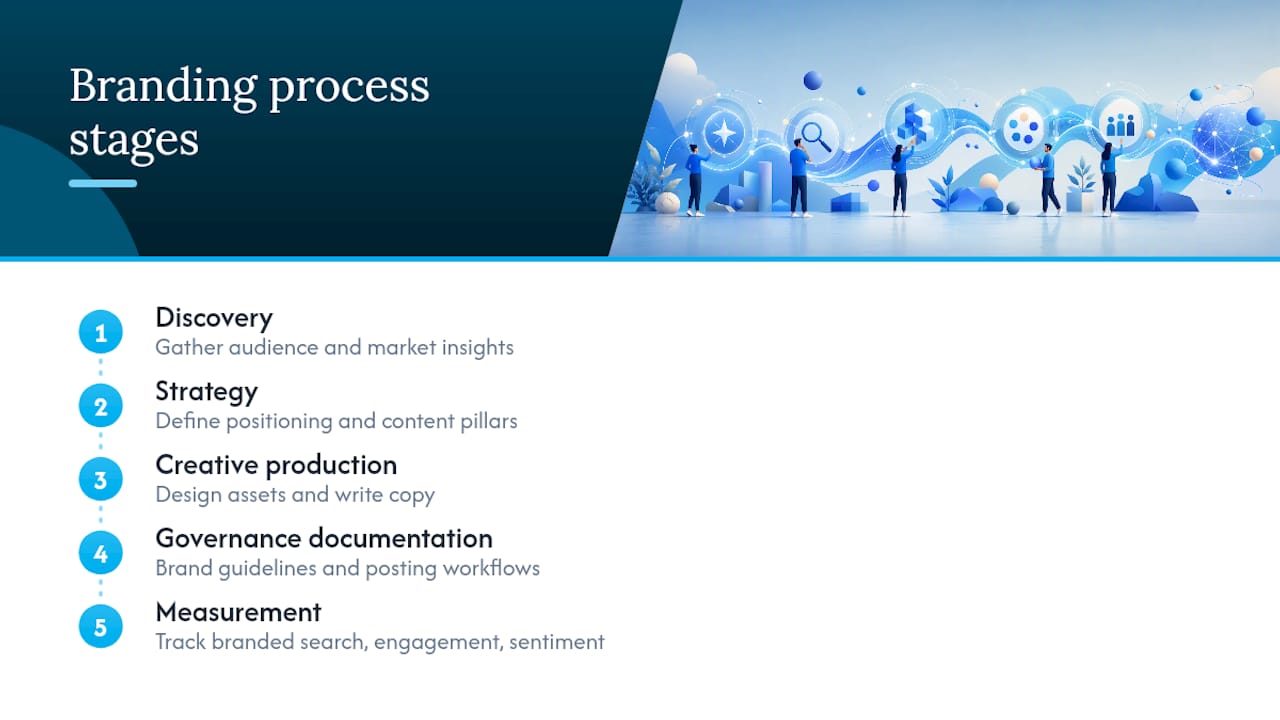
I’m Alex, and this framework reflects how All City Graphix has approached brand work for clients over 15-plus years of agency practice. Our process runs discovery, strategy, creative production, governance documentation, and measurement, in that order, because skipping straight to creative is how brands end up polished but inconsistent.
Clients typically track lift in branded search, engagement quality, and sentiment within the first quarter of a structured rollout.
What Marketers Consistently Get Wrong About Social Branding
The biggest pitfall I see with clients isn’t a bad logo or a weak caption. It’s treating the brand guide as a document instead of a habit. A guide written once and never revisited drifts within months as new team members interpret “our voice” their own way.
The single habit worth prioritizing is a weekly fifteen-minute content audit, just glancing back at what went out and flagging anything off-tone before it becomes a pattern. Consistency isn’t a personality trait. It’s maintenance.
— Alex
Let All City Graphix Build the System for You
Reading a strategy is one thing. Having a team execute the audit, build the templates, and document the guide while you run your business is another. All City Graphix turns everything in this article into a done-for-you engagement instead of another project on your own to-do list.

A starter engagement typically runs through a discovery session, a brand and voice audit, a template and content system build, and a governance document you keep long after the project wraps, usually within four to six weeks depending on scope. If your visual identity needs a refresh first, our logo design work anchors the rest of the system, and if your social presence needs to connect cleanly to a website built to convert that traffic, we handle that piece too. For businesses juggling scheduling and always-on content demands, pairing this with automation support from a partner like HarbourSide Digital can keep the system running between engagements.
Ready to stop patching your feed together post by post? Visit All City Graphix to book a discovery call and get a system built around your business, not a template built for everyone else’s.
Sources
- Social Media Branding: Strategy, Examples & Tips for 2025 | Sprinklr
- How to build a brand on social media | MeetEdgar
- Social Media Branding Guidelines: What You Need to Get Started | Agorapulse
- Mastering Social Media Branding: Strategies that Drive Results | Neil Patel
FAQ
What Is the 5-5-5 Rule for Social Media?
It’s a content habit some marketers use: spend five minutes engaging with five accounts on five different platforms daily to build visibility and relationships, though it’s a personal productivity guideline rather than a formal branding standard.
What Are the 5 C’s of Branding?
Definitions vary across sources, but a common version includes clarity, consistency, credibility, competitiveness, and character, all of which map directly onto the visual, voice, and pillar work covered above.
What Is the 3-7-27 Rule of Branding?
This isn’t a standard, sourced branding framework, and definitions circulating online conflict with each other, so it’s safer to build your strategy around documented brand guidelines and content pillars rather than this rule.
What Is the 5-3-1 Rule for Social Media?
It’s an informal content-mix guideline some marketers follow: for every nine posts, five share others’ content, three share your own original content, and one is a soft promotional post, useful as a rough ratio starting point, not a rigid rule.
How Long Does It Take to See Results From a Social Media Branding Strategy?
Most businesses see documented consistency and early engagement quality improvements within 30 days of running a structured plan, with measurable shifts in sentiment and branded search typically visible over a full quarter.