

Brand content pillars are the 3 to 5 recurring themes your content consistently returns to, each one assigned a single job so your team never has to invent a topic from scratch. Fewer pillars force sharper focus and make planning repeatable. This guide covers the exact steps to define them, examples by type, and a quarterly scorecard to keep them honest.
TL;DR:
- Audit your 15 to 20 best performing posts before brainstorming; name themes already working, then connect each pillar to an audience need and business goal.
- Keep editorial themes separate from brand foundations; each content pillar should support a brand pillar, own a job, and include two to three repeatable series.
- Label each calendar item by pillar, assign recurring publishing slots and an owner, and add an approval check to catch misaligned content before scheduling.
- Review each pillar quarterly using one metric tied to its job; test a new format or hook for two weeks before cutting an underperforming theme.
Table of Contents
- What brand content pillars are and how they differ from brand pillars
- Why content pillars matter for consistency and growth
- Step-by-step process to build your content pillars
- Pillar examples and the specific job each one does
- How to operationalize pillars across a growing team
- Measuring pillar performance with a quarterly scorecard
- How we apply content pillars in client work
- Common mistakes to avoid when developing content pillars
- Aligning pillars with your broader brand strategy
- The habit that fixes most pillar problems
- How we help you build a pillar system that runs itself
- FAQ
- Sources
What brand content pillars are and how they differ from brand pillars
Content pillars are the editorial themes your content keeps coming back to: the three to five recurring buckets that organize what you publish and why. They are tactical, living in your calendar and your captions, not your mission statement.
Brand pillars are a different thing entirely. According to Mailchimp’s definition, the five brand pillars are Purpose, Positioning, Personality, Perception, and Promotion, the strategic foundation that defines who you are before you ever write a post.
Mixing the two causes real damage: teams end up trying to “publish” their mission statement instead of turning it into formats people actually want to consume. Keeping the distinction clear means:
- Brand pillars answer “who are we and why do we exist.”
- Content pillars answer “what do we talk about, on repeat, to prove it.”
- Every content pillar should trace back to at least one brand pillar, but they are never interchangeable.
Once a team confuses these layers, content strategy becomes a rewrite of the brand deck instead of a publishing system people can execute weekly.
Why content pillars matter for consistency and growth
Pillars solve a problem every content team eventually hits: staring at a blank calendar with no idea what to post next. A defined set of themes turns that blank page into a short menu, which cuts decision fatigue and the burnout that comes with constant topic hunting, as explained in this paid social analytics guide.
Pillars also connect content to business outcomes instead of letting production be an end in itself:
- They map directly to audience jobs (what someone needs to learn, decide, or feel).
- They tie each theme to a business goal, whether that is awareness, trust, or conversion.
- Focused pillar clusters support SEO and AI visibility by signaling topical depth rather than scattershot posting, as Ahrefs notes in its description of the hub-and-spoke model.
According to Content Marketing Institute’s 2025 B2B benchmarking, 82% of top-performing content marketers cite deep audience understanding as a major success factor. Pillars are the structure that turns that understanding into a repeatable output.
Step-by-step process to build your content pillars
Building pillars is a sequence, not a brainstorm. Skipping steps is why most pillar documents end up ignored by week three.
- Start with audience jobs and business goals. Write down what your audience needs to know, feel, or decide, and match that to what your business needs this quarter (leads, retention, awareness).
- Audit your existing content. Pull your 15 to 20 best-performing posts and look for themes already working, a method Vista Social recommends because it surfaces pillars that already exist but were never named.
- Choose a few pillars and assign each one job. One pillar drives reach, another builds trust, another pushes conversion. No pillar should share a job with another.
- Design 2 to 3 repeatable series per pillar. A series is a format you can run monthly without reinventing it, such as a weekly tip, a customer spotlight, or a behind-the-scenes clip.
- Document the rules and store them where your team works. Put pillar definitions, series names, and posting cadence into your calendar tool or CMS so nobody has to ask what “on-pillar” means.
Pro Tip: Run the audit before you brainstorm new pillars. Themes that already perform well are faster to scale than ideas built from a whiteboard session.
Pillar examples and the specific job each one does
Different pillar types exist to do different jobs, and naming the job prevents a pillar from drifting into vague “general content.”
- Educational pillars teach something specific, usually through how-to posts or short explainer videos, and they drive reach.
- Entertaining pillars build attention through humor or trend participation, often the fastest way to grow new followers.
- Community or UGC pillars feature customers or team members and build trust through social proof.
- Product or proof pillars show the offering in action, usually through demos or case-style posts, and they drive conversion.
- Timely pillars tie into seasonal moments or industry news, giving a reason to post outside the regular rotation.
Two sample sets show how this plays out for different goals:
A single pillar strategy rarely fits both goals at once, which is why the mix shifts based on what the business needs that quarter.
How to operationalize pillars across a growing team
A pillar document is useless if nobody checks it before hitting publish. Operationalizing means baking the pillar into the actual workflow, not just the strategy slide.
- Label every calendar item with its pillar name, and assign a recurring slot per pillar (Mondays for Education, Wednesdays for Community, for example).
- Add a simple “is this on-pillar?” checkbox to your approval workflow so drift gets caught before scheduling.
- Assign a pillar owner, even informally, who is responsible for that theme’s quality and consistency.
- Use a CMS tag or calendar label as the single source of truth, so reporting by pillar takes minutes, not a manual sort.
These steps work regardless of the specific tools involved: a spreadsheet calendar, a dedicated social media branding workflow, or a full CMS all support labeling and slotting the same way.
Pro Tip: Give each pillar a two-word nickname your team actually says out loud (“Proof Tuesday,” “Trend Friday”). Nicknames get used; formal pillar titles get forgotten.
Measuring pillar performance with a quarterly scorecard
Each pillar’s job determines which metric actually matters. A reach pillar should be judged on impressions or new followers, a trust pillar on saves or comments, and a conversion pillar on click-through or sign-up rate. Grading every pillar on the same metric hides which ones are actually working.
A one-line scorecard run every quarter keeps the system honest:
| Pillar | Job | Metric | Verdict |
|---|---|---|---|
| Educational | Reach | Impressions | Keep |
| Community/UGC | Trust | Saves/comments | Fix |
| Product/proof | Conversion | Click-through rate | Cut |
Enterprise content research points to exactly this kind of lightweight, single-metric scorecard as the fix for pillar inertia, where teams keep publishing a theme long after it stopped earning its slot. When a pillar underperforms, the fastest fix is a short experiment: change the format or hook for two weeks before cutting the pillar entirely.
How we apply content pillars in client work
Our discovery-led process starts the same way this guide does: we audit existing content and audience data before naming a single pillar, so every theme traces back to a real business goal rather than a guess.
For branding and content clients, we typically produce:
- A documented set of 3 to 5 pillar definitions, each with an assigned job.
- Repeatable series templates mapped to each pillar.
- Calendar labels and tagging conventions built into the tools the team already uses.
- A quarterly scorecard format so pillars get reviewed, not just published on autopilot.
This mirrors the messaging framework we use to keep pillar language consistent with broader brand positioning.
Common mistakes to avoid when developing content pillars
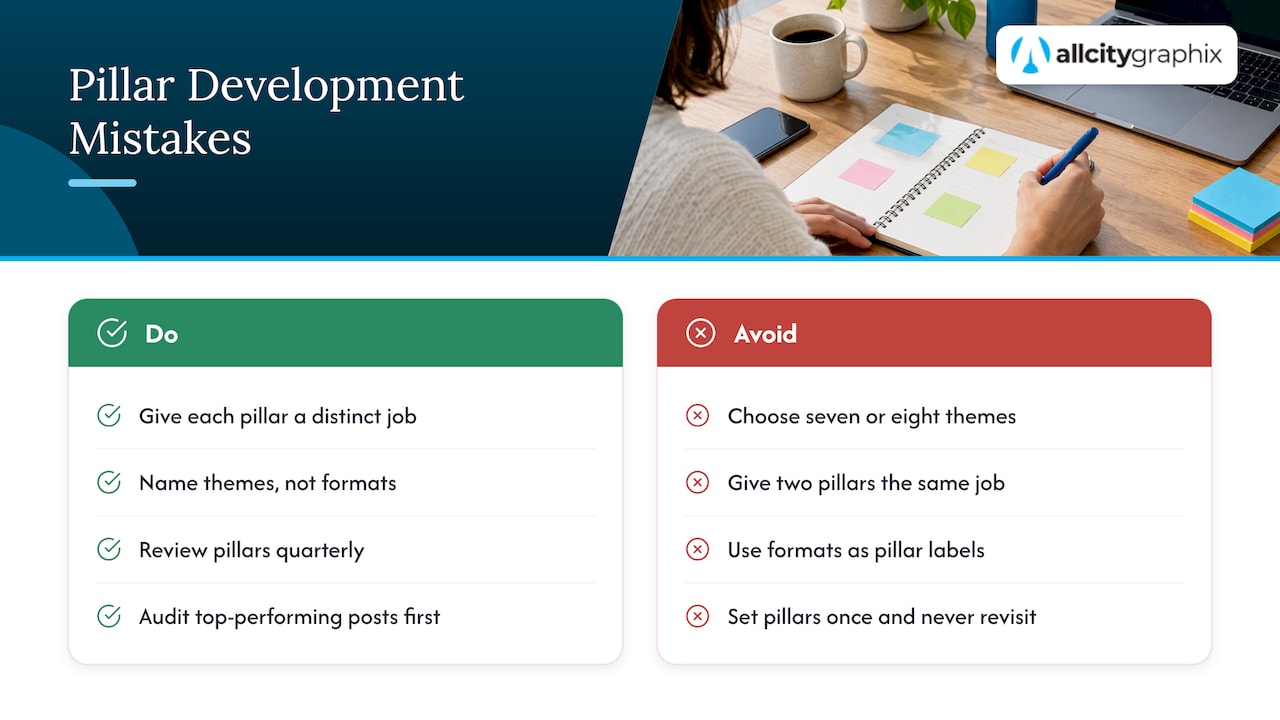
The most common failure is picking too many pillars. Seven or eight themes sound thorough on a strategy deck, but no team actually rotates through that many consistently, and the extras quietly die within a month.
A second mistake is giving two pillars the same job. If both your “educational” and “proof” pillars are secretly trying to drive conversion, you lose the ability to tell which one is actually working when you review performance.
Teams also tend to name pillars after formats instead of themes, something like “Reels” or “Carousels” as a pillar label. A format is not a theme: it is a container. The pillar should describe the topic or job (Education, Community), and the format is a choice you make within it.
Another recurring issue is treating pillar documentation as a one-time exercise. A pillar set defined at a kickoff meeting and never revisited drifts as the team changes, the audience shifts, or a format stops performing. Without a quarterly check, pillars become outdated without anyone noticing.
Finally, many teams skip the audit step and invent pillars from a whiteboard session instead of looking at what already works. Vista Social’s research found that pulling top-performing posts first is faster and more defensible than starting from a blank page, because the pillars that already resonate are usually hiding in plain sight.
Aligning pillars with your broader brand strategy
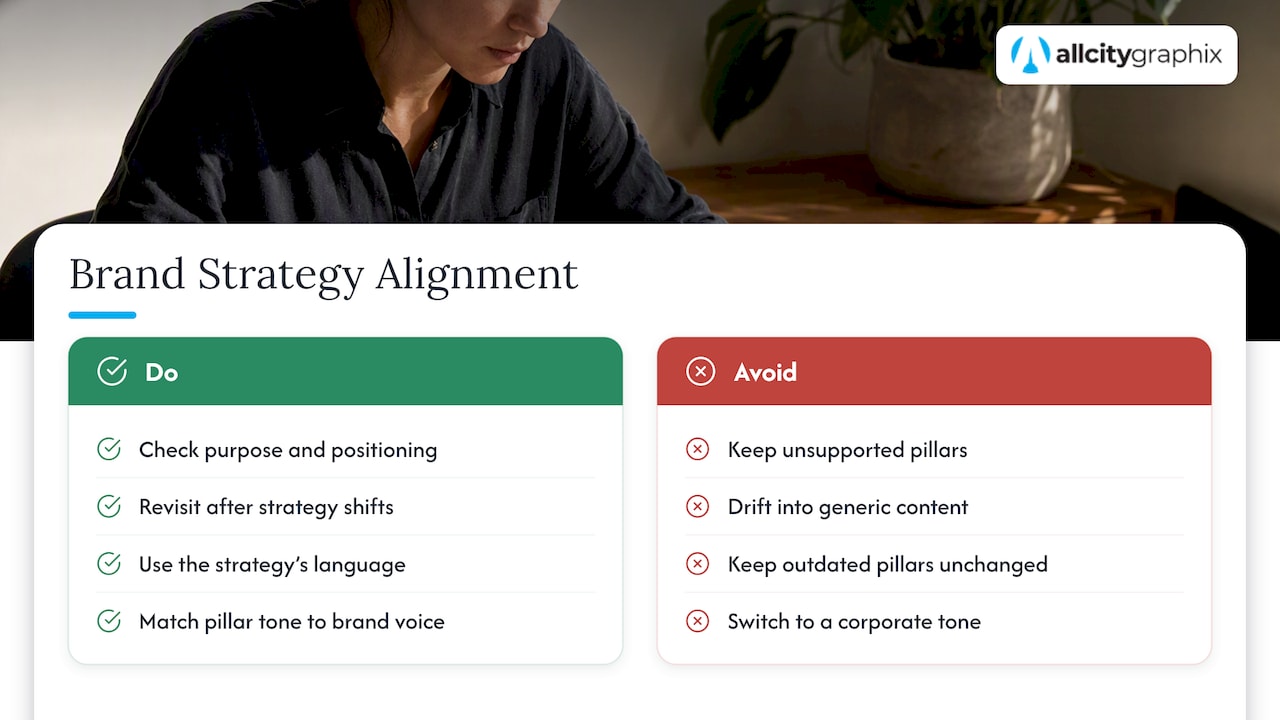
Content pillars only work when they trace back to the brand strategy underneath them, not the other way around. Before locking in a pillar set, check it against your stated brand purpose and positioning: if a pillar does not support at least one of those, it is probably filler.
Shopify’s guidance on brand pillars frames this as alignment between identity elements and the content built on top of them, so the published voice always echoes the brand’s actual positioning rather than drifting into generic industry content.
Practically, this means revisiting your pillar list every time your brand strategy shifts, whether that is a repositioning, a new audience segment, or an expanded product line. A pillar that made sense for last year’s goals might now be pulling attention away from what the business actually needs to communicate.
It also means your messaging hierarchy and your content pillars should use the same language. If your brand strategy describes your personality as “direct and no-fluff,” your educational pillar should read that way too, not shift into a corporate tone just because it is a blog post instead of a tagline.
The habit that fixes most pillar problems
The most common failure is not having too few pillars. It is never assigning each one a single job, so every post starts to look the same. The fix is simple: label every piece of content by pillar before you schedule it, and run a five-minute weekly check against that label.
— Alex
How we help you build a pillar system that runs itself
If defining pillars, series, and a scorecard sounds like more structure than your team has time to build alone, that is exactly where our brand strategy and content services come in. We run the discovery, audit, and documentation work, then hand your team a pillar system with calendar labels and quarterly review built in.

If you want a second set of eyes on your current content before committing to a new pillar set, book a discovery meeting and we will walk through what is already working.
FAQ
What are the 7 pillars of branding?
There is no single standardized framework; the most commonly cited version in branding resources is the five-pillar model covering Purpose, Positioning, Personality, Perception, and Promotion, as described by Mailchimp.
What are the 5 brand pillars?
The five brand pillars most widely referenced are Purpose, Positioning, Personality, Perception, and Promotion, according to Mailchimp’s definition. These describe brand identity and strategy, separate from the editorial content pillars used in day-to-day publishing.
What are 5 content pillars?
Five content pillars are five recurring editorial themes a brand consistently publishes around, each with its own job such as education, entertainment, community, proof, or timely relevance. Common examples include Educational, Entertaining, Community/UGC, Product/proof, and Timely, a pillar type structure Vista Social outlines in detail.
What are the 7 pillars of marketing?
There is no single agreed framework across the industry; the concept of marketing pillars varies by source and typically covers areas like strategy, content, channels, and measurement rather than a fixed numbered list. For content specifically, the more reliable structure is the 3 to 5 pillar rule for editorial themes described throughout this guide.
How many content pillars should a brand have?
Most practitioners recommend a few content pillars, since fewer themes make planning and production repeatable without overloading a team’s capacity. Going beyond five typically means some pillars get neglected within a few months.
Sources
- B2B Content Marketing: 2025 Benchmarks & Trends
- How to create your social media content pillars | Vista Social
- What are content pillars? (Ahrefs)