

Most small businesses should plan to spend somewhere between 2% and 8% of annual revenue on marketing, then split that money across two or three digital channels instead of many. The exact figure depends on your goals, your industry and how fast you want to grow. This guide shows you how to land on a number, divide it, and know when to change it.
TL;DR
- Small-business marketing budgets commonly fall between 2% and 8% of gross annual revenue. Newer or faster-growing companies sit toward the top.
- Two methods work together: a percent-of-revenue ceiling, and a goal-based build (target customers times cost per customer, plus fixed costs).
- Fund two or three channels properly rather than six thinly. Reserve a slice, often 10%, for testing.
- Review paid channels monthly or quarterly and move money toward what produces customers, not clicks.
Table of Contents
- Start with the outcome, not the percentage
- Two ways to build the number
- What counts as digital marketing spend
- What small businesses actually spend
- How to divide the budget across channels
- The 70-20-10 rule, in plain terms
- A worked example: a local service business
- Shifting money from ads to organic over time
- Perspective: what we see when budgets go wrong
- Measuring results and adjusting the budget
- When to hire help, and what to ask for
- How All City Graphix can help
Start with the outcome, not the percentage
A percentage tells you what businesses like yours tend to spend. It does not tell you what you need. Harvard Business School Online makes the point that a digital marketing budget should begin with business goals and objectives, because those direct money toward the methods best suited to the result you want.
Before touching a spreadsheet, write down three things:
- The result you want in the next 12 months. New customers, booked appointments, online orders, or a launch. One sentence.
- What a customer is worth. Average first sale, plus repeat purchases if they are common.
- What you can afford to lose while you learn. Marketing rarely pays back in week one, so decide how much runway you have.
If you cannot answer the second item, fix that first. A budget with no customer value behind it is a guess.
Two ways to build the number
Top down: a percentage of revenue
This is the fast method. Take last year’s revenue (or your realistic forecast if you are new) and apply a percentage.
Shopify’s small-business guide puts typical budgets at 2% to 8% of gross annual revenue, with the right figure shifting by industry, growth stage and competition. Constant Contact shows 5%, 7% and 10% as example levels. On $50,000 of annual revenue, those equal $2,500, $3,500 and $5,000.
Here is how it looks for a business with $400,000 in annual revenue at 5%:
- Annual marketing budget: $20,000
- Monthly: about $1,667
That is a ceiling and a starting point. It is not a promise that $1,667 a month will deliver anything.
Bottom up: work backward from customers
This method is more honest about what you are buying. Semrush describes it as multiplying the number of customers you want by your cost to acquire each one, then adding fixed costs such as payroll and software.
Their example: 100 new customers at a $250 acquisition cost is $25,000. Add $13,000 in fixed marketing costs and the budget is $38,000.
The weak spot is the acquisition cost. If you have never run campaigns, you do not know yours. In that case, use the top-down figure for your first quarter, record what each channel actually costs per lead and per customer, and rebuild bottom up from real data.
Reconcile the two
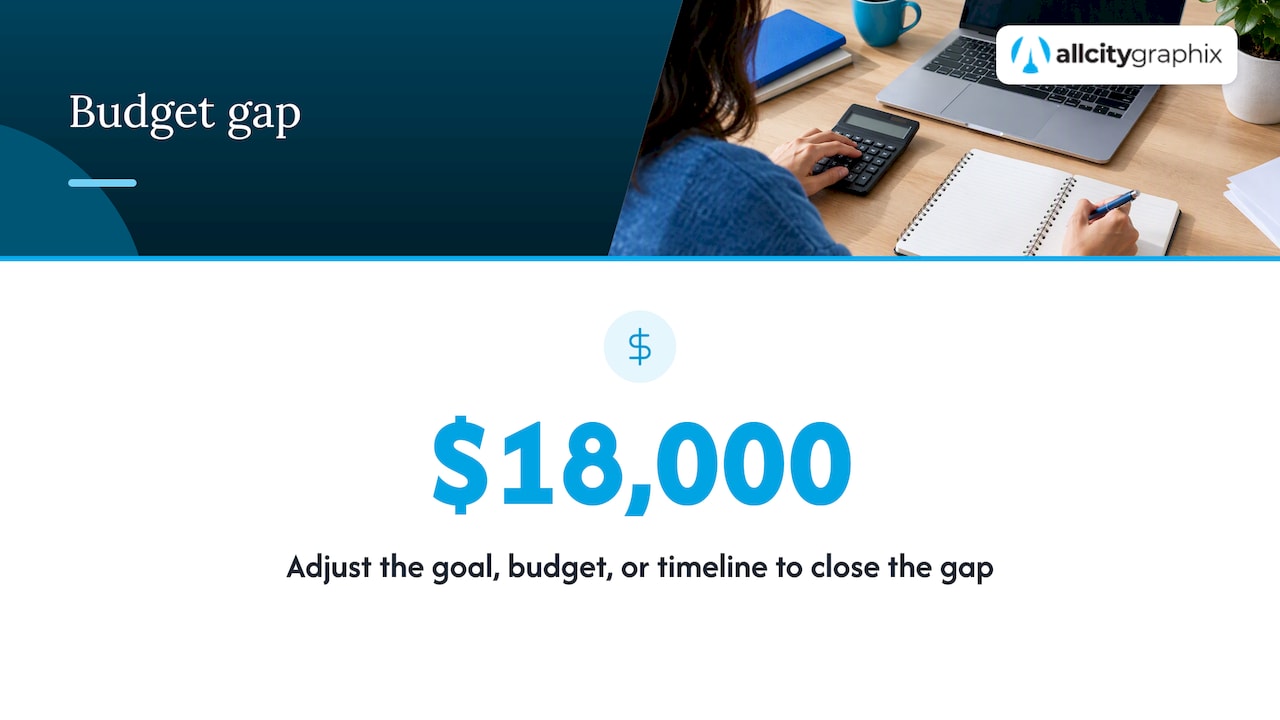
Run both. If the top-down number is $20,000 and the goal-based number is $38,000, you have a decision to make: lower the goal, raise the budget, or accept a longer timeline. Finding that gap on paper is far cheaper than finding it after the money is spent.
What counts as digital marketing spend
Owners often budget only for ads and then get surprised by the rest. A complete breakdown includes:
- Paid media: search ads, social ads, video, remarketing.
- Content: blog posts, video, email, photography, design and creative.
- Website: development, updates, hosting and maintenance. Your site is where every channel sends people, so it belongs in the plan.
- Tools: email platform, analytics, scheduling, CRM.
- People: freelancers, an agency, or a share of an employee’s salary.
- Research and testing: surveys, keyword work, landing page tests.
DigitalOcean’s budgeting guide lists a similar spread, from paid campaigns and events to agencies, tools, video, staffing and website development. EY adds a useful warning: look at total investment across agency fees, media spend, technology and talent together, rather than squeezing one line in isolation. A cheap ad budget attached to a slow, confusing website is not a saving.
What small businesses actually spend
Benchmarks help you sanity-check, as long as you remember they describe other businesses.
- Intuit’s 2025 survey. Intuit SMB MediaLabs found that 96% of U.S. small businesses planned to advertise in 2025, 92% planned to maintain or increase spending, and the average estimated advertising budget was $78,000. That average is pulled up by larger small businesses. Do not read it as a target for a three-person shop.
- Local Google Ads. The Rhode Island Small Business Development Center suggests $1,000 to $2,000 per month for a local business that wants steady traffic or leads, starting Google Ads at $10 to $50 per day.
- Other platforms. The same source suggests $500 to $1,500 per month for Meta Ads and $300 to $1,000 for YouTube.
Notice what these have in common: they are ad media costs only. Design, content, tracking and website work sit on top.
How to divide the budget across channels
Fewer channels, funded properly
Intuit found that small businesses typically use three to four advertising channels, and 10% planned six or more. In the same survey, 75% used social media advertising and found it effective, while 27% used paid search and 30% used video.
More channels is not better when money is tight. Constant Contact’s math is blunt: a $500 monthly budget spread evenly across six channels leaves less than $85 each, which is too little to learn anything. They recommend funding two or three channels well.
Match channels to where customers decide
Choose channels by funnel stage and audience behavior, not by what is fashionable. DigitalOcean’s perspective is to match the mix to the stage of the buyer’s journey, then use conversion and acquisition-cost data to shift money toward what returns more.
A practical way to apply that:
| If your customers… | Lean on | Why |
|---|---|---|
| Search for your service when they need it (plumber, dentist, accountant) | Local SEO, Google Business Profile, search ads | You meet them at the moment of intent |
| Buy on impulse or by browsing (retail, food, beauty) | Paid social, short video, email | Attention comes first, demand second |
| Have long, considered purchases (B2B, high-ticket) | Content, SEO, email nurture, remarketing | Trust builds over weeks |
| Already bought from you | Email and text | Owned channels cost little to reach existing customers |
When you are weighing which channels deserve scarce dollars, a look at digital advocacy campaigns built around a clear audience shows how much a focused channel choice matters when budgets are limited.
Do not forget owned channels
Constant Contact advises prioritizing owned channels such as email and text, setting a hard cap on paid ads, and following where your customers’ attention actually is. Owned channels do not charge you per impression. Reaching people who already know you, with something like a simple customer reactivation campaign, is often the cheapest revenue in the plan.
A larger example
Harvard Business School Online illustrates a $120,000 annual budget divided among content marketing and SEO, paid social and influencer marketing, paid search, email and CRM tools, events and research, and design and creative. Their stated lesson matters more than the split: the mix should change with industry, objectives and growth stage.
The 70-20-10 rule, in plain terms
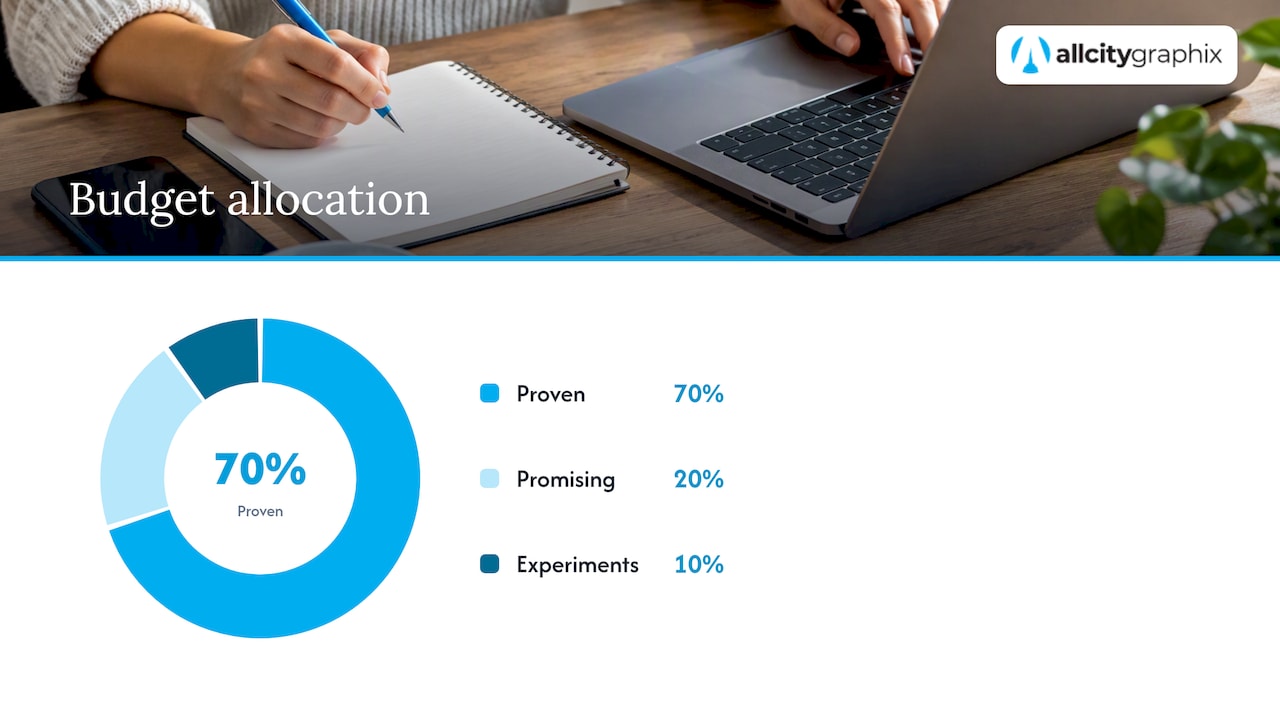
The 70-20-10 rule is a simple way to avoid two mistakes: betting everything on one channel, and chasing every new idea.
- 70% goes to channels already producing results.
- 20% goes to promising newer channels you have early signs about.
- 10% goes to true experiments.
Chief Marketer describes it as a starting point that can be adjusted, for example to 80/15/5 or 90/5/5, rather than a rigid rule. Xero’s U.S. guide illustrates it with a local bakery on $500 a month: $350 on proven activities, $100 on promising ideas and $50 on experiments.
Applied to the $1,667 monthly figure from earlier, that is roughly $1,167 for proven channels, $333 for promising ones and $167 for tests.
If you are brand new, you have no “proven” channels. In that case, treat your first three to six months as the 20% and 10% phase, and keep careful records so you know where the 70% should go next.
A worked example: a local service business
Say a Brooklyn home renovation company has $600,000 in revenue and chooses 4%, or $24,000 a year, $2,000 a month. These are illustrative numbers, not a recommendation for any specific company.
| Line | Monthly | Notes |
|---|---|---|
| Google Ads (local search) | $800 | Proven demand, tracked by calls and forms |
| Website and landing page upkeep | $300 | Fast pages, clear contact options |
| Local SEO and Google Business Profile work | $400 | Compounds over time |
| Email to past clients | $100 | Referral and repeat work |
| Testing (short video, social ads) | $200 | The 10% bucket and a bit more |
| Tools and analytics | $200 | Call tracking, CRM, reporting |
The split favors a channel where buyers already search, protects the website, and keeps a small, deliberate amount for learning. You can adapt the logic even if your figures differ.
Shifting money from ads to organic over time
Paid ads stop the moment you stop paying. Organic search takes longer but builds an asset. Many small businesses start heavy on paid search for fast leads, then move a portion of spend toward search optimization as rankings improve. We cover that shift in our guide to moving budget from Google Ads to SEO, and the local side in SEO for small businesses. Quick wins such as a well-optimized Google Business Profile cost mostly time.
Content follows the same logic: slower to pay back, but it keeps working. If you plan to invest there, start with a content marketing strategy tied to revenue.
Perspective: what we see when budgets go wrong
We have worked with small businesses, startups and established companies for over 15 years, and the pattern is consistent: budgets rarely fail because they were too small. They fail because they were not tied to a decision.
Three habits separate budgets that work from budgets that drain:
- They start with discovery. Before we recommend where money goes, we want to know who the customer is, what a sale is worth and what the business can realistically handle. A plan that ignores capacity wins leads the owner cannot serve.
- They treat the website as part of the budget. Sending paid traffic to a slow or unclear site is the most common waste we see. Fixing the destination often does more than raising the ad spend.
- They keep support after launch. A campaign or a site is not finished on launch day. Someone has to read the numbers, adjust and decide what to cut.
Our advice for most small businesses: pick a percentage you can sustain, commit to two or three channels, and give it a full quarter before judging. If a number feels too small to do anything useful, spend it on one channel instead of three.
— Alex
Measuring results and adjusting the budget
A budget is a forecast. It needs a review rhythm.
Track business outcomes. Google’s guidance on building a demand-driven marketing budget calls for a measurement plan that shows marketing’s impact on business outcomes and supports changes in investment, including effects across online and offline channels and the whole customer journey. For a small business, that means tracking calls, forms, orders and booked jobs, not only clicks and likes.
Review on a schedule. Chief Marketer says digital budgets should be reviewed and reallocated quarterly or monthly, especially in automated, high-volume channels such as paid search and paid social, because performance and seasonality shift.
A simple monthly review:
- Cost per lead and cost per customer, by channel.
- Lead quality: how many leads became paying customers?
- Any channel above your target cost for two months in a row gets cut or fixed.
- Move that money to the channel with the lowest cost per customer, or to a test.
Attribution is imperfect, and tools disagree. Our piece on why attribution alone falls short for marketing ROI explains how to combine it with simpler checks, like asking new customers how they found you.
When to hire help, and what to ask for
You can run a modest budget yourself. Outside help earns its place when the work needs skills you do not have, such as brand identity, a site rebuild, or search strategy, or when your time is worth more elsewhere.
When you talk to any agency, ask:
- How do you decide where my budget goes, and what will you want to know first?
- Who will actually do the work, and will I speak with senior people?
- What do you report on, and how often?
- What happens after launch?
If the answers are vague, the budget will be too.
How All City Graphix can help
We are a New York City creative agency covering branding, web design, digital marketing, SEO, content and ongoing support. Our process starts with a discovery meeting, so the budget you set is based on your goals and your customers instead of a generic percentage. From there we build custom solutions and stay on after launch to keep results moving.

If you want a second pair of eyes on your numbers, or a marketing plan to go with them, start with our small business marketing plan template or [get in touch through our main site](https://allcityg