

A good discovery workshop agenda is not a list of topics. It is a sequence of decisions, each time-boxed, each ending in something written down. Below is a full one-day agenda you can copy, plus the pre-work, roles and follow-up that decide whether the day was worth it.
We use the brand and website project as the running example, because that is the work we do. The structure holds for product, software and marketing projects too.
TL;DR
- Design the agenda backward from the outcomes: what must be true when the room empties? Every activity should feed one of those outcomes.
- Use four phases: context, success definition, options, and action plan. Time-box every block and name the output.
- Send a short survey (30 minutes at most) and hold 1:1 conversations before the day, so the room aligns views instead of collecting basics.
- Assign four roles: facilitator, note-keeper, timekeeper and a research or subject lead. One person cannot do all of them.
- Name an owner for the action list and book a 30-day check-in before anyone leaves.
Table of Contents
- What a discovery workshop is for
- Design the agenda backward from outcomes
- Before the day: pre-work that saves two hours
- Roles: who does what in the room
- The one-day discovery workshop agenda
- Adapting the agenda
- Facilitation habits that protect the agenda
- After the workshop: where the value is
- Perspective: what we have learned from running discovery
- Need a partner to run discovery for your brand or website?
- A copyable agenda checklist
- FAQ
- Sources
What a discovery workshop is for
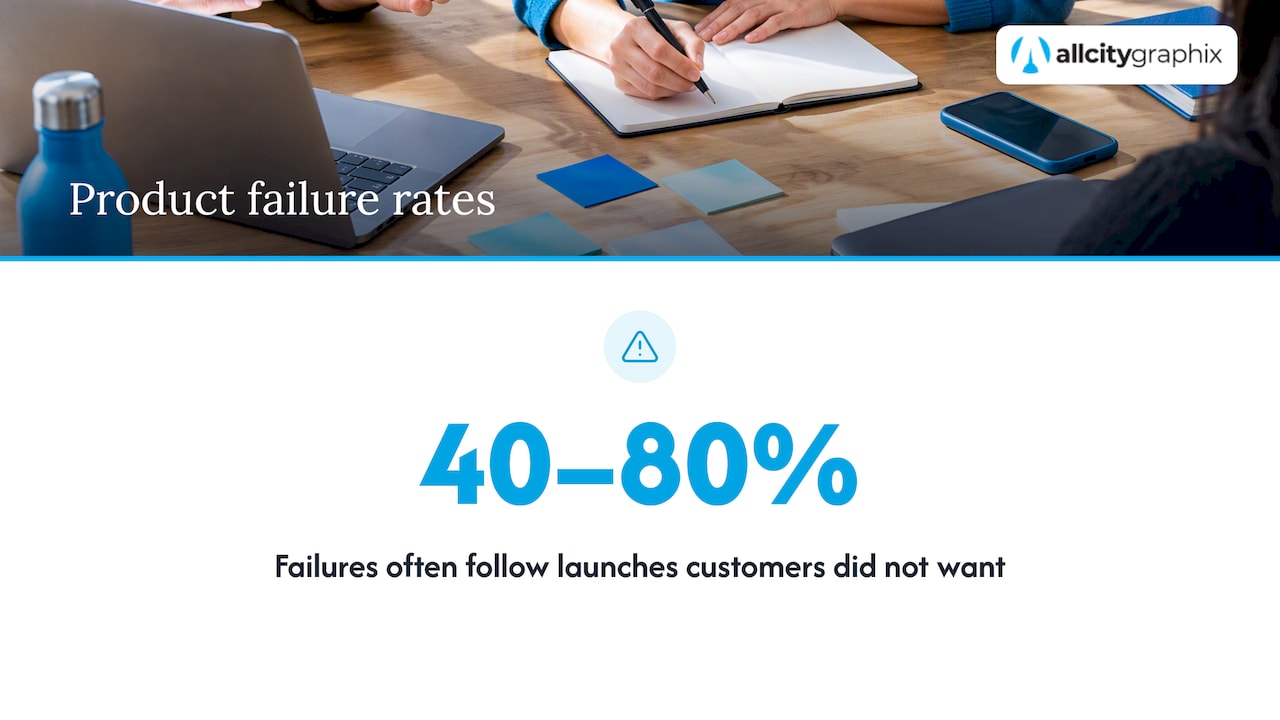
A discovery workshop is a concentrated session, anywhere from half a day to several days, that aligns stakeholders, deepens everyone’s understanding of the business vision and produces a clear plan for execution. New product failure rates are commonly cited between 40% and 80%, often because teams launch something customers did not actually want. A workshop is a cheap way to catch that early.
For a branding or web project, the same logic applies. Before anyone designs a logo or a sitemap, the people paying for it need to agree on who the customer is, what the business promises, and what success looks like. If the founder, the marketing lead and the sales director each hold a different answer, no amount of polished design will fix it.
Design the agenda backward from outcomes
Start at the end. Write three to five sentences that must be true when the session closes. For example:
- We agree on a one-sentence problem statement.
- We have ranked our top three audiences.
- We have a shortlist of priorities, each with an owner.
- We know what happens in the next 30 days.
Facilitators who build agendas this way connect every activity to at least one concrete outcome, such as an agreed problem statement, a prioritized list or a signed action log. If an activity connects to nothing, cut it. The same guidance suggests setting aside a couple of hours of design time for a single session, and doing it one to three days before the event, once attendees are confirmed.
Why decision flow beats topic lists
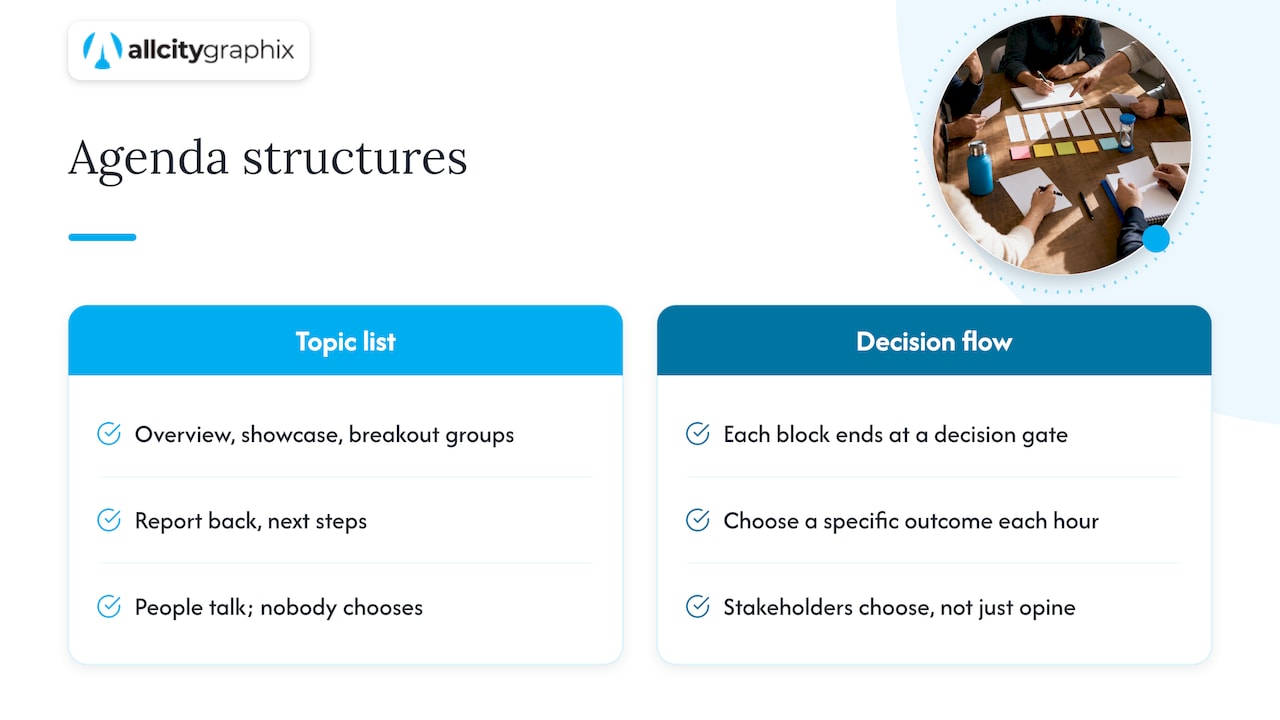
The typical agenda looks like this: overview, showcase, breakout groups, report back, next steps. It is all input. People talk, nobody chooses. A decision-flow structure frames each block around a gate: by the end of this hour, we will have decided X. Stakeholders then have to choose rather than only share opinions.
Before the day: pre-work that saves two hours
The agenda starts a week before the workshop. Two pieces of pre-work do most of the lifting.
A short discovery survey
Send participants a questionnaire on mission, positioning and target personas. Keep it to no more than 30 minutes. Ask people to complete it alone, without conferring. The disagreements that appear are exactly what the room should spend its time on. If you are building a website, our list of website discovery questions to ask before you build is a good starting set.
One-to-one conversations
Seniority distorts group discussion. Junior people agree with the boss; executives avoid contradicting each other in public. Practitioners recommend pre-workshop 1:1 interviews to surface disagreements that would otherwise stay hidden. If you have not run them before, this piece on the role of stakeholder interviews in requirements gathering explains how they sharpen what the group needs to resolve.
Also gather the inputs people will need on the day: current brand assets, analytics, customer feedback, sales notes and competitor examples. Share them in one folder, and keep the pre-reading under an hour.
Roles: who does what in the room
One person should not facilitate, take notes and watch the clock at once. Experts advise a dedicated split of roles: facilitator, research lead, note-keeper and timekeeper. The split keeps the session calm and protects the agenda.
| Role | Job in the room |
|---|---|
| Facilitator | Runs the activities, asks questions, keeps the group moving toward each decision |
| Note-keeper | Records decisions, open questions and owners in the shared log, not the full conversation |
| Timekeeper | Calls time on each block and flags when a topic needs to be parked |
| Research or subject lead | Brings facts on customers, market and technology when opinions need grounding |
| Decision-maker | The person with authority to say yes; must be present for the whole day |
If the person who signs the budget is missing, reschedule. Decisions made without them tend to be reopened.
The one-day discovery workshop agenda
This agenda assumes 8 to 12 participants, in person or on video, running about six and a half hours of working time plus breaks. Adjust the blocks, not the order. The order is the decision flow: context, success, options, plan.
Phase 1: Context (9:00 to 10:45)
| Time | Block | Output |
|---|---|---|
| 9:00 to 9:15 | Welcome, goals, ground rules, roles | Shared understanding of the day’s outcomes |
| 9:15 to 9:45 | Survey readback: where do we agree, where not? | A short list of disagreements to resolve |
| 9:45 to 10:15 | Business snapshot: offer, customers, numbers | One-page fact base |
| 10:15 to 10:45 | Audience and competitive landscape | Draft audience list and three or four reference points |
Start with the survey results, because they show where the room actually stands. Display them anonymously. The point of the readback is to name the splits out loud, not to assign blame.
Phase 2: Define success (11:00 to 12:30)
| Time | Block | Output |
|---|---|---|
| 11:00 to 11:40 | Problem statement: what are we solving, for whom? | Agreed one-sentence problem |
| 11:40 to 12:10 | Vision and brand personality | Three to five words the team accepts |
| 12:10 to 12:30 | Success metrics | Two to four measurable goals with a timeframe |
The metrics block is the one people skip. Do not. A goal like “look more professional” cannot be checked later. “Increase quote requests from the website” can. If marketing performance is on the agenda, our article on why attribution alone falls short for marketing ROI helps frame which numbers to pick.
Break for lunch from 12:30 to 1:15, and keep conversation light.
Phase 3: Explore options (1:15 to 3:00)
| Time | Block | Output |
|---|---|---|
| 1:15 to 1:45 | Audience deep-dive: needs, objections, journey | Two or three prioritized personas |
| 1:45 to 2:30 | Positioning and messaging: what do we say, and why us? | Draft positioning statement and key messages |
| 2:30 to 3:00 | Scope and technology: what do we need, and what can wait? | Must-have, should-have and later lists |
Use silent individual writing first, then discuss. It prevents the loudest voice from anchoring the room. For the messaging block, a messaging matrix and hierarchy gives the group a ready format to fill in.
Phase 4: Decide and plan (3:15 to 4:30)
| Time | Block | Output |
|---|---|---|
| 3:15 to 3:45 | Prioritization: effort against impact | Ranked priority list |
| 3:45 to 4:15 | Action plan: who does what, by when | Action register with named owners and dates |
| 4:15 to 4:30 | Recap, open questions, 30-day check-in booked | Calendar invite sent before people leave |
The last 15 minutes carry more weight than any other block. Read the decisions aloud. Ask the decision-maker to confirm each one. Anything unresolved gets an owner and a date, not a vague promise to revisit.
Adapting the agenda
Half-day version
Keep all four phases but cut each to roughly half. Drop the audience deep-dive and fold audience into the context block. Rely harder on the survey and 1:1 interviews, so the room spends no time on basics.
Multi-day or remote version
Longer programs spread the same flow over several sessions. One remote brand strategy process, for instance, splits the work into information gathering, analysis, and separate workshop days. For video, keep blocks shorter, take more breaks, and use a shared board so quiet participants can contribute in writing.
Small team or solo founder
If your team is two or three people, you do not need the role table. You still need the structure: write the outcomes first, time-box each block, and record decisions. A founder can run the exercise with an outside facilitator who asks the uncomfortable questions.
Facilitation habits that protect the agenda
- Park tangents visibly. Keep a “parking lot” list on a wall or board. People relax when they see their point recorded.
- Write decisions in a log as they happen. Date, decision, owner, next step. Not minutes.
- Use decision gates. At the end of a block, ask: are we agreed, or do we need more information? Both are acceptable answers, but silence is not.
- Rotate who speaks first. Start with the least senior person in a round, then move up.
- Cut a topic before you cut a break. Tired groups decide badly.
Where genuine executive disagreement shows up, one playbook suggests that when the group cannot settle, a documented interim decision, with a date to revisit, beats an open argument.
After the workshop: where the value is
The real value of a discovery workshop shows up in the 30 days after it, not in the room. Practitioners warn that a large share of workshop decisions can be lost within six weeks without a named owner with authority. That figure is a practitioner estimate, not a controlled study, but the pattern is familiar to anyone who has been in a few workshops.
Before people leave:
- Confirm who owns the action register.
- Send the written summary within 48 hours: decisions, owners, dates, open questions.
- Hold the 30-day check-in and review each action as done, blocked or dropped.
- Feed the outputs directly into the next phase, whether that is a brand brief, a sitemap or a launch plan. Our brand launch plan shows how decisions turn into a timeline.
Perspective: what we have learned from running discovery
We work with small businesses, startups and established companies on branding, web design and digital marketing. The same pattern repeats: the clients who struggle to communicate who they are are rarely short of ideas. They are short of agreement. Discovery is where that agreement gets built.
That is why our process starts with discovery meetings before any design work, and why we prefer to work directly with experienced leadership on the client side and ours. A discovery session full of delegates who cannot decide is polite, and useless. We would rather have fewer people in the room who can say yes.
We also treat the workshop as the start of a relationship, not a deliverable. Decisions need support after launch, which is why ongoing help sits in our model alongside the project work. If you want to see how we frame this for brand projects specifically, read our brand discovery workshop guide.
Our advice to anyone planning a workshop: spend your effort on the survey, the guest list and the last 15 minutes. The activities in between matter less than people think.
— Alex
Need a partner to run discovery for your brand or website?
If you would rather not build and facilitate this yourself, we can run discovery as the first step of a branding or web design project. Learn how it fits our brand development services, browse the full list of services, or get in touch through our site to talk through your project.
A copyable agenda checklist
Use this as your working template:
- Outcomes written (three to five sentences).
- Participants confirmed, decision-maker locked in.
- Survey sent a week out, 30 minutes maximum.
- 1:1 conversations held with senior stakeholders.
- Roles assigned: facilitator, note-keeper, timekeeper, subject lead.
- Agenda built in four phases, every block with a time and an output.
- Decision log and action register set up.
- 30-day check-in booked in the final block.
FAQ
How long should a discovery workshop be?
It depends on scope. A focused brand or website project can often be covered in a single day, as in the agenda above. Larger product efforts run several days or are split into multiple sessions. Whatever the length, time-box every block and assign each an output.
Who should attend a discovery workshop?
Include the people who can decide, the people who know the customer, and the people who will carry out the plan. For most small and mid-size businesses, that means 8 to 12 people at most. The person who signs off on budget and direction must attend the whole day.
What questions should you ask in a discovery session?
Start with the problem: what are we solving, and for whom? Then ask what success looks like in numbers, who the customer is, why they choose you over alternatives, and what is out of scope. The survey and the 1:1 conversations before the workshop should already have collected the basics.
What should a workshop produce?
A short, written set of decisions: a problem statement, priorities, metrics, owners and dates. If you leave with only sticky notes and a good feeling, the workshop did not finish its job. Send the written summary within 48 hours.
Sources
- Design Thinking and Business Model Innovation, AIM SEELL (PDF)
- Workshop Agenda Template, BoardSnap
- Remote Brand Strategy Workshops, Toptal
- AI Workshop Facilitation Guide, AI Advisory Practice
- GoTranscript
- Strategy Offsite and Board Alignment Workshop Playbook, Think Insights
- Stakeholder Interviews: Their Role in Requirements Gathering