

Yes, content marketing is the most durable, cost-effective way for startups to build awareness and lower acquisition cost when it targets a clear revenue outcome. This week, pick one outcome, one audience segment, and one channel, then publish a single flagship asset against that combination. Everything below is the operational playbook and measurement system that turns that first asset into a repeatable growth engine.
TL;DR:
- A sustainable cadence is one excellent long form asset monthly, supported by three to five repurposed pieces, rather than four rushed weekly posts.
- Before publishing, tag content influenced deals in the CRM, add UTM tracking to each channel, and set the KPIs you will report after 90 days.
- Use short video, search focused articles, and research reports for awareness; reserve case studies and comparisons for evaluation, and demos or ROI calculators for closing.
- Prioritize owned channels, then reach buyers through relevant communities and partner audiences; spend on paid promotion only after an asset proves it converts organically.
- Use AI to scale repurposing, but keep a founder’s voice or named expert attached; fully automated generic output weakens credibility with skeptical buyers.
Table of Contents
- What Content Marketing Means for a Startup
- Why Startups Should Invest: The Business Case for Leadership
- The Prioritized Playbook: Your Startup Content Checklist
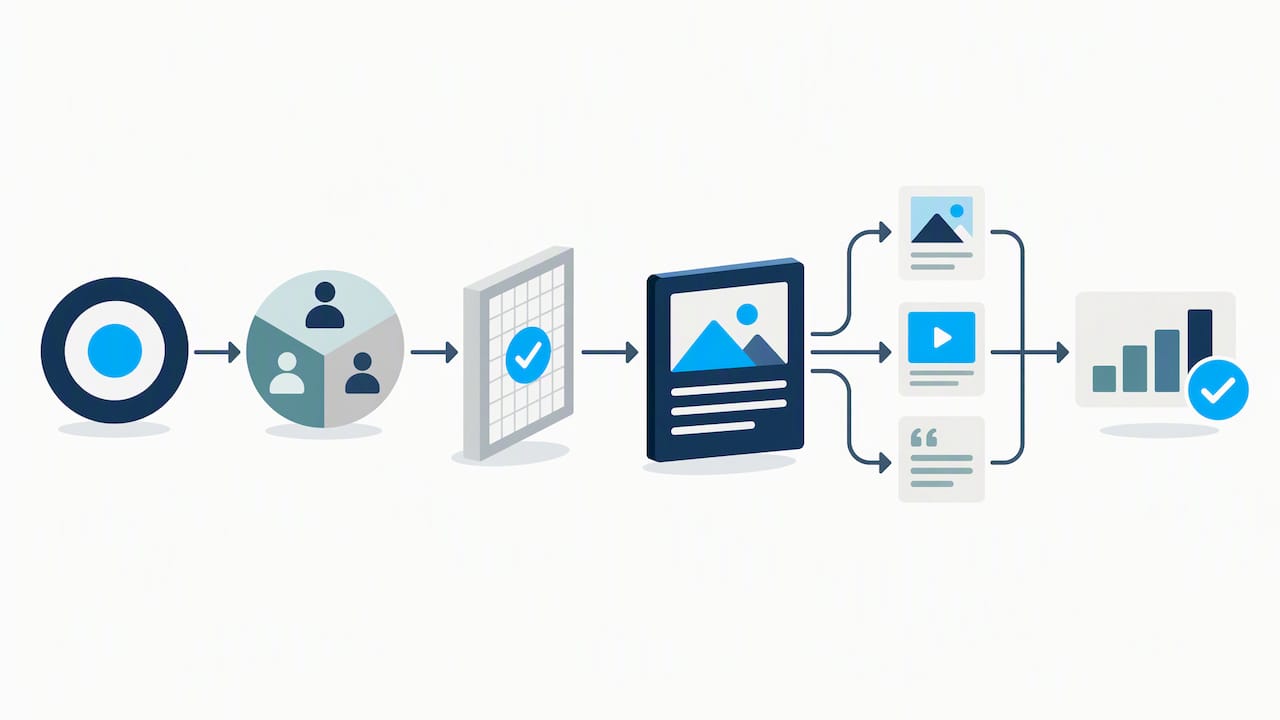
- Matching Content Formats to Funnel Stage
- Where to Publish: Distribution and Amplification That Compounds
- How to Measure Whether Content Is Working
- Running Content Like an Operation: Story Budget, Roles, and Cadence
- Budgeting and Resourcing on a Startup Runway
- Common Mistakes and How to Fix Them Fast
- How We Apply This Playbook in Practice
- A Founder’s 12-Month Timetable
- Let Us Build and Run This Playbook With You
- FAQ
- Sources
What Content Marketing Means for a Startup
Content marketing for startups is the practice of building durable, owned assets (guides, tools, videos, data reports) that answer real buyer questions, rather than running one-off campaigns that disappear once the budget runs out. A campaign ends. A well-built asset keeps attracting readers, ranking in search, and feeding sales conversations months after publication.
The distinction matters because startups have limited runway and cannot afford to rebuild their content machine every quarter. CMI’s 2026 guidance frames this directly: the biggest mistake founders make is treating content as a campaign instead of a durable business operation, and leadership now expects measurement tied to revenue impact, not just clicks.
Content does three jobs for an early-stage company:
- It builds awareness among people who have never heard of you.
- It establishes credibility with buyers who are comparing you against incumbents.
- It produces deal-stage signals, like a prospect reading a pricing guide right before a sales call, that tell your team who is ready to talk.
Two examples show how this plays out. A seed-stage SaaS tool publishes a benchmark report that ranks for a buyer-intent keyword; six months later, that report is the top source of demo requests. A two-person DTC brand builds a single detailed buying guide; a year later it still drives a third of organic traffic because it never stopped being useful.
Why Startups Should Invest: The Business Case for Leadership
Founders who pitch content marketing as “more blog posts” lose the budget fight. Founders who pitch it as a media operation, a durable capability that produces measurable buyer signals, win it. The reframe matters because leadership does not fund activity; leadership funds outcomes.
When you bring this to a leadership team or investor, talk about what they actually track:
- Content-influenced pipeline: deals where a prospect engaged with an asset before converting.
- AI visibility: whether your brand shows up when people ask ChatGPT or Perplexity about your category.
- Operational efficiency: how much value you extract from each asset through reuse.
CMI’s research on content ROI recommends shifting the entire internal conversation from activity metrics to business impact, and pitching content as an operational capability rather than a campaign line item. That shift changes how budget conversations go: instead of asking for money to “do more content,” you ask for resources to build a system that compounds.
Pro Tip: When you pitch budget, open with the pipeline number you plan to influence, not the number of posts you plan to publish.
The Prioritized Playbook: Your Startup Content Checklist
This is the sequence. Work through it in order. Each step builds on the one before it, and skipping ahead (especially straight to “publish more”) is the single most common reason startup content efforts stall.
-
Set an outcome-based goal. Pick one business result: content-influenced pipeline, demo requests, or qualified signups. Tie it to a number and a timeframe, like “20 content-influenced demo requests by the end of Q2.” Vague goals like “build brand awareness” cannot be measured, so they cannot be defended in a budget review.
-
Define your audience and map their questions. Write down the three to five questions your buyer asks at each stage: before they know you exist, while they are comparing options, and right before they sign. These questions become your coverage pillars, the topics you commit to owning regardless of what competitors publish. CMI’s story budget framework recommends treating this coverage map as a living budget rather than a one-time brainstorm: every pitch has to earn a slot by answering one of these mapped questions.
-
Apply the tension test before you commit resources. Not every idea deserves a slot. CMI’s three-part test asks whether an idea has heat (does it matter right now), standing (do you have the right to speak on it), and edge (does it say something competitors are not saying). An idea that fails all three is calendar filler, not strategy.
-
Pick one primary channel and one flagship format. Startups that spread thin across five channels in month one usually produce five mediocre things instead of one excellent thing. Choose the channel where your audience already spends time (often organic search or LinkedIn for B2B, short-form video for consumer brands) and build your first flagship asset there: a research report, a definitive guide, or a founder-led video series.
-
Build repurposing rules before you publish. Decide in advance how one flagship asset becomes five to ten smaller pieces: a report becomes a LinkedIn carousel, three blog posts, a newsletter section, and a short video script. HubSpot’s research on marketing leadership found that the startups balancing AI-assisted repurposing with human-authored authenticity, keeping a founder’s voice or a named expert attached to the content, outperform teams that either skip repurposing or automate it into generic output.
-
Set up your editorial backbone. This is the lightweight system that turns scattered ideas into a functioning operation: an intake process for pitches, a weekly or biweekly review to approve or kill ideas, and a single owner accountable for the calendar. Without this, content work reverts to whoever has time that week, and quality becomes inconsistent.
-
Establish a publishing cadence you can sustain for a year. One excellent long-form asset per month, backed by three to five repurposed pieces, beats four rushed posts per week. Startups that overcommit early usually go dark by month three, which damages SEO momentum and reader trust more than publishing less, consistently.
-
Build your distribution checklist. For every asset, confirm you have covered owned channels (email list, website, app), earned channels (outreach to relevant communities, partner newsletters, journalist pitches), and, once you have proof the content converts, paid amplification to extend reach on your best-performing pieces.
-
Wire up measurement before the first asset goes live. Tag content-influenced deals in your CRM, set up UTM tracking for every distribution channel, and decide now which KPIs you will report in 90 days. Retrofitting measurement after six months of publishing means losing that data permanently.
-
Run a quarterly review and iterate. Every quarter, look at which assets influenced pipeline, which channels produced the best cost per qualified lead, and which coverage pillars are working. Kill what is not working. Double down on what is.
Pro Tip: Build your editorial backbone and your measurement wiring in the same week you publish your first flagship asset, not after. Retrofitting tracking later means losing your baseline data.
The sequence matters because each step reduces risk for the next one. Goals without an audience map produce content that nobody searches for. An audience map without a tension test produces safe, forgettable content. A flagship asset without repurposing rules gets used once and buried. And any of this without measurement wiring means you will be unable to prove it worked when the next budget conversation comes around.
Matching Content Formats to Funnel Stage
Startups with limited production capacity cannot build every format at once. The fix is matching format to funnel stage so every piece of content does a specific job.
At the top of the funnel, where buyers do not yet know your name, prioritize short-form video, SEO-driven blog pillars that target high-volume search questions, and research-led reports that earn backlinks and social shares. HubSpot’s 2025 State of Marketing data names short-form video as one of the highest-performing formats marketers report, and repurposing as a major driver of expanded reach without added production cost.
In the middle of the funnel, where buyers are actively comparing options, invest in webinars, long-form guides that go deeper than a blog post, case studies with specific results, and product comparison pages that address the exact objections a prospect raises before a sales call.
At the bottom of the funnel, product demos, one-page spec sheets, and sales enablement content (battle cards, objection-handling scripts, ROI calculators) remove the final friction between a qualified lead and a signed contract.
Repurposing is what makes this affordable for a small team:
- Turn one research report into a webinar deck, three blog posts, and a LinkedIn carousel.
- Turn a single customer interview into a case study, a testimonial clip, and a sales one-pager.
- Turn a long-form guide into a short video series and an email nurture sequence.
A practical guide to startup content strategy can help you map which formats fit your specific buyer journey before you commit production time to any one of them.
Where to Publish: Distribution and Amplification That Compounds
Publishing without a distribution plan is the fastest way to waste a good asset. Prioritize channels based on your stated goal: if you are optimizing for long-term compounding traffic, invest first in owned SEO content and an email newsletter. If you need faster signal, earned channels (community posts, partner newsletters, relevant subreddits or Slack groups) produce quicker feedback at near-zero cost.
A practical priority order for most early-stage startups:
- Owned first: your website, blog, and email list, because you control the asset and the data forever.
- Earned second: founder-led outreach to communities, podcasts, and partner audiences where your buyer already spends time.
- Paid last, and only on proof: once an asset shows it converts organically, paid amplification extends its reach efficiently instead of masking a weak asset.
For organic search specifically, a startup-focused SEO playbook lays out how to sequence keyword targeting before and after product-market fit, which matters because pre-PMF startups often chase the wrong search intent entirely.
AI tools can stretch a small team’s output considerably, but the evidence points to a balance rather than full automation. HubSpot’s marketing executive research found that successful teams use AI to scale repurposing and personalization while keeping founder voice or named experts attached to the final output, because that human signal is what builds credibility with a skeptical buyer. Pure AI-generated content with no human point of view tends to blend into the noise.
How to Measure Whether Content Is Working
Vanity metrics (page views, social likes) feel good and prove nothing to a finance team. The measurement plan below ties content directly to the numbers leadership already tracks.
Start with three primary KPIs:
- Content-influenced pipeline: the dollar value of deals where a prospect engaged with content before converting.
- Content-assisted win rate: whether deals touched by content close at a higher rate than deals that were not.
- Cost per qualified lead: total content spend divided by leads that meet your sales-qualified bar, not just form fills.
Alongside those, track AI and search visibility signals: whether your brand gets cited when someone asks an AI assistant a category question, whether you appear for branded and unbranded prompts, and your share of voice against competitors on the topics you have chosen to own.
37% of venture-backed startup professionals report that AI lowered their customer acquisition cost, and HubSpot’s startup GTM research found that 72% say AI improved their ability to upsell and cross-sell when applied strategically to go-to-market work, including content operations. That makes AI-assisted measurement and repurposing a meaningful lever for a resource-constrained team, not just a production shortcut.
Finally, track operational KPIs that tell you whether your content system itself is healthy: reuse rate (how many channels each flagship asset feeds), time-to-publish (how long an idea takes to go live), and support deflection (whether content is reducing repetitive customer questions). Review all of this with sales and finance monthly, not just marketing, because content-influenced pipeline is only credible when sales agrees on the definition of “influenced.”
Running Content Like an Operation: Story Budget, Roles, and Cadence
A content calendar built by guessing what sounds good this month is not a strategy. CMI’s guidance on story budgets is explicit on this: do not treat a calendar as strategy, use a pre-publication story budget process instead.
A story budget works like a newsroom pitch meeting. Every idea gets a one-line slug, a stated narrative angle, and a list of sources or assets needed to execute it. Ideas that cannot pass the three-part tension test (heat, standing, edge) get cut before they consume production time.
Roles do not need to be elaborate for a small team:
- One person owns intake, collecting and triaging pitches from the team.
- One person (often the founder early on) owns editorial review and final approval.
- The whole go-to-market team joins a quarterly business review where content performance is assessed alongside sales and product updates, not in isolation.
CMI’s reporting on budget approval describes this editorial business review as a replacement for campaign-style status decks: instead of reporting activity, the review checks asset health against the pipeline and visibility goals set earlier.
Pro Tip: Keep your first story budget in a shared spreadsheet with four columns: slug, angle, sources needed, and tension-test score. Add tooling only once the volume of pitches outgrows it.
Budgeting and Resourcing on a Startup Runway
There is no universal percentage that tells you how much to spend on content. HubSpot’s budgeting guidance recommends a calculation-based framework instead: set spend based on your specific goals, your current content performance, and the outcome you are targeting, then adjust each quarter as data comes in.
A workable starting split for most early-stage teams:
- Production (50-60%): writing, design, video, and any paid tools that directly create the asset.
- Distribution (20-25%): newsletter tools, community outreach time, and paid amplification once an asset proves it converts.
- Measurement (10%): analytics setup, CRM tagging, and reporting time.
- Contingency (10%): reserved for the flagship asset that needs more polish than planned, or an unplanned distribution opportunity.
On staffing: hire in-house once you have proven which content format and channel work and need someone dedicated to sustaining cadence. Use an agency or contractors earlier, while you are still testing formats and need strategic and creative range without a full-time salary commitment. Many startups run a hybrid: a founder or in-house marketer owns strategy and story budget, while an agency handles production and design at a quality bar the startup could not staff for alone.
Common Mistakes and How to Fix Them Fast
Most startup content failures trace back to a handful of repeatable errors.
- Calendar-first strategy: teams fill a calendar before defining an outcome. Fix: run the story budget process before scheduling anything.
- Unfocused audience: content tries to speak to everyone and resonates with no one. Fix: write down the three specific questions your actual buyer asks, and reject ideas that do not answer one of them.
- Vanity metrics: teams report page views to leadership and lose the budget fight anyway. Fix: report content-influenced pipeline and cost per qualified lead instead.
- Underutilized assets: a strong flagship piece gets published once and forgotten. Fix: build repurposing rules before publishing, not after.
A quarterly editorial business review, the same one described in the governance section above, catches most of these before they become a pattern rather than a one-time mistake.
How We Apply This Playbook in Practice
The sequence above mirrors how we run content and brand strategy work for founders: a discovery-led process that starts with the business outcome, not the content format. Every engagement starts with a discovery meeting where buyer questions and funnel stages are mapped before any asset gets produced, which is the same audience-mapping step the playbook calls for.
From there, we build an editorial backbone tailored to team size: a lightweight intake and review process for a two-person startup, a more structured cadence for a growth-stage company adding headcount. Every plan includes a measurement framework tied to the outcome set in discovery, whether that is content-influenced pipeline, qualified leads, or organic visibility.
Our process in practice:
- A discovery meeting to define the business outcome and audience before any content gets written.
- A story-budget-style asset plan mapped to buyer questions and funnel stage.
- Ongoing support after launch.
A Founder’s 12-Month Timetable
If I had to compress a year of startup content work into a timetable, it would look like this. Month one is about ruthless focus: one outcome, one audience segment, one channel, one flagship asset published before the month ends. Resist the urge to launch on five channels at once.
Months two and three are about extending that first asset: repurpose it into smaller pieces, get your measurement wiring live in the CRM, and start outreach to the communities and partners where your buyer already spends time.
Months four through twelve are where the compounding happens, if you let it. Scale production only as fast as your editorial backbone can absorb it without breaking cadence. Run a quarterly business review every three months, look honestly at what influenced pipeline and what did not, and kill the formats that are not earning their slot. The founders who win this year are not the ones who publish the most. They are the ones who published consistently enough, and measured honestly enough, to know what to do more of.
— Alex
Let Us Build and Run This Playbook With You
Running this playbook well takes a strategist, a designer, and a writer working from the same outcome, which is exactly the gap we fill for founders who need senior creative and strategic range without the overhead of a full in-house team. Where a startup is still testing formats and channels, partnering with an experienced team gets you to a working content system faster than hiring and training from scratch.

Our content marketing strategy work starts the same way the playbook above does: a discovery meeting to pin down your outcome and audience before anything gets produced. From there, we help build the flagship asset, the repurposing plan, and the measurement setup that ties it back to pipeline.
- Need your website itself to function as a flagship asset? Our website content strategy work aligns site content with the buyer questions your sales team hears most.
- Building the brand voice behind your content? Our brand strategy and identity work gives your content a consistent point of view before a single post goes live.
- Need production range, from written content to video? Teams like Glenwood Media handle video production and event coverage, and we often coordinate with specialists like this when a flagship asset calls for it.
Ready to put a discovery-led content plan in place? Start with our services overview and tell us the outcome you are chasing this quarter.
FAQ
What are the 5 P’s of content marketing?
Definitions vary across sources, and no single authoritative version applies universally. A commonly cited framework covers purpose, people, planning, production, and performance, which lines up with the outcome-first, audience-mapped approach described throughout this playbook.
What are the 3 C’s of content marketing?
As with the 5 P’s, the 3 C’s are not a fixed industry standard and different sources define them differently. A frequently used version refers to content, context, and channel, reflecting the idea that the right asset matters only when matched to the right audience context and the right distribution channel.
What is starting content marketing?
Starting content marketing for a startup means picking one business outcome, one audience segment, and one channel, then publishing a flagship asset built around a real buyer question rather than a generic topic. From there, you build repurposing rules and measurement before scaling to more formats or channels.
How much do startups pay for marketing?
There is no fixed percentage that applies to every startup, since spend depends on your specific goals, current performance, and target outcomes rather than a flat rule. A practical approach is to set content budget using a calculation-based framework tied to the pipeline or visibility outcome you are chasing, then adjust the split each quarter as results come in.
Sources
- The New Rules of Measuring and Proving Content ROI
- The Marketing Executive’s Playbook: How Marketers Can Work & Level-Up Like 700+ Leaders in 2025