

Online reputation management (ORM) is the ongoing work of monitoring, shaping and protecting what people see and believe about your business online: search results, reviews, social media and press. You do it by watching your name, earning and answering reviews, publishing content you control, and fixing problems at the source. This guide covers each step, the rules that keep you out of trouble, and what it costs.
TL;DR
- ORM is a routine, not a rescue job: search your name monthly, check reviews weekly, and answer every review promptly and politely.
- Reviews carry real weight. In one 2024 US survey, 54% of consumers trusted online reviews first, ahead of friends and family.
- Never buy, fake or selectively suppress reviews. The FTC says you can be held responsible for what a vendor does on your behalf.
- To repair damage, audit your search results, request fixes from site owners, flag policy-violating reviews and publish stronger content of your own.
- Small-business ORM services are commonly quoted at roughly $500 to $2,500 per month, depending on scope.
Table of Contents
- What online reputation management covers
- Why it matters to revenue
- How to monitor your brand reputation
- How to manage business reviews
- How to repair your online reputation
- Building a brand reputation strategy
- What online reputation management costs
- Our perspective
- Get the foundation right with All City Graphix
- FAQ
- Sources
What online reputation management covers
ORM focuses on a business’s online presence, including reviews, social media, search results and press coverage. The aim is to shape what customers see and how they perceive you, which builds credibility and trust. Another way to put it: it is the process of monitoring, maintaining and positively influencing how your business is perceived across the internet.
In practice, that breaks into four jobs:
- Listening: knowing what is said about you and where.
- Responding: answering reviews and comments in public, fast and with care.
- Building: creating accurate, positive content and a steady flow of honest reviews.
- Repairing: correcting or outranking what is false, outdated or harmful.
The first page of Google when someone searches your name is your real storefront window. Your website, your Google Business Profile, your social profiles and a handful of review sites usually fill it. If you don’t shape those results, someone else’s content will.
Why it matters to revenue
The numbers point the same way across several studies.
- A peer-reviewed study in the Journal of Small Business Strategy, based on 251 small business owners, found that ORM had a significant positive effect on small business performance and explained 35% of the variance in performance.
- In a July 2026 survey of 1,068 US adults, 88% had decided against a business after reading negative reviews, and 67% check reviews before buying either often or every time.
- PwC’s 2025 survey, as cited by Shopify, found that 52% of consumers stopped buying from a brand after a bad experience.
- Per Semrush, almost 60% of US consumers would avoid buying from a brand that seems untrustworthy.
Reputation is not only a marketing concern. It is the sum of what your customers experience, so the best ORM starts with the service itself and uses online tools to make that visible.
How to monitor your brand reputation
Monitoring does not need an enterprise platform. A small business can run a reliable routine with three habits, recommended by Xero’s US guide:
- Set up Google Alerts for your business name, your owners’ names and your product names.
- Check review sites weekly: Google, Yelp, Facebook and any industry-specific directory.
- Search your business name monthly in a private window and look at the first page of results.
Add two more checks that pay off. First, note which results are yours and which belong to others: if a third-party directory outranks your own site, your listings need work. Second, scan comments and tags on social media, where complaints often surface before they reach a review site.
Social speed matters too. Semrush notes that customers whose social media complaints were handled in under five minutes tended to spend more later. You don’t need to be on call all day, but a daily check of notifications is reasonable.
A simple monitoring calendar
| Frequency | Task | What you are looking for |
|---|---|---|
| Daily | Review notifications and social mentions | New complaints, questions, tags |
| Weekly | Read new reviews on every platform | Patterns, replies owed, policy-violating content |
| Monthly | Search your name and top services | Rankings of your own pages, new negative results |
| Quarterly | Audit listings and profiles | Wrong hours, phone numbers, outdated photos |
If you keep seeing the same complaint, treat it as a signal. Semrush points out that repeated complaints usually mean an underlying issue to fix. That fix is the cheapest reputation repair there is.
How to manage business reviews
Reviews are the biggest lever you control. Two things matter: getting more honest ones, and answering all of them well.
Ask for reviews the right way
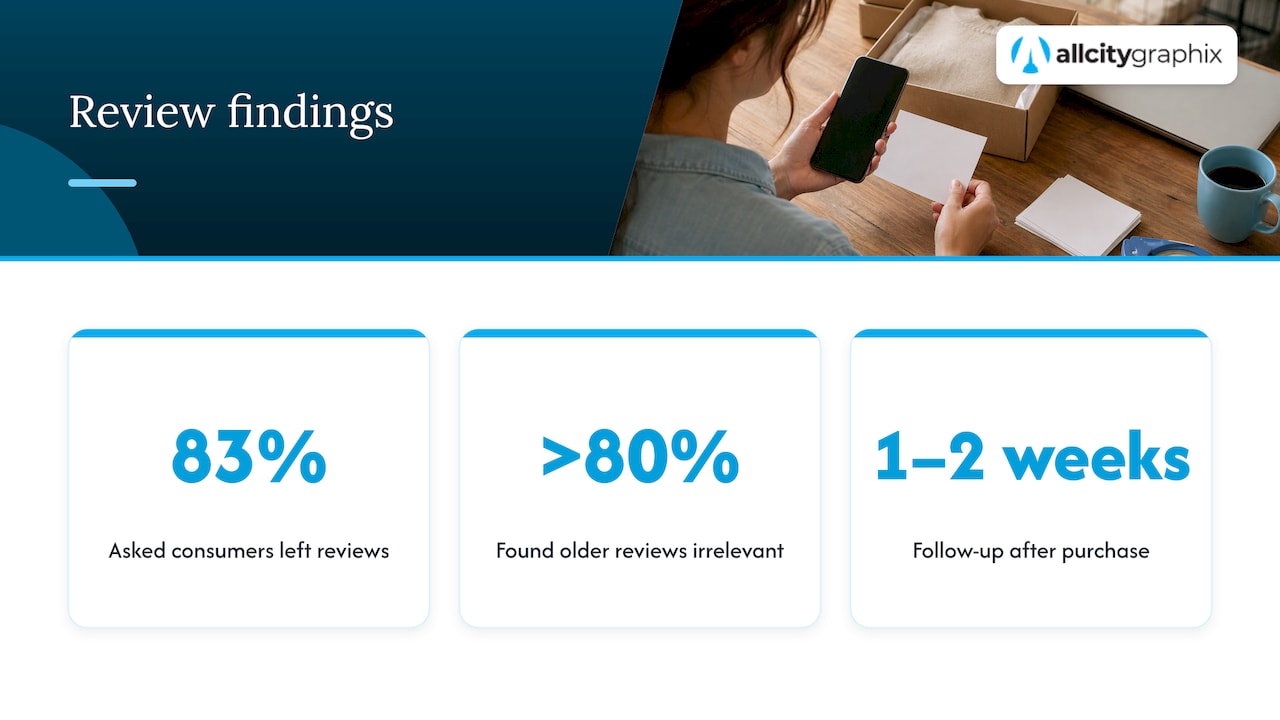
Asking works. BrightLocal data cited by the BBB shows that 83% of consumers who were asked to leave a review went on to do so. The BBB recommends following up a week or two after a purchase to check the product or service is meeting expectations, then asking for an honest review.
Freshness counts as well. According to the BBB, citing BrightLocal, more than 80% of people thought reviews older than three months were irrelevant. Build asking into your normal process so reviews arrive steadily rather than in bursts.
The FTC’s guide sets clear limits. You should not ask for reviews from people who haven’t used your product or service, should not have staff write reviews without disclosure, and should not condition any incentive on the review being positive. The FTC’s updated Endorsement Guides also warn against suppressing, boosting or editing consumer reviews in a way that distorts them. Ask everyone, not just happy customers, and let the results stand.
How to respond to negative reviews
A negative review is a public conversation, and the audience is every future customer. In one survey, 85% of consumers said reading responses to negative reviews factors into their decision. The same survey found that businesses responding within 24 hours saw a 33% increase in the likelihood of consumers upgrading their ratings. And 89% of consumers expect owners to respond, per BrightLocal data cited by the BBB.
The BBB’s advice for responding to negative reviews is to respond promptly, stay respectful, acknowledge the concern, apologize for mistakes and offer a resolution or a way to address the issue. Here is a structure that follows it:
- Thank the reviewer by name, without sarcasm or defensiveness.
- Acknowledge the specific issue so it is clear you read it.
- Apologize where you were wrong. Don’t apologize for things that didn’t happen.
- Offer a next step: a direct phone line or email, not a long public debate.
- Keep it short. Two to four sentences is plenty.
An example for a restaurant: “Thank you for telling us, Maria. A 45-minute wait for your entrée is not the experience we want for anyone, and we’re sorry. Our manager, Dan, would like to make this right. Please email him at the address on our site.”
What if the review is not legitimate? You can report it. Google says only reviews that violate its policies are eligible for removal, and that you shouldn’t flag a review just because you disagree with it. The BBB notes that businesses can remove or prohibit reviews that are abusive, vulgar or threatening, while the Consumer Review Fairness Act protects a customer’s right to leave honest reviews. A harsh but truthful review stays; your reply is your response.
For a deeper look at the profile where most of your reviews live, see our Google Business Profile checklist.
How to repair your online reputation
When damage is already visible, work through it in order. Search Engine Land’s repair process is to audit your Google results for negative, inaccurate or erroneous content, contact site administrators about unwanted articles, flag reviews that violate platform guidelines, and create positive content that ranks above whatever remains.
- Audit. Search your business name, owner names and top services. List every result on the first two pages and mark each as yours, neutral, positive or harmful.
- Sort by cause. Is it a real service failure, a false claim, an outdated article or a policy-violating review? Each has a different fix.
- Fix the root cause. If the complaint is true, correct the process and say so publicly.
- Request corrections. Write to the site owner with the specific inaccuracy and evidence. Flag reviews that break platform rules through the platform’s own tool.
- Build what you control. Strengthen your website, About page, case studies, Google Business Profile and social profiles so they hold the top spots. Fresh, useful content gives search engines better results to show.
- Keep monitoring until the picture is stable.
Be realistic about pace. Pushing a result down means building better pages that earn their place, which takes weeks or months of consistent work.
Beware vendors who promise shortcuts
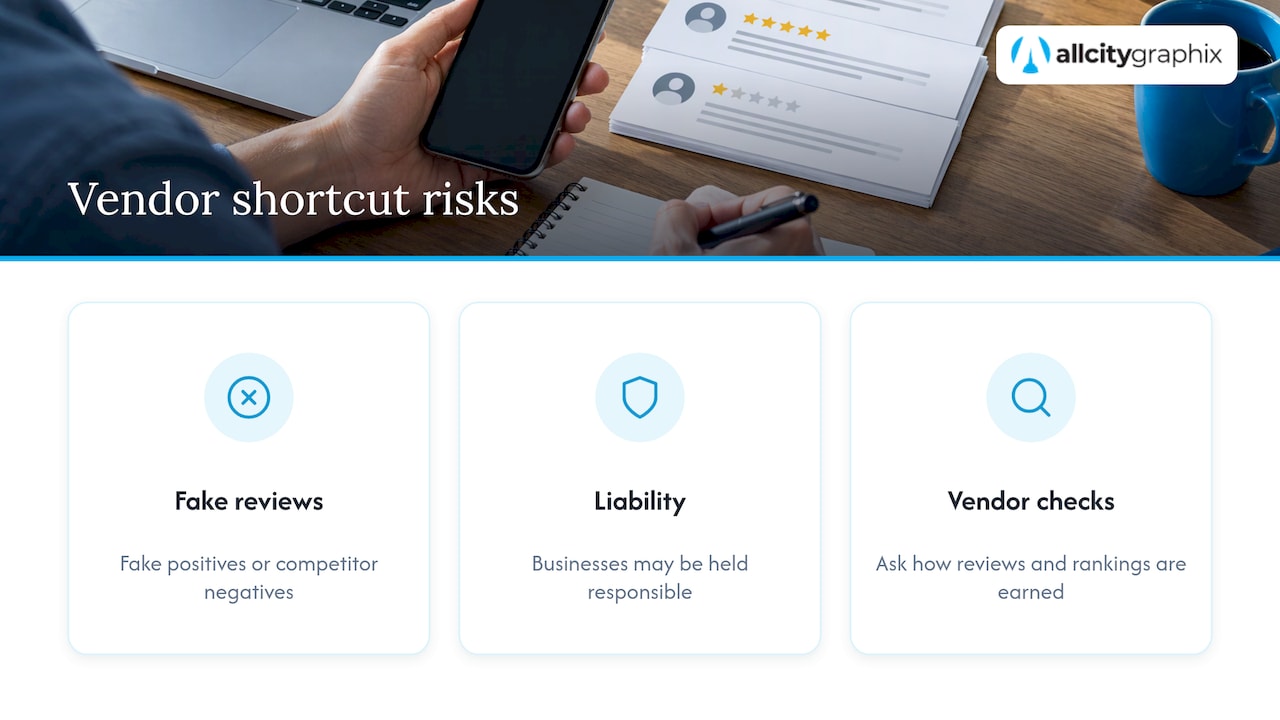
The FTC warns that some SEO and reputation management companies may get results by writing fake positive reviews of your business or fake negative reviews of competitors, and that you can be held responsible for what they do on your behalf. Before you hire anyone, ask how they earn reviews and rankings, and walk away from any answer involving purchased or fabricated reviews.
Building a brand reputation strategy
A strategy is what keeps your presence consistent when you aren’t in crisis. It has five parts:
- A clear promise. What you stand for and who you serve, stated the same way on your site, profiles and ads.
- A consistent identity. Logo, colors, voice and imagery that look and sound like one company everywhere. Inconsistency reads as carelessness.
- Accurate listings. Name, address, phone, hours and categories match across every directory. Our guide to fixing citations and local links walks through it.
- A content plan. Regular pages, posts and case studies that answer customer questions and give search engines strong material to rank.
- A response policy. Who replies, how fast, in what tone, and when a problem is escalated.
Shopify’s reporting, based on a 2025 survey, found that 43% of store owners cited brand reputation as a competitive advantage. Social channels are part of the same system, so a documented approach helps: see how to build a social media brand system in 30 days. For local businesses, local SEO keeps your own pages visible where neighbors search.
What online reputation management costs
Prices vary widely because scope varies. One 2026 industry pricing roundup puts small-business packages at about $500 to $2,500 per month, with a median around $830, covering monitoring and response management. Mid-sized businesses and serious repair projects cost more.
What moves the price:
- Severity. Maintenance is far cheaper than repairing a page of damaging results.
- Number of locations and platforms. Each location multiplies profiles and reviews to watch. See our guide to multi-location SEO.
- Content volume. Rebuilding the first page needs new articles, pages and profiles.
- Response coverage. Same-day replies cost more than weekly batches.
- Software versus people. Tools monitor; people write good responses and fix the cause.
A small business with a healthy reputation can often handle monitoring in-house with free alerts and an hour a week, and bring in help for strategy, content and website work.
Our perspective
We see the same pattern with small businesses: reputation problems are rarely only reputation problems. A scattered logo, an outdated website, an unclaimed profile or a thin About page all tell a customer something before a single review does.
That is why we treat reputation as part of brand and web work, not a separate emergency service. A discovery-led process shows what you want to be known for. Strategy and creative execution then make that visible and consistent across your site, profiles, ads and printed materials.
Launch is not the finish line. Ongoing support, with someone senior who knows your business, is what keeps your presence accurate, current and ready when a review or a rumor appears. Done honestly, with real customers and real fixes, it compounds.
Alex
Get the foundation right with All City Graphix
If your search results, profiles or website don’t reflect the business you run, we can help. All City Graphix is a New York City creative agency with over 15 years of experience in branding, web design and digital marketing, including brand strategy, SEO, content and social media management.

We start with a discovery meeting, build a custom plan and stay with you after launch. If you want your brand to look consistent, rank for the right things and earn trust, start with our services page or learn more about our brand development work.
FAQ
What is an online reputation management strategy?
It is a documented plan for how you monitor, build and protect your reputation online. It covers your brand promise, listings, content, review requests and response policy. It also assigns who does each task and how often.
How can I manage my online reputation myself?
Set up Google Alerts for your business name, check review sites weekly and search your name monthly. Reply to every review politely, ask satisfied customers for honest reviews and keep your listings accurate. These habits take an hour or two a week for most small businesses.
Can I get a bad review removed?
Only if it violates the platform’s policies, such as abusive, fake or off-topic content. You can report it through the platform’s tool, but Google advises against flagging reviews simply because you disagree. If the review is honest, respond professionally and let your answer speak for you.
How much does online reputation management cost?
One 2026 pricing roundup puts small-business services at roughly $500 to $2,500 per month, with larger needs costing more. Your cost depends on the severity of the problem, the number of locations and how much content is required.
Sources
- Online Reputation Management: The Ultimate Guide (Forbes Advisor)
- Online Reputation Management: A Beginner’s Guide (Ahrefs)
- From Reviews to Revenue (Journal of Small Business Strategy)
- LocalImpact Report: 88% of Consumers Have Avoided a Business
- Online Reputation Management: A Business Guide (Shopify)
- A Beginner’s Guide to Online Reputation Management (Semrush)
- Online reputation management guide for small businesses (Xero US)
- Better Business Briefing: The power of customer reviews (BBB)
- BBB Business Tip: How to handle negative reviews
- Soliciting and Paying for Online Reviews: A Guide for Marketers (FTC)
- FTC Updates to Endorsement Guides (National Law Review)
- New Survey Reveals the Strong Influence of Online Reviews
- Report inappropriate reviews on your Business Profile (Google)
- How to repair your Google search results (Search Engine Land)
- Online Reputation Cost Breakdown (SurveySparrow)